
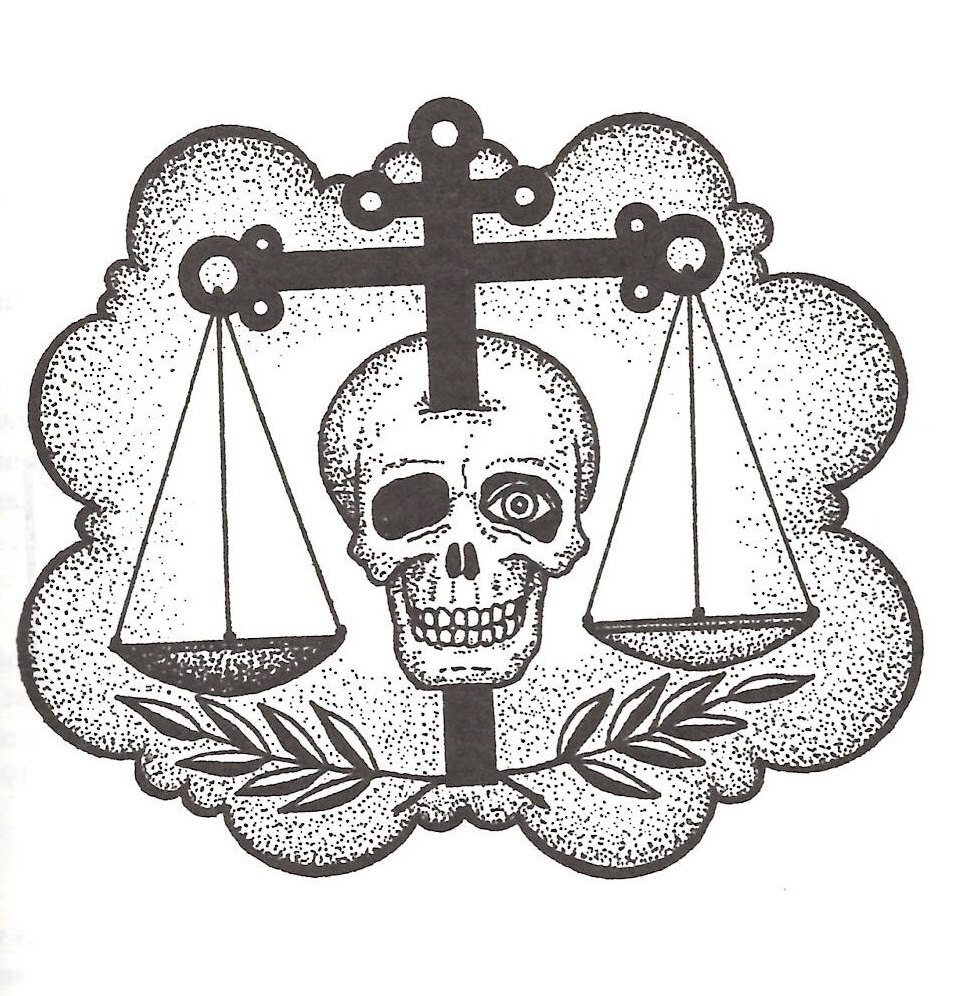

In the absence of the divine, can an image symbolise a higher reality? The visual language of Soviet prison tattoos and its use of religious symbols affords an interesting opportunity to answer this question. Indeed, what is absent from a secularised religious image may be theologically insightful. To examine this question, we will first briefly describe Russian prison tattooing and its function codifying a criminal ethic.1 We will then outline two historic Orthodox interpretations of an image and apply these characteristics to the system of Russian prison tattooing in order to highlight the loss of theological grace and grace’s replacement with systematic violence.
Russian Criminal Tattooing and Religious Icons
The world of Soviet prison tattoos was a curious inversion of an ethical system whose manifestation was the visual language of those tattoos. Prison tattoos in Soviet gulags were not adornments reflecting one’s taste or personality; instead, tattoos reflected their bearer’s criminal history and status within penal society. Lexicographer Alexei Plutso-Sarner writes that ‘the tattoo-covered body of a vor v zakone (legitimate thief), is primarily a linguistic object’.2 As a language, the lexicon of tattoos was communal: criminal tattoos had agreed-upon meanings, and tattoos were applied by criminal society collectively as awards and punishments alike. Honourable tattoos were earned by serving the bosses of one’s ‘zone’; humiliating tattoos satisfied unpaid debts; messages were tattooed on bodies, making people living letters to be sent to different zones of the penal system; tattoos found to be fraudulent would be brutally removed, or their bearers killed. Tattoos bore witness to and actualised the ‘thieves’ law’ of the criminal caste, and this law’s coherence required adherence by all to ensure its function as a universal and reliable means of discerning any prisoner’s status within the vast Russian penitential system. This adherence was ensured through the widespread use of force, both in the forceful application of tattoos and in the retribution against those who transgressed the system.
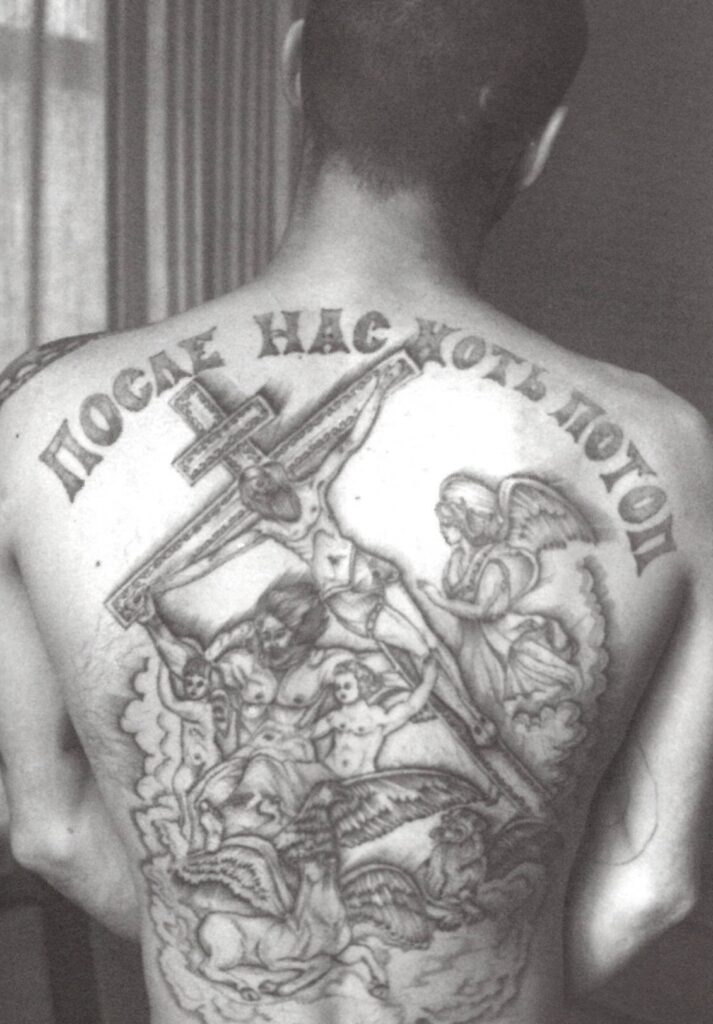
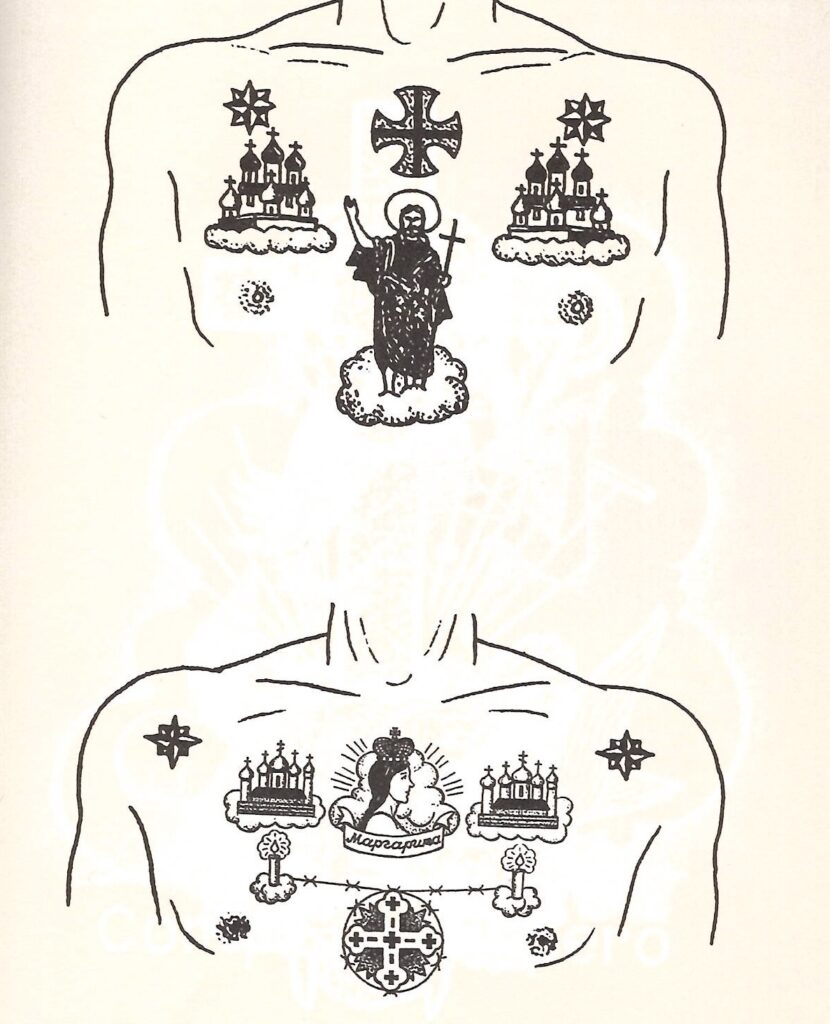
The system of tattooing employed a vast array of symbols, and religious symbols in particular represented key roles and values for the vor. Plutso-Sarner describes how ‘images of churches make up a distinctive category of [prison tattoos] … [and] the talisman tattoo of an authoritative thief is an image of Jesus Christ [or] the Virgin Mary, … or a cross’.3 Religious tattoos did not indicate their bearer’s spiritual beliefs, but were subtextual, and the commonality of these subtexts lay in their positive symbolisation of the criminal law itself.4 Here, it is worth pointing out three religious symbols in particular: the crucifix, the Virgin Mary, and the image of Orthodox church domes. The crucifix was ‘the general symbol of thieves’, representing fidelity to the thieves’ law and a clean conscience before it.5 The Virgin Mary represented the thief’s death to their old life and rebirth into the world of thieves.6 Finally, church domes signified the prison itself as the communal home of thieves.7 In these three cases, the tattoos carried an individual, historical meaning. Additionally, they all symbolised the communal legitimacy of the thieves’ law that bound criminals through their tattoos.
Dionysian Image Theologies
Given the semiotic nature of Russian prison tattoos and their Orthodox inflection, it is appropriate to employ two theologies of image indebted to Pseudo-Dionysius, the sixth century Neoplatonic writer whose theology greatly influenced the Christian East. In addition to being resonant with the iconographic style appropriated by the vor v zakone, the formal and hierarchical Dionysian image as understood by Orthodox theology roughly corresponds to the quasi-ethical system that tattoos actualise.8
The first image-theology we can draw upon is that of John of Damascus. Images for John are necessary to mediate our relationship to the divine for ‘since we are twofold, fashioned of a soul and body, and our soul is not naked but … covered by a mantle, it is impossible for us to reach what is intelligible apart from what is bodily’.9 For John, images are necessary to even think about God and the divine, as mental concepts are themselves types of images. Images of religious content–the icons John is defending–are manifestations of their divine formal causes, and the suffusion of grace present in them orients their viewer’s thought towards suprarational being. Christ is himself the living image of God and exemplifies why images are legitimate means by which we may understand God’s purpose (telos) for the human life. As John states, ‘Every image makes manifest and demonstrates something hidden … certainly for our profit and well-doing and salvation’.10 Images thus have didactic and ethical potency, and serve as a means of effecting change in human lives by reorienting Christians towards their Godly ideal.
The second thinker indebted to Dionysius’ conception of image is Maximus Confessor. In his Mystagogy, Maximus applies the concept of image to the structure of the Church, whereby ‘holy church bears the imprint and image of God since it has the same activity that he does by imitation and in figure’.11 For Maximus, the Church is the communal structure that acts out God’s unifying and idealising will. Maximus writes that God:
makes [all beings] converge in each other by the singular force of their relationship to him as origin … by transcending [individual relationships] and revealing them, as the whole reveals its parts … it is in this same way that the holy Church of God will be shown to be working for us the same effects as God, in the same way as the image reflects its archetype.12
The activity of the Church images God’s will, and Maximus further states that the Church ‘circumscribes [the principles of beings’] extension in a circle and brings back to himself the distinctive elements of beings which he himself brought into existence’.13 In other words, God uses the Church to realise individual sanctification that conforms the believer to their archetypal self through the ethical structures the Church images. Given this, for Maximus, the Church is the image that communally orients humanity toward its ideal form and assimilates them into their likeness to God.14 This likeness is ‘imaged’ by Christians acting according to the formal, ethical mandates of God’s will, as efficient causes effecting that will in the world.
The Image and the Imaged
As stated initially, our goal is to theologically appraise the semiotic system of Russian prison tattooing. To apply the above theological descriptions of a Dionysian image then, we must first define the tattoo in the Dionysian image’s terms. If we were to map the meanings of the three types of tattoos identified in the first section onto our Dionysian image-framework, we could translate them as follows:
- The crucifix, as an image of a ‘thief-in-law’, symbolises the ethical status of the criminal who bears this tattoo and their historic acceptance of and fidelity to the thieves’ law.
- The Virgin Mary, symbolising birth into the criminal system and the death of individual identity, images the causal power that the system bestows on the criminal to realise their ideal self.
- Church domes, symbolic of the prison system as the ‘home’ of thieves, posit the collective reality of the criminal law that tattoos uphold and the ethical structure of that reality.
In all three cases, these tattoos indicate a relation between the criminal and the criminal law that tattoos promulgate, and it is this relationship between the individual and collective that is especially elucidating.
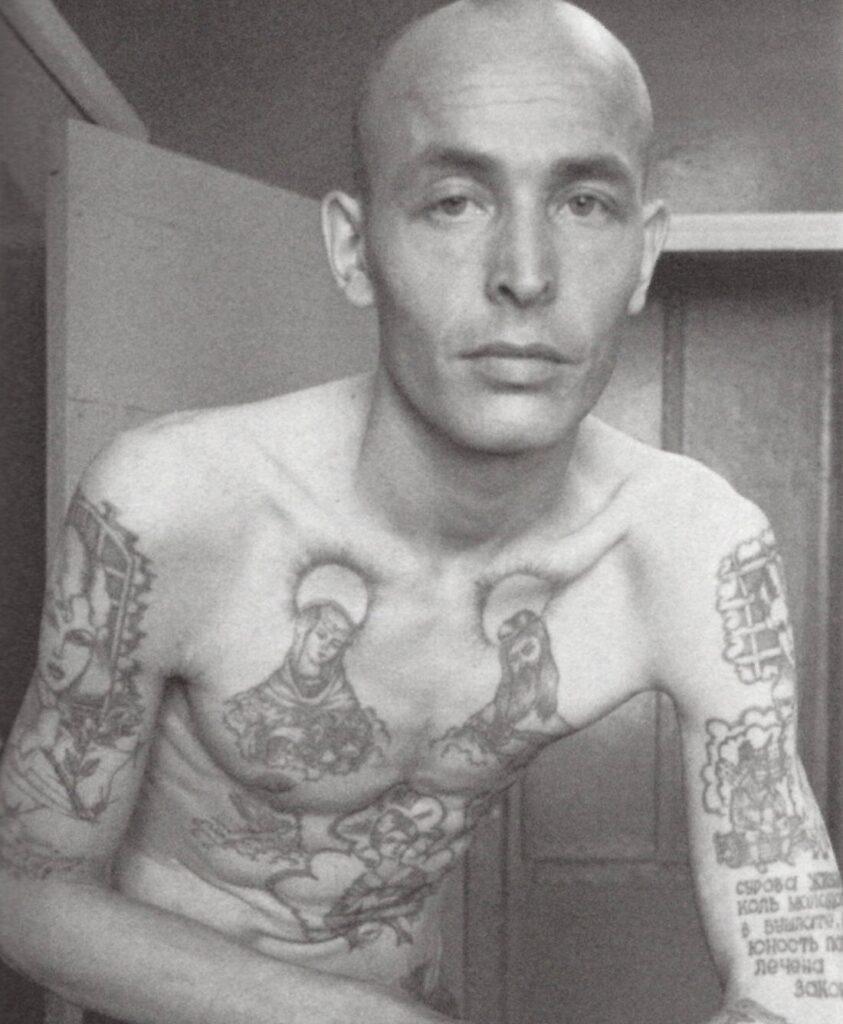
As tattoos relate to the individual bearing tattoos, they serve as a form of pseudo-permanency, imaging the past that determines their present self.15 Plutso-Sarner writes that the thief’s body:
is concealed within itself, closed, its essential nature is not displayed … [but upon receiving his first tattoo,] the thief emerges as it were from within onto the surface of the body, passing through his symbolic ‘death’ into the world of thieves.16
Tattoos realise the form of their bearer materially through the history their tattoos testify to, the form first granted to them by their birth into the world of thieves represented by the Madonna. Personal continuity has been displaced from the formal, theological continuity of the soul, to the visual imprinting of historic actions upon the bearer’s flesh. The tattoo-bearer is strictly related to the ethical system they inhabit through the finality of their actions. This is manifested in the permanency of their tattoos and vouchsafed by the crucifix tattoo’s meaning of fidelity to the thieves’ law. This permanency is necessary to uphold the system’s reliability, and so there can be no concept of past erasure within such a system without destruction of the system’s continuity. As Plutso-Sarner writes, ‘It is only the body the thief can trust, only the body that cannot lie’.17 Where trust is to be established across a collective, the body must tell the truth. This is why the body that does not bear tattoos had no protection under the thieves’ law in Soviet prisons.18 The un-tattooed were essentially stripped of humanity and treated as matter without form. In this we might hear a strange echo of John of Damascus’ argument for our rational reliance upon images, in the fact that the body whose form is not imaged by tattoos is excluded from moral consideration. To cohere within the ethical system of tattoos, Soviet prisoners had to image their status, the result of an accretion of their actions as judged by the ethic of the criminal law, in order to remain a coherent subject of that law. As that by which the individual was judged, tattoos functioned in the thieves’ law much like sin does in Christian theology. However, without a soul that can be redeemed by grace, sin is as permanent as the history of the tattoo’s bearer, and forgiveness is a structural impossibility.
Conversely, for the community witnessing tattoos, the tattoos actualise a material power with the illusion of formal reality. Recall Maximus’ vision of the Church as the place where man’s actions and will are drawn into causal alignment with God’s telos for him. If tattoos idealise their bearer, they also claim to be the source of this ideality, and dictate the possibilities of all formal being. In this way, the system of tattooing enervated all individual wills that it bestowed power upon. As criminals acted according to the thieves’ law that tattoos signified, the system’s power was manifested in the inevitable violence that was needed to uphold its brutal ethic. The more power the criminal law accrued, the more it could govern behaviour and interaction between all participants within the prison system,19 the prison ‘home’ where ideality is realised represented by the tattoo of Orthodox church domes. Consequently, when Maximus says that ‘absolutely no one at all is in himself separated from the community since everyone converges with all the rest and joins together with them’,20 we can see a twisted form of his words applicable to the system of Soviet prison tattooing. Where God is absent, the application of material force unified each participant through subjugation by violence, which created the illusion of a formal unitive ethical reality. This reality transcended the power of any individual as a collective law, and so its causal power could not be controlled. Instead, it acted like a blind and mindless god, bestowing its power on those who accept its subjugation.
Whether as pseudo-icons stamped on the flesh in place of a soul, or as a collective force which acted upon all whom it claimed formal power over, applying the Dionysian conception of image to Russian criminal tattooing exposes a key absence: that of God’s personal and creative grace. Instead, the system we have examined created a crude illusion of impersonal, mechanistic necessity. This illusion was manifested by the violence needed to uphold a system that had no formal universality or eternity. This extreme example radically draws out a conclusion that the Soviet prison tattooing system makes especially evident: what upholds an ethical system in the absence of God’s grace may be brute violence. Without the positive ideal of grace to reconcile and realise formal community, violence welded man together by negating him through fear and force in Soviet prisons. Violence perpetuated the semblance of an absolute within the thieves’ law that lacked any claim to a formal reality. Violence could not create real noumenal continuity, universal knowledge, or eternal permanency, but it could actualise its own twisted image of memory–the criminal tattoo–and force the tattoo’s bearer to speak according to the language it controlled and defined.
The Mystery of Grace
The application of image-theology to prison tattooing emphasises the functional importance of grace within Christian theology. It is personal and creative grace that stands opposite brute force as the means by which unity and sanctity are realised in Christian life. The system of criminal tattooing present in Soviet prisons shows us in the strongest terms that, where grace is absent, violence risks functionally replacing it. This violence was wrought to uphold the illusion of absolute ethical knowledge over others, so that all stood in judgment of one another according to the image their tattooed flesh bore. In contrast to this, grace exists as mystery. Where the system of tattooing enacted a hellish remembering, grace freely forgets. This forgetfulness is forgiveness, and this is the Church’s practical basis as an ethical community. Its absence, as we have seen, affirms this.
Citations
