

Musical loci of pilgrimage–such as Elvis Presley’s Graceland, the Beatles’ Abbey Road zebra crossing, or Jim Morrison’s grave at the Père Lachaise cemetery in Paris–constitute a well-known phenomenon, extensively documented by both music fans and journalists. Since the 1980s, they have also received proper scholarly attention from musicologists, sociologists, and scholars of religion.1 Unlike Santiago de Compostela or Mecca, these are secular places imbued with religious meaning by fans, who travel great distances and pay a significant amount of money for a chance to experience the aura of their favourite singer, band, or album cover. Because these trips are not explicitly religious, but rather stem from a deep appreciation for a select group of popular artists, musical pilgrimages are understood as an offshoot of musical tourism. Therefore, the term ‘pilgrimage’ should be seen as a metaphor, one whose appeal to the sacred conceals its connection to a lucrative industry powered by nostalgia.
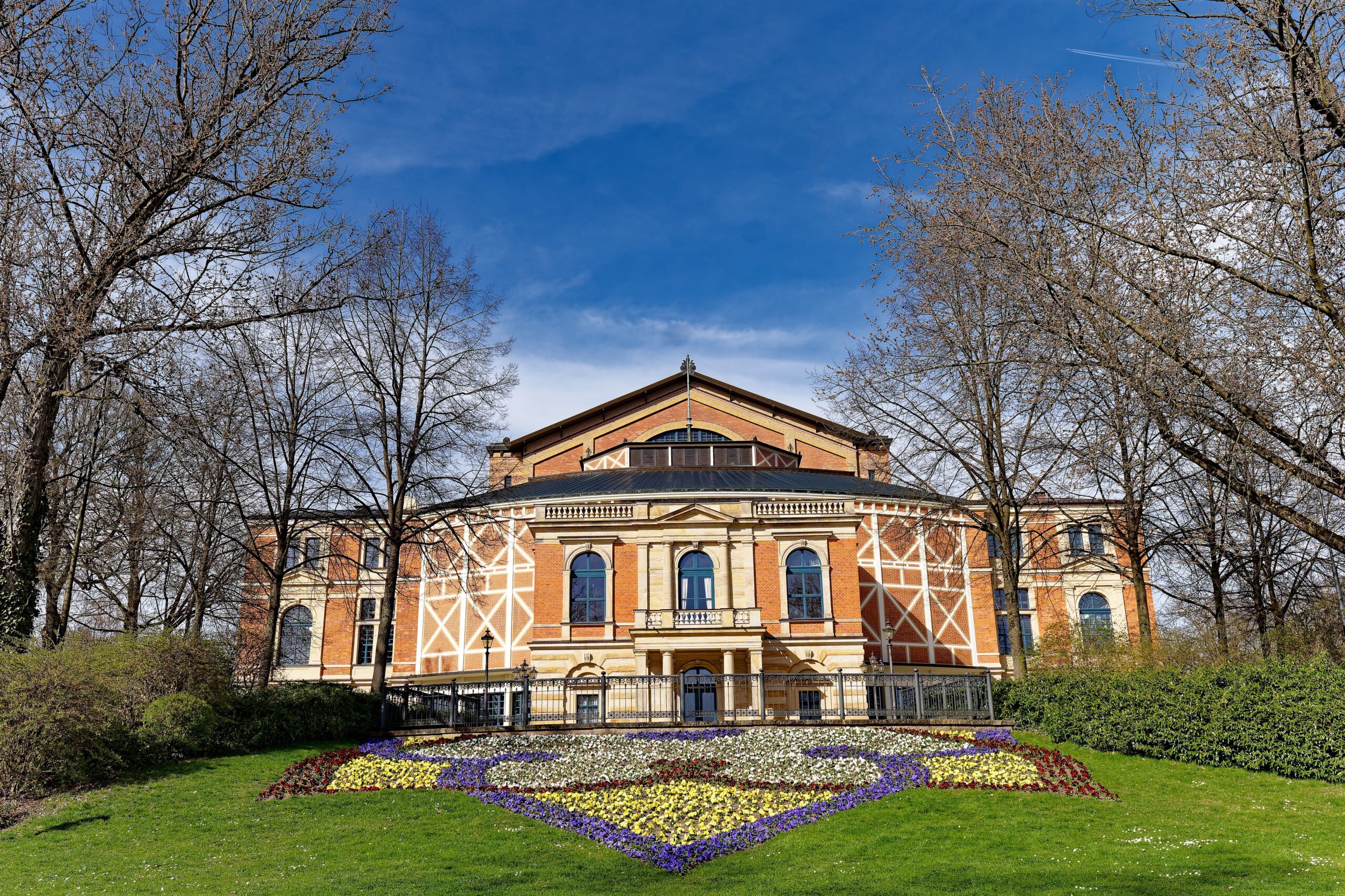
While the phenomenon has been given proper coverage in popular music studies, it remains relatively underrecognized in the classical music world, which is likewise replete with its own sacred places–from Beethoven’s birth house in Bonn to the Holy Cross Church in Warsaw, where Chopin’s heart is sealed. This article focuses on one prominent example of musical pilgrimage in classical music: the Bayreuth Festival, which is an annual series of performances and associated events exclusively dedicated to Richard Wagner. The Festival takes place in the mid-sized German city of Bayreuth, in Franconia, a region that once belonged to the Kingdom of Bavaria. Its main ‘shrines’ are the Festspielhaus–the opera house, which is only active in the summer and is situated on top of a hill outside of the city centre–and Wagner’s Wahnfried mansion and its surroundings, which includes his house, his son Siegfried’s house (now closed largely due to its association with Nazism),2 a museum, an archive, and a cluster of graves. As sociologists like Winfried Gebhardt and Arnold Zingerle have demonstrated in their 1998 book Pilgerfahrt ins ich [Pilgrimage Within the Self], Bayreuth spectators have long adopted the behaviour of traditional pilgrims.3 They are willing to wait for years to snag an opera ticket, pay high prices, travel great distances, sit on thin cushions, and devote their attention to operas that can last up to five hours. In this regard, Bayreuth’s successful combination of reverence, capitalism, and art anticipates the advent of Graceland and other music-related shrines by almost a century.
Religious undertones have been present at the Bayreuth Festival since its foundation in 1876, as is visible in the collection of testimonies assembled by Robert Hartford under the name Bayreuth: The Early Years (1980).4 Both admirers, like the Irish composer Sir Charles Villiers Stanford, and detractors, like the Austrian music critic Eduard Hanslick, referred to Bayreuth as a place of pilgrimage, underscoring the religious undertones of Wagner’s special event in the summer of 1876, which was not only the opening of his own theatre but also the premiere of the four-part Ring cycle. The association between travelling to Bayreuth as a tourist and the medieval mystique of religious pilgrimage started right there and then, with contemporary accounts from the late nineteenth century onwards using many religious metaphors–and not specifically Christian ones–to describe the particular commitment shown by self-sacrificial Wagner fans from all over Europe and North America, many of whom had to travel by train for a whole day in order to reach the isolated town with little touristic infrastructure.
Bayreuth’s remote location meant it could become a liminal space outside of everyday activities. It is no coincidence that Wagner chose a town with few entertainment options and organized the festival’s schedule to ensure the concertgoers’ full dedication.5 Indeed, Bayreuth’s geographical isolation and lack of distractions meant that ticket holders would be occupied from afternoon until evening, oftentimes using their mornings to study the score and/or the libretto. In his Preface to the ‘Ring’ Poem (1862), Wagner explained how he created the conditions for the same kind of concentration required of churchgoers during worship:
In the heart of summer this visit would include the advantage of a recreative excursion, on which the first duty of everyone would be to rid himself of the cares of workaday existence… So, with all his [the spectator’s] powers refreshed and readily responsive, the first mystic sound of the unseen orchestra will attune him to that devotional feeling without which no genuine art-impression is so much as possible. Drawn by his own desire, he willingly will follow; and quickly will he reach an understanding of things which hitherto were bound to remain strangers to him, nay impossible.6
According to Wagner, the Bayreuth listener was drawn through the performance into a state of feeling which parallels that of a religious experience. Thus, he intended to create the conditions for an exchange of metaphysical truths between the audience and the performers.
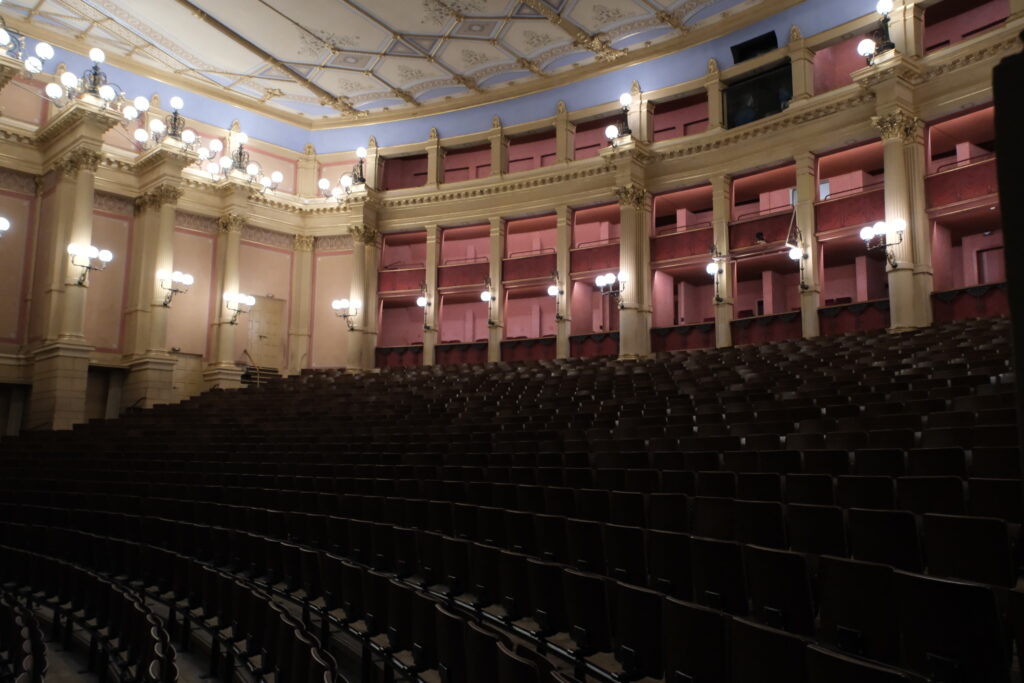
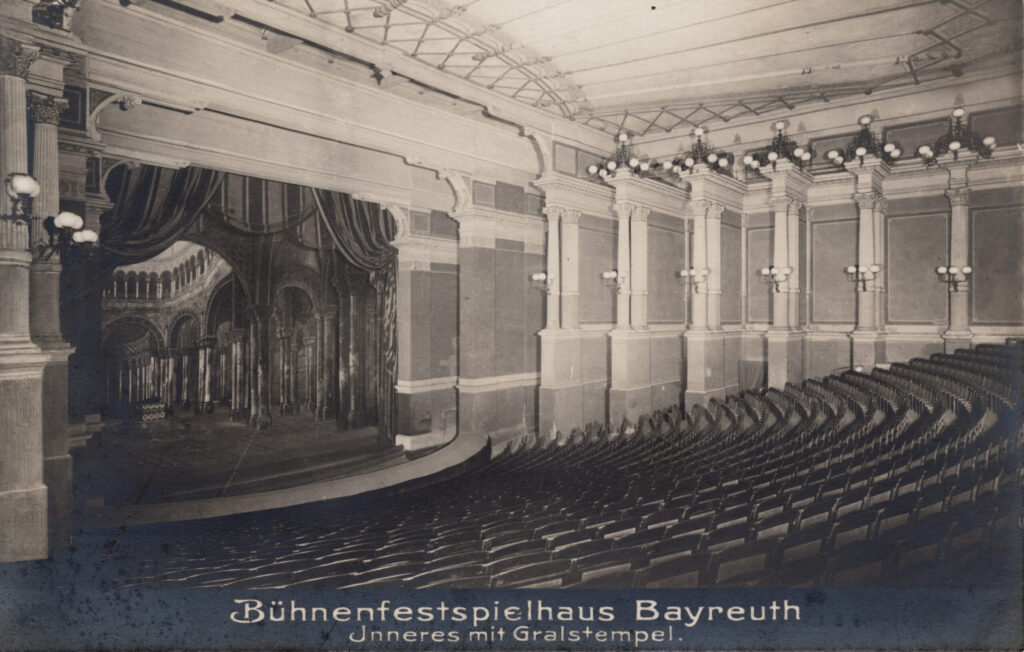
After Wagner died in 1883, this existing religious dynamic became even more prevalent, and Bayreuth completed its transformation into a shrine dedicated to the memory of a quixotic artist who had strived to restore a sense of the sacred in the arts during a time of increasing secularization, commercialism, and industrialization. As Wagner explained in the late treatise Religion and Art (1880), the artworks he created in Bayreuth—from the Ring to Parsifal—were part of a process of dual regeneration for the modern world, both social and artistic: ‘Where religion becomes artificial it is reserved for art to save the spirit of religion by recognizing the figurative value of the mythic symbols which the former would have us believe in a literal sense, and revealing their deep and hidden truth through an ideal presentation’.7 To accomplish this weighty task of saving the spirit of religion Wagner believed that opera required a new presentation. He intentionally designed the Festspielhaus to architecturally embody and convey these ideals, and to serve as an example for other opera houses. In this new conception the entertainment provided should also serve a higher spiritual ideal. Indeed, some of its major innovations–lights off during the performance, the immersive illusion created by the double proscenium and the hidden orchestra–are commonly recognized as important foundations for modern performance, even inspiring modern cinema.8
One of the most eloquent accounts of Bayreuth’s atmosphere of religiosity in the late nineteenth century comes from Mark Twain, who attended the Festival in 1891 while on assignment for the Chicago Daily Tribune. There, he saw performances of Tannhäuser, Tristan und Isolde, and Parsifal. The letters he wrote at the time–later republished under the ironic title ‘At the Shrine of St. Wagner’–rely on an outsider’s perspective, that of a ‘heretic in heaven’ who had infiltrated the Wagner cult.9 Bemused by the quasi-religious fervour he witnessed, Twain went back to the US ‘wondering why people should come from all corners of America to hear these operas, when we have lately had a season or two of them in New York with these same singers in the several parts, and possibly this same orchestra’.10 This quotation raises the question of whether the Bayreuth Festspielhaus should be seen as a place of pilgrimage–complete with all the trappings of the sacred: a dedicated building, pulpit, officiator, and congregation–or if it is simply a summer opera house. Twain’s experience in Bayreuth led him to conclude that ‘its atmosphere of devotion’ towards one man differed from what he would usually see at the Metropolitan Opera.11 In short, he concluded that the audience largely contributed to the Bayreuth mystique and collectively helped turn the theatre into a temple.
The public’s participation in turning Bayreuth into a secular place of worship was no mistake. In fact, Wagner had been inspired by several religious sources: the first was ancient Athens, which placed theatrical performances at the core of religious celebrations. Second, Christianity was a consequential influence on Bayreuth’s design. This is unsurprising for an artistic endeavour rooted in German nationalism, a movement that saw itself as fundamentally Christian.
Bayreuth’s Christian influences should be separated into two categories: the first is Protestant, and more specifically, Lutheran, owing to Wagner’s own Lutheran background, while the second (and more marginal one) is tied to Catholicism. After Wagner’s death, the far-right followers who belonged to his widow Cosima Wagner’s inner circle formulated what scholar Udo Bermbach has aptly named the Bayreuther Theologie: the theory that religion–strictly understood as Lutheranism, which they believed had to be ‘made Germanic again’ and ‘purified’ from outside influences–had been underestimated as an integral part of Wagner’s thought.12 The writings of Hans von Wolzogen–the editor of the Festival’s official monthly journal, Bayreuther Blätter–and Houston Stewart Chamberlain–the English-born son-in-law of Wagner who promoted racist theories–helped establish Bayreuth as a völkisch proto-fascist cultural centre through nationally inflected religious language and imagery.
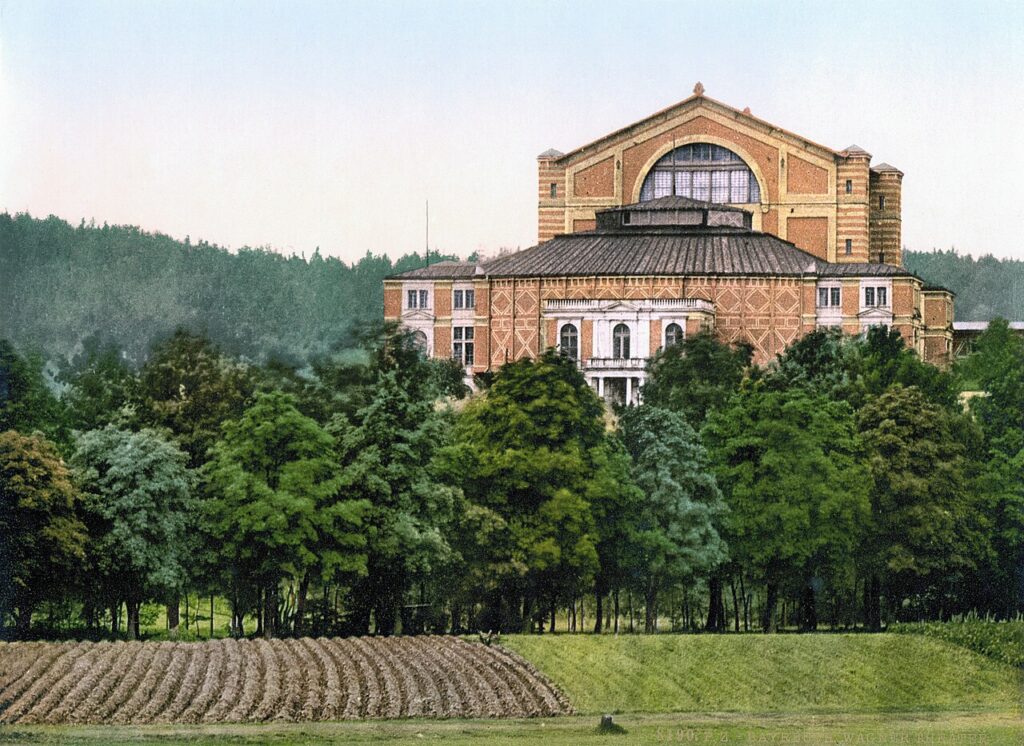
In many ways, the Festspielhaus resembles a Protestant church: the building is innocuous-looking; it is made of timber, a very inexpensive material, and the inside is just as bare, a far cry from the typically opulent red-and-gold opera house. If we are to believe local legend, the building was so unremarkable that it was spared by the Allies when they bombed Bayreuth in April 1945, allegedly because it was taken to be a brewery. The Festspielhaus’s architectural modesty, complete with its notoriously uncomfortable wooden benches (which acquired thin padding a few decades into its existence), seems to prioritize communion through art and a rejection of materialism over the spectators’ comfort. What matters is to give space to the listeners’ inner life. This occurs by creating a more egalitarian seating plan and also by burying the orchestra under the stage. According to the scholar Beate Wyss, the denial of the spectators’ individuality was the very point, and it was noted by Bayreuth concertgoers from the beginning: ‘It is a question of the inner realm, “das Eigentliche”, the essence; and for the superficial, for the clatter of vanity, there is no space’.13 Just imagine the ordeal of watching a five-hour performance of Parsifal during the hottest days of summer, in a theatre with little ventilation, where there was no toilet available. The point was, still according to Wyss, to ‘cancel the public as a corporeal fact’,14 to more easily impart collective revelations.
As for the more specifically Catholic elements of the Bayreuth Festival, they are most prominently tied to Wagner’s last work Parsifal (1882), a work conceived as a Bühnenweihfestspiel or consecrated festival stage-play that includes a Eucharist scene in the first act. The Catholic elements arguably became even more pronounced after Wagner died in 1883 as the formerly sleepy town of Bayreuth increasingly took on a new identity as a tourist hot spot. Much like Beethoven and Mozart, objects that belonged to Wagner, as well as his handwritten letters and manuscripts, became collectors’ items after his passing. For all three composers, however, the situation goes beyond traditional collecting in order to take on a more religious significance that can be extended to any item vaguely related to Wagner. Thus, personal items related to Wagner and souvenirs purchased in Bayreuth, which progressively became more mass-produced, can take on the role of ‘relics’ to Wagner fans. This is still visible today in the dedicated antiquarian bookstore Antiquariat Rainer Schlicht, which sells not just books about Wagner, musical scores and recordings, but also rare trinkets. Any object that may have been touched by Wagner goes for tens of thousands of euros at the very least.15
Finally, the last important Christian element in the Festival’s design concerns its location and the inner journey it is meant to represent. The theatre sits atop an isolated ‘Green Hill’ outside the city centre, which attendees must climb on foot.16 Ascending the hill thus evokes a broader climb to heaven, redolent of Dante’s Divine Comedy, where spectators must hold on to their faith during the climb, with the promise of artistic and religious apotheosis awaiting once they enter the theatre and take a seat. Thus, the architecture, geographical situation, theatrical experience and surrounding culture all combine to create a heady mix of Wagnerian religiosity. A ‘pilgrimage to Bayreuth’ therefore is the experience of sacrificing money, time, comfort and attention in hopes of securing intellectual and spiritual rewards.17
Citations
