
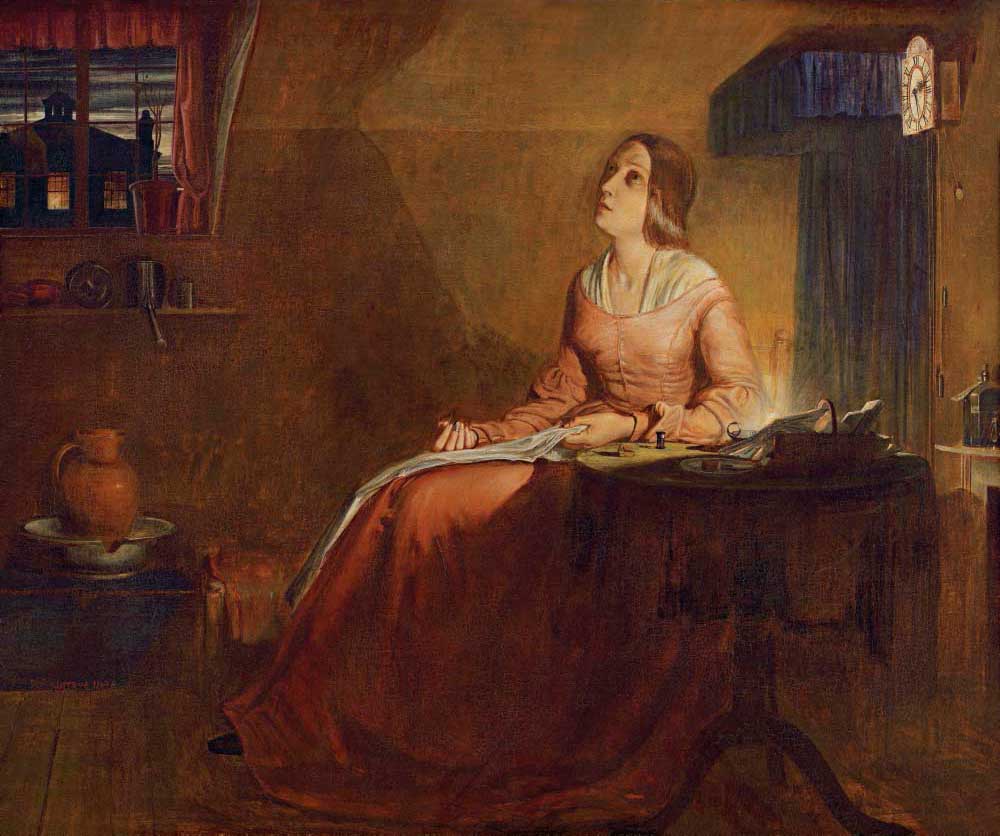

When you sow, you do not plant the body that will be, but just a seed, perhaps of wheat or of something else. But God gives it a body as he has determined, and to each kind of seed he gives its own body… So will it be with the resurrection of the dead. The body that is sown is perishable, it is raised imperishable; it is sown in dishonor, it is raised in glory; it is sown in weakness, it is raised in power; it is sown a natural body, it is raised a spiritual body.
1 Corinthians 15:37-38, 42-44a
Fashion has very little to do with what Paul writes in 1 Corinthians 15. Indeed, it is not a clever hermeneutic which brings fashion into play with the verses above, but analogy. Yet when read in dialectic conversation with an analogical model of circular fashion – by which I mean a closed loop, sustainable system in which clothing is designed, produced, worn, and recycled; therefore wasting nothing – Paul’s thoughts yields new insights. After raising the need for theological engagement with fashion and defining the concept of circular fashion, this article explores the links between creation, de-creation, and resurrection. This analogical exploration of ecotheology and fashion compares creation (the natural body) with original garment creation; de-creation (death and the seed sown) with garment breakdown; and resurrection (the new, spiritual body grown from the seed) with a new garment sewn from the recycled fabric. Bringing Paul’s writing into dialogue with the craft of fashion invites us to consider how ethical clothing can both function as neighbourly love and as an eschatological signpost.
As the Western fast fashion industry continues to devastate the environment and take advantage of marginalized communities, there is a need for Christian theological thinking about fashion.1 When an expert of the law tested Jesus on the greatest commandment, Jesus responded that the first commandment is to love God while the second is to ‘love your neighbour as yourself’. (Matt 22:34-40). Paul echoes Jesus’ command to love one’s neighbour (Rom 13:8-10, Gal 5:14). This commandment of neighbourly love provides a pattern for clothing in terms of how fashion is sourced and made. Ethically, circular fashion is the most responsible way forward because it intentionally considers justice, dignity, and the environment. This is not to say that all circular fashion models are ethical; however, they ideally create space for systematic change toward the common good. Given Jesus’ and Paul’s positions on loving one’s neighbour and caring for the marginalized, circular fashion is ripe for theological engagement from a Christian perspective.
Anna Brismar, a consultant and researcher in the field of environment and sustainability, coined the concept of ‘circular fashion’ in June 2014. Simultaneously, H&M posted a slide from a sustainability event using the phrase ‘cirkulärt mode’ (the Swedish form of ‘circular fashion’) on Twitter.2 This strange happenstance launched the integration of circular economy and sustainable fashion beginning in Sweden and broadening from Europe to a global interest. Brismar originally defined circular fashion as:
clothes, shoes or accessories that are designed, sourced, produced, and provided with the intention to be used and circulate responsibly and effectively in society for as long as possible in their most valuable form, and hereafter return safely to the biosphere when no longer of human use.3
Her definition has since been expanded by Surjit Ramamoorthy, a professor of fashion technology to involve ‘the concept of utilising apparel and dress materials to the maximum possible extent by reusing, recycling or extending their usage by any means’.4 In this model materials are used for as long as feasible and cycled from new to old as many times as can be contrived.5 The beginning and end of clothing are valued equally.
ANIÁN, a Canadian-made brand founded in 2013 and located on Vancouver Island, serves as a case study and visual aid. Their origin story states that the brand was developed ‘to make clothing that lasts—garments so well-made they could be shared, handed down, and worn for years—crafted in ways that respect the Earth’.6 Furthermore, ANIÁN is ‘committed to slow fashion and a circular economy, transforming post-consumer textiles into garments built for the city, the country and the wild’.7 While many brands have integrated circular fashion, ANIÁN began with it. And, notably, they launched a full year before Brismar coined the term. The ongoing success of the brand makes them a suitable case study; ANIÁN has thirteen years of retail evidence that indicates consumers are eager to embrace circular fashion.
To return to the analogy, creation is the origin point. A garment is designed, fabric is sourced, patterns are followed, and the result is familiar: a new piece of clothing has been created. Where circular fashion is concerned, this is the beginning of the closed system. There is a marked contrast between circular fashion and the linear model of fast fashion: produce–use–dispose.8 The third step, dispose, becomes pivotal in circular fashion. Rather than disposing of a garment, the materials are gathered to become something new. This can take many forms, such as patching, upcycling, or recycling.
On average, garments are discarded after ‘five to seven uses’.9 According to one study, 20% of textile waste is collected for recycling;10 this number is highly optimistic compared to the 1% cited by Elizabeth Cline in a CBC interview.11 The rest of the textile waste is typically incinerated or left to slowly break down in landfills.12 A shocking 1.7 billion tons of carbon dioxide is produced by the fashion industry – nearly 10% of the world’s total emissions.13 Creation is groaning and ablaze with post-consumer waste.
ANIÁN clothing begins with garment waste. Since its founding, it has rescued 1,125,000 pounds of textile waste from landfills.14 Read through a Pauline lens, this is the seed that is planted and becomes something new. The de-creation in circular fashion is the necessary step of destruction. This means shredding textile waste. Wool sweaters are sorted into colour bundles before the knits are broken down into the right length of fibers for re-spinning. Natural fibers like wool can be re-carded and re-spun – where carding refers to preparing fibers by cleaning, detangling, aligning and removing debris, while spinning refers to twisting fibers together into yarn.
Natural fibers quite literally come from seeds. Even animal sources of wool – sheep, alpacas, llamas, goats, and rabbits – grow from eggs and sperm, the seeds of mammals.15 What is planted is not what is harvested. When these same fibers are twisted into yarn and woven or knit into cloth before sewing garments, the transformation is even further from the original seed. No one can predict the garment that will emerge just by studying the seed. A pile of fabric scraps suggests construction but reveals little about what was – or will be – made.
To continue the analogy further, the de-creation of a garment through the recycling process is also a death towards life. The garment is sown through shredding. The fibers are gathered, re-carded, re-twisted, and re-woven, but it is not the same fabric as before. Furthermore, the garment that is produced cannot be determined by looking at the prior, discarded, dead clothing. This new garment is the resurrected body.
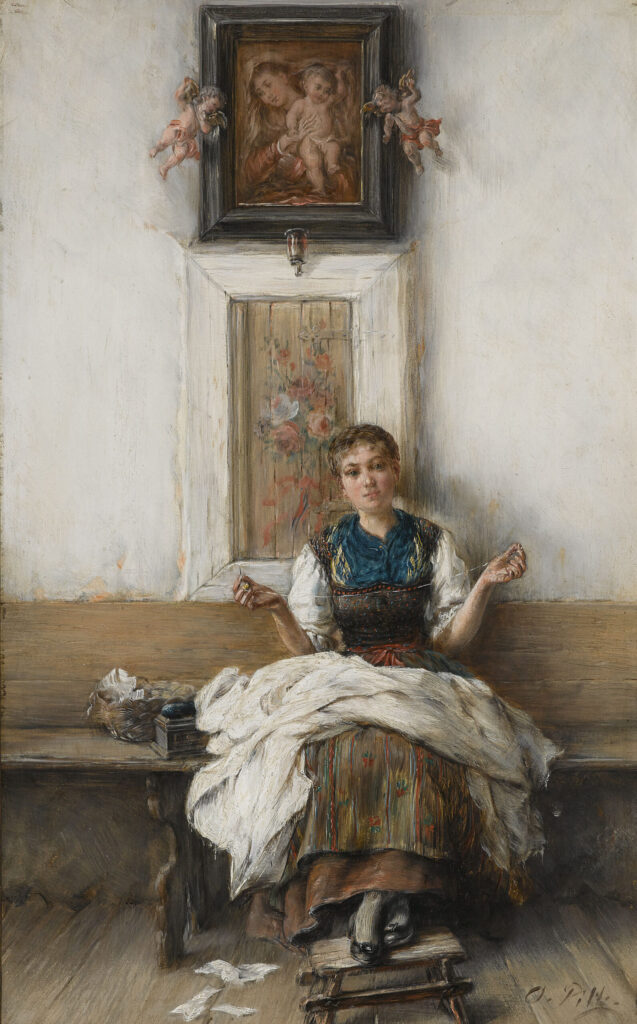
Granted, the analogy begins to break down at this very point. Clothing is still clothing. Unlike a resurrection body, which will be recognizable and yet unlike an earthly body (1 Cor 15:35-49), the difference between old and new garments is comparatively slight. In ANIÁN’s case, a discarded wool sweater becoming a wool coat is more of a baby being born than a resurrection body. ANIÁN intentionally uses classic shapes to encourage longevity of wear. The garment is new, but it is not so new that one has never seen anything like it before. Nevertheless, the distance between fabric waste and a new garment sparks our imagination. Perhaps our current human bodies are akin to piles of discarded clothing and shredded fibers, and our resurrection bodies are new garments in a form never conceived.
In 2 Cor 5:1-5, Paul compares the resurrection process to a tent being taken down in return for a mansion. Human beings groan while in ‘this tent’ because we desire to be ‘clothed instead with our heavenly dwelling’. We are not unclothed when the seed is planted – the tent is taken down – but rather exchange our clothing; the mortal becomes immortal, the seed becomes a plant, the tent becomes a mansion.
As other companies committed to circular fashion emerge, purchasing their styles can be a small step of resistance to today’s cultural moment. In Fashion Theology, Robert Covolo describes our current fashion dispensation:
Less and less a sign of social responsibility or identities constructed by the cannons of haute couture, taste is homogenized through mass marketing by which individuality is expressed through the uniform practice of self-identifying with a particular group or season. In this final dispensation, fashion’s consummation results in an irony: the ideal of virulent individualism – the valorization of individual choice as the key to social equality – creates a new kind of morality that makes identifying one’s individual voice as critical for creating normative social order.16
Covolo suggests that marketing has taken over taste and media sells individuals a homogenized identity. This has resulted in an irony, where individualism is now morality: it is the right to a personal style voice which defines social norms as individual. While this can be deeply problematic – when power stays in the hands of marketing schemes – it also offers space for change. Individuals or communities may resist the produce-use-dispose model of fast fashion and prioritize circular fashion by purchasing a few well-made, durable garments. Ideally, in doing so, a new social order will emerge that is more attentive to the material world and able to inhabit and steward its resources well.
Circular fashion has great potential for ethical, dignified, just, and environmentally sustainable practices. This alone recommends it to Christians. Yet, the above analogy can also work as an embodied liturgical practice: every time one puts on a garment that has been fully recycled from old clothing, it may symbolize one day being clothed with a resurrection body. That gives much needed hope.
Paul wrote of seeds becoming plants and tents traded for mansions as analogies of hope to communities which needed such reminders. Today, his words generate analogies that offer hope in the face of the world groaning, one way in which it is ablaze. Quite literally, fast fashion clothing waste is adding fuel to the fire. Perhaps fully recycled garments, created, de-created, and recreated from post-consumer waste, will open theological, imaginative dialogue through the image of the seed becoming a plant – a symbol of resurrection hope.
https://greenstrategy.se/circular-fashion-definition/. ^
