
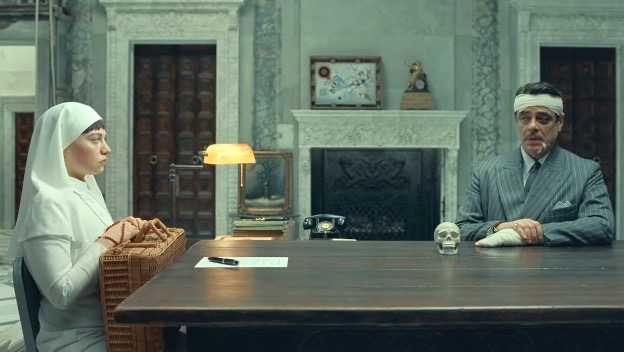

Wes Anderson’s latest film, The Phoenician Scheme (2025), is replete with religious imagery. Crucifixes, white-winged angels, and cloudy depictions of a kitsch heaven imbue the film with a religious tone that invites theological interpretation. In conducting this analysis, this article draws on Gianni Vattimo, an Italian philosopher whose postmodern thought elucidates the thematic motifs of The Phoenician Scheme while the film fleshes out Vattimo’s philosophical ideas. Although neither Anderson nor Vattimo directly influenced the other, their contemplations on death are strikingly similar and allow for a fruitful pairing of the auteur and philosopher. This article explores what drives Anderson and Vattimo to make use of Christian imagery—when they are not themselves religious—and shows the narrative corollaries of their symbolic choices.
Both Anderson and Vattimo find the impetus for religious imagery in the face of human death. During an interview, Anderson stated that Zsa-Zsa Korda, the larger than life business tycoon protagonist of The Phoenician Scheme (played by Benicio Del Toro), was inspired by his father-in-law, who died two years prior to the release of the film and to whom the film is dedicated.1 In another interview Anderson said that the religious images used throughout the film are not meant to be religious as such, but are simply ‘a way of engaging with the big unknowns and in [Korda’s] case the very present prospect of being dead’.2 As for Vattimo, encounters with death sparked his own ‘rediscovery’ of Christianity: ‘Then how does religion “return” . . . in [our] contemporary experience? As far as I am personally concerned, I am not ashamed to say that it is related to the experience of death – of people dear to me’.3 Both Anderson and Vattimo, when confronted with death, reach for the familiar symbolic language of Christianity as a means of facilitating the cognitive and emotional processing of human mortality.
Given that The Phoenician Scheme is a way of coming to terms with death, it is no surprise that Anderson invokes religious imagery in the visions of heaven which intrude on Korda each time he has a near-death experience. Since his brother, the mysterious Nubar, is perpetually attempting to assassinate Korda, these near-death experiences occur frequently throughout the film. Nubar (played by Benedict Cumberbatch) is several times described as ‘not human’, but ‘biblical’, and personifies the evil in the world which leads to death.4
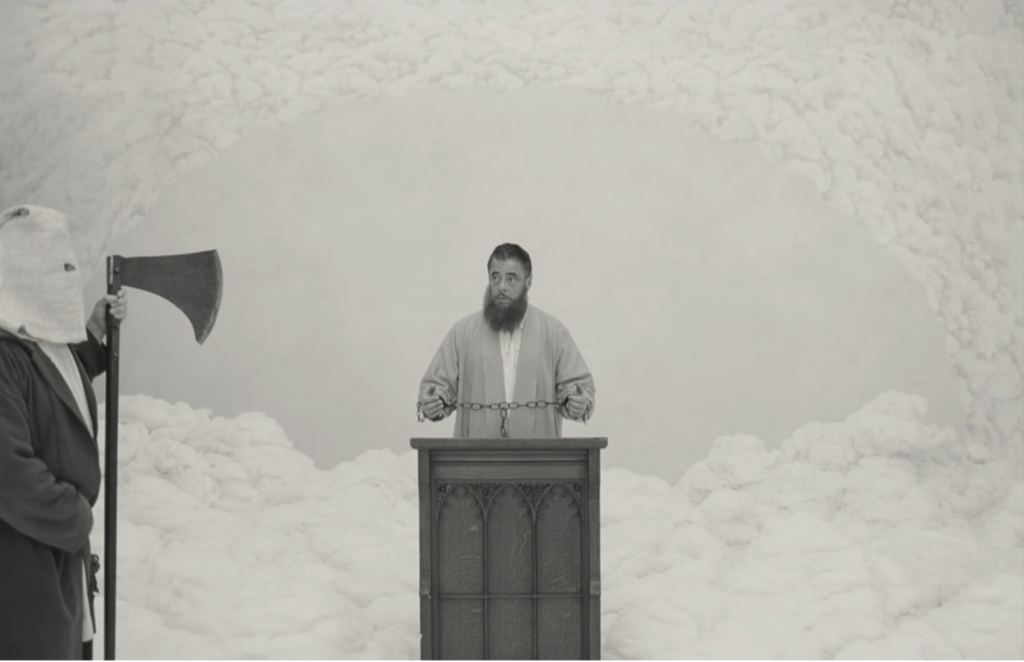
Anderson uses the black and white heavenly visions throughout the film as transition moments in Korda’s story. They denote and facilitate a search not only for meaning but also for the answer to the question of how we humans may come to terms with our own mortality. In the terms of the film, the repercussions of evil—what Christianity would call ‘sin’—is labeled ‘the Gap’. The Gap is literally the financial difference of Korda’s construction project before and after he is sabotaged by an international cabal; metaphorically, the Gap represents more. Korda himself implies a metaphorical reading when he quips that ‘off the record, the Gap might be bottomless. Closer to an abyss. In fact, there’s even more to it now, a further dimension than I previously anticipated’.5 The Gap is diegetically financial but to Anderson and the viewer represents the repercussions of evil.
The main question of the film, and a crucial question in Vattimo’s philosophical reflection, is this: Who can cover the Gap?6 Meta-narratively, where the Gap is the brokenness of the world, Anderson and Vattimo seek an answer in three places: first, a classical view of God the Father, who in Vattimo’s work is referred to as ‘the metaphysical God’; second, a human progressivism, where humanity has the ability to progress past evil; and third, the kenotic, self-emptying love embodied by Jesus Christ.
After each of the visions Korda comes to serially represent each of these three potential saviors.7 They are tested in sequence to determine whether each can adequately equip humanity to live well in the face of inevitable evil.
Korda as Father
Korda first embodies a distant and calloused version of God the Father. Korda is emotionally distant from his children, at one point insisting that spying on his children is ‘nurturing’; Anderson emphasises this point through visual distance. 8 Later, Korda hands out hand grenades labeled as ‘fruit’—a reference to the fruit in the garden of Eden, the eating of which carried deadly consequences.

The fact that this disinterested Father is not concerned with ending suffering, and in many cases is its very cause, is the primary reason why Anderson and Vattimo reject the metaphysical God. Although Anderson seems to claim not that this God does not exist but rather that he is cold and ineffective, Vattimo, more polemically, sees this conception of God as actively harmful. He describes the metaphysical Father as nothing more than the ‘violent mechanism’ of ‘the projection of human desires’ onto ‘a supreme being’; he rejects this distant God as an invention of human imagination, used by humans to extort and control others through rigid laws.9 Both thinkers view this God as untenable, of no use in covering the Gap. Accordingly, Korda moves on to represent human progress as an alternative.
Korda as Man
Just before this transition from Korda as God the Father to Korda as a representation of human progress, a new character, Captain Marty, prepares the audience by addressing Korda as ‘man’ five times in thirty seconds.10 After a vision of Heaven in which his culpability is made apparent, Korda is revived when infused with mortal blood, further emphasizing both his humanity and advancements in medical technology.11
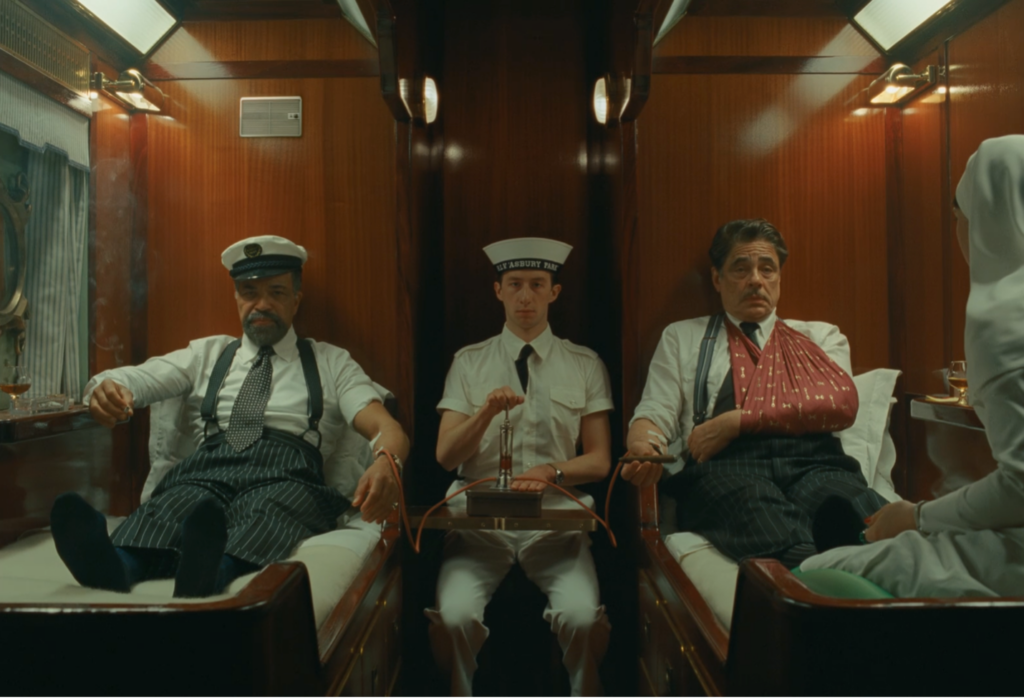
Anderson depicts this version of Korda as compassionate but ultimately not powerful enough, evident in the subsequent string of misfortunes. The repercussions of Korda’s actions come back to haunt him in the form of a failed business deal, a plane crash, a betrayal, and finally near-death by quicksand.12 These events represent what Vattimo states explicitly: after the ‘sensational “failures” of . . . Auschwitz . . . and Eurocentric colonialism’, Vattimo deems ‘the ideology of progress untenable’, and quotes Heidegger’s declaration that ‘by now only a God can save us’.13 Both Anderson and Vattimo conclude that something more than pure humanity is required; consequently, both turn to Christ’s kenosis, or self-emptying sacrifice.
Korda as Son
Korda’s coming to represent Christ is signaled by the first and only time the name ‘Jesus’ is spoken in the film. In the exact instant in which Korda speaks the name during a vision of heaven, he is flashed back to the physical realm and begins to enact a plan to cover the Gap at his own expense. When told that his plan to cover the Gap ‘defies the basic laws of economics’, he simply replies, ‘That’s why it’s never been done before. My plan defies everything’.14 Anderson thus depicts the kenosis of Jesus, his covering the Gap through self-emptying, as being radical to the point of defying all human reasoning, yet also mysteriously efficacious. Korda’s declaration of this plan to sacrifice his entire livelihood to cover the Gap is littered with biblical references, and this Korda-as-Christ defeats the evil personified in Nubar—but only after being symbolically thrown down in a striking visual representation of the crucifixion.

This single still contains imagery referencing Christ’s descent from Heaven (the stairs), his sinlessness (white robes), the crucifixion (his bloodied head and outstretched arms), and his temporary separation from the Father (cut off from the oasis of God’s presence). This scene expresses Vattimo’s understanding of the incarnation as well. In Belief, he writes that he has ‘rediscovered a doctrine which has its keystone in the kenosis of God and in salvation understood as the dissolution of the sacred as natural-violent’.15 In Vattimo and Theology, Thomas Guarino writes that ‘ultimately, for Vattimo, Christianity’s contribution to the public square can only be that open-ended tolerance which is rooted in the self-emptying vulnerability of the kenosis’.16 Both Anderson and Vattimo see the kenosis of Christ, an attitude of self-sacrifice, as the only way of covering the Gap.
Their understanding of this kenosis is, however, significantly different from the orthodox Christian view. Anderson and Vattimo depict Christ as acting alone in the self-emptying, effectively acting in subversion of God the Father. In a Marcion-esque movement the metaphysical God of the Old Testament and the compassionate Christ of the New Testament are pitted against one another. This is contrary to the Christian tradition in which Jesus empties himself in willing obedience to the Father, an obedience which is grounded in the trust that even his death on a cross will be redeemed by the Father’s justice.
Conclusion
Is this postmodern representation of Christian kenosis, explicitly stated by Vattimo and implicitly depicted by Anderson, enough to be experientially robust? One benefit of pairing Vattimo’s thought with Anderson’s narrative is that it allows the concepts to be evaluated not only theologically or philosophically but also aesthetically. In this aesthetic register, the theological frailties are most strikingly evident.
Korda defeats the ‘biblical evil’ of his brother Nubar but leaves him alive. Anderson correctly realises that Korda cannot fulfill the roles of kenotic lamb and righteous judge simultaneously, and that Christ’s kenosis does not immediately remove sin from the historical experience but rather provides a hope through which the brokenness of the world may be endured. Christians look towards the eschaton as the fulfillment of that hope–the ultimate removal and final defeat of sin. The film evokes only Christ’s kenosis and ignores any hint of divine judgement, and Anderson is left with a narrative gap. How will Nubar, evil personified, be ultimately vanquished? Having dismissed the metaphysical God, the judicial bench remains empty. Anderson is left to write a narratively unsatisfying ending in which Nubar ends his own life.
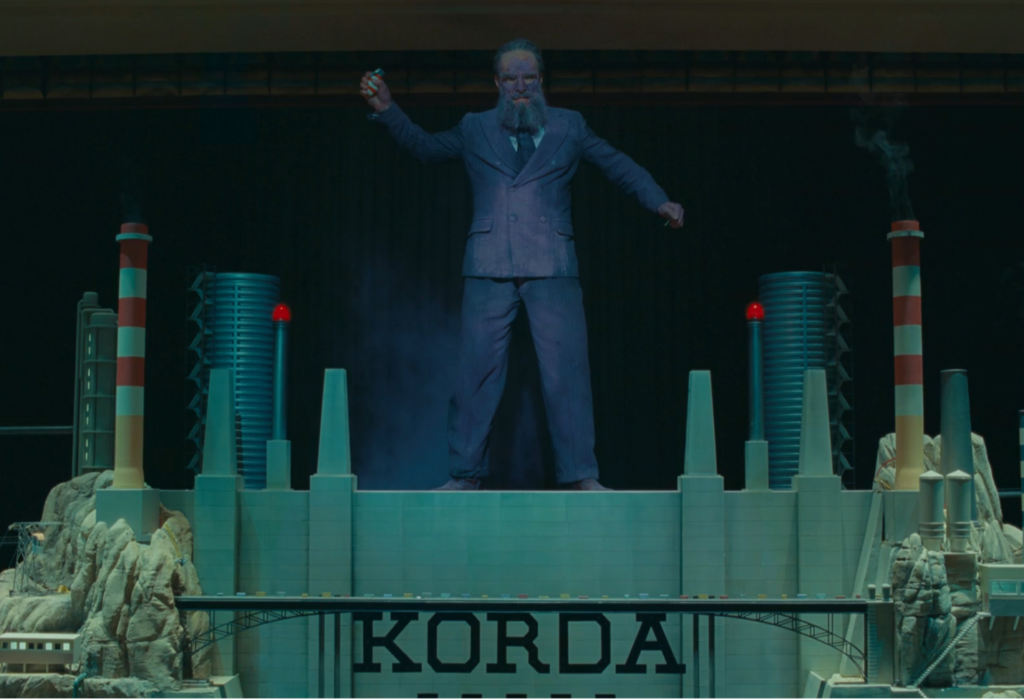
This personification of evil, who has shown no traces of remorse throughout the film, is suddenly struck by a sense of ambiguous regret or charity, and in an act of his own kenosis chooses to remove himself from the narrative. Nubar’s violent suicide solves Anderson’s narrative problem but does so only discordantly, thereby exposing a weakness of both Anderson and Vattimo’s postmodern philosophy.
In their borrowing of religious imagery and language to reckon with death, Anderson and Vattimo unintentionally expose the danger of fragmenting Christian doctrine and imagery. By picking out only the aspects of Christianity which are the most palatable to a postmodern culture concerned primarily with tolerance, they inadvertently reveal the inherent interconnectedness of these Christian images. Even when taken only as narrative symbols, the Father and the Son cannot be easily separated. This is not to insist that Anderson’s film must adhere to and uphold Christian doctrine, as that would be an unfair standard by all accounts; this is, rather, to suggest that, had Anderson understood the complexity of the theological images he borrowed, he could have achieved a greater narrative cohesion in the film. The symbols themselves could have given him the storytelling techniques necessary to craft a compelling conclusion.
In the end, this reading of The Phoenician Scheme serves as a reminder that there are limits to the extent which religious symbols may be co-opted if any original meaning is to be kept intact. A theological coherence must be retained, which in this case emphasises that Christ kenotically sacrifices himself only because he trusts the supreme justice of the Father. Attempting to have the kenosis of the Son without the justice of the Father is not only non-orthodox; it leads to an unsatisfying narrative.
