


There is a particular kind of difficulty within a painting which is at once entirely atheistic in vision and entirely dependent on Christian architecture for its power. Francis Bacon’s Three Studies for Figures at the Base of a Crucifixion, painted in 1944, presents us with exactly this difficulty—and I want to suggest that the difficulty is precisely the point.
It is all too easy to read Bacon as borrowing from Christian iconography out of nostalgia, or even out of provocation for its own sake. However, when noting Bacon’s Christian upbringing in the Catholic Republic of Ireland (and potential familiarity with the predella form), it seems he has understood, with something close to theological precision, that the predella form carries devotional weight that cannot simply be detached from its content. It is precisely that weight he needs, because without it, his vision has nowhere to land. For Bacon, the horror requires the reverence to function: if you destroy the form, you destroy the effect. Thus, Bacon intends to keep the form, and systematically evacuates what the form was built to hold.
I read this as an act of what I will call architectural subversion, and will do so through three interlocutors whose works can illuminate what Bacon is doing with great precision. The first and primary is Georg Wilhelm Friedrich Hegel, whose account of Spirit (Geist) and its dialectical movement through negation provides a framework for understanding what the predella normally performs in the context of an altarpiece—and, perhaps, what Bacon refuses to let it perform.1 The second is a Hegelian framework through Slavoj Žižek, who I reference explicitly as a reader of Hegel rather than as an independent authority. Žižek’s Christian Atheism (2024) radicalises the Hegelian account in ways that approach the particular coldness of Bacon’s vision, and I argue that this reading of Hegel is the most precise available account of what the death of God without sublation (Aufhebung) actually entails as a structural claim.2 The third is Judith Wolfe, whose work on the theological imagination and art as revelation describes precisely the economy Bacon’s triptych has been engineered to foreclose.
The Predella as Theological Form
We need to begin with the form itself, because the subversion only registers if we understand what is being subverted. The predella—from the Italian, roughly, for kneeling step—is a structurally subordinate panel within an altarpiece, but theologically essential to it. In the great Italian altarpiece tradition, from Duccio to Fra Angelico, the predella houses the supporting witnesses of the Passion: the Virgin; St John; the Magdalene. Their presence anchors the crucifixion in what Hans urs von Balthasar calls the drama of divine kenosis, as the human recipients of God’s self-emptying, witnesses to an event whose full significance they partially endure and only partially comprehend.3 In the predella, the suffering has both direction and telos, and demonstrates this truth through invitation to self-participation. By positioning these human witnesses at the physical base of the altarpiece, at the eye level of the kneeling congregant, the panel acts as a devotional mirror, inviting the viewer to adopt the saints’ own posture and ‘beholding’ of the cross, and to engage in the exchange of receiving grace from the cross, and projecting their own sorrow into the space of, and with, the holy witnesses.
Hegel provides the vocabulary to say precisely what the predella does at a deeper level. In his Lectures on the Philosophy of Religion, Hegel argues that the highest religious art is what he calls Vorstellung: pictorial representation of genuinely speculative philosophical truth.4,5 The incarnation says that the infinite becomes finite. The crucifixion says that the finite is negated, and towards the resurrection through which the negation is itself negated. Finally, the Spirit recovers itself, enriched by having passed through finitude and death. The predella is Vorstellung made architectural: it is theology in images, which is precisely why Hegel regarded Christian art as the summit of religious representation. It gives pictorial form to the movement of Geist itself.
The decisive name for that movement is Aufhebung (elevation): something is cancelled and preserved at a higher level. The crucifixion is the paradigm case. The death of God in Christ is the condition of its recovery in the community of mutual recognition, and what Hegel reads as the church.6 The predella witnesses and enacts this logic: the mourning figures below the cross have their grief oriented towards an end and fulfilment. Hegel’s Aufhebung is written into the architecture of the altarpiece.
The Hijack: Eumenides for Saints
Bacon’s first and most precise act of subversion is the substitution of figures. Where the traditional predella houses mourning saints—figures whose grief is oriented toward a horizon they do not yet fully see—Bacon installs the Eumenides, the Furies of Greek tragedy: blind, vengeful, and answerable to no redemptive economy whatsoever.
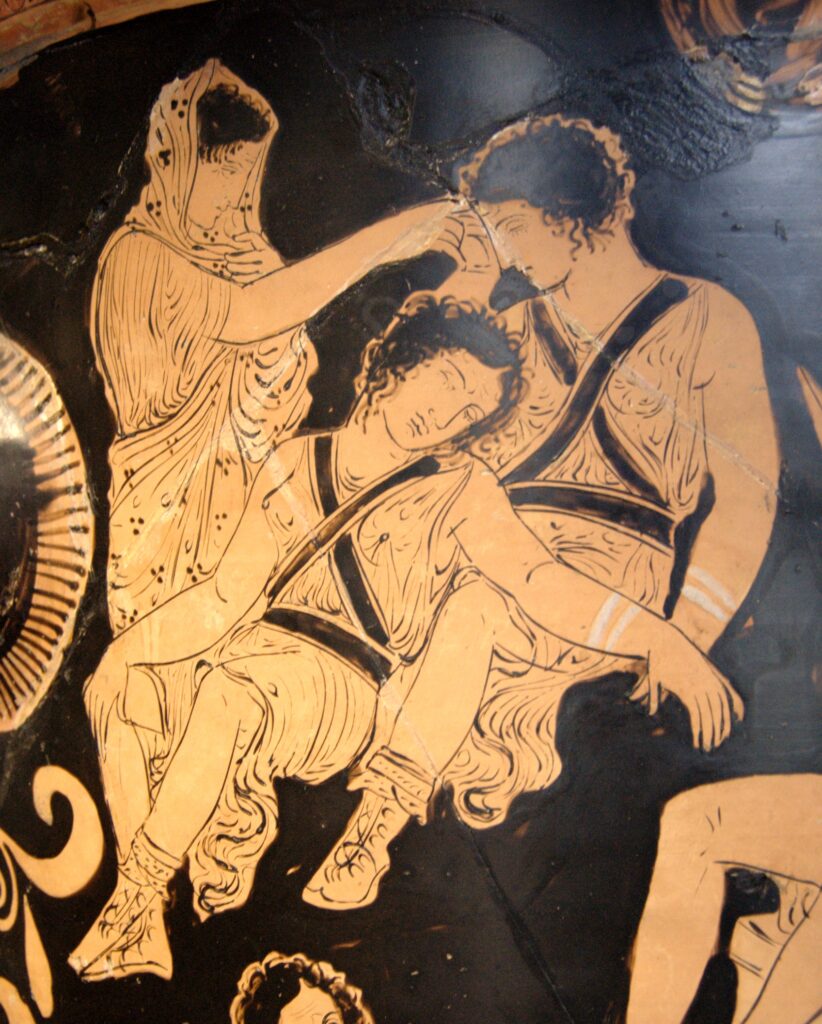
The choice is exact, and its exactness matters in how we interpret Bacon’s intention. The Eumenides are as theologically untranslatable as they are violent or disturbing. They belong to a moral universe which Christianity claimed to have superseded: a universe in which wrong is repaid not by sacrificial grace but by retributive compulsion without end, mercy, or transformation. They are pre-incarnational and pre-kenotic, and precede everything the predella was built to witness through Creator and Creature.7 By placing them in the predella’s structural position, he reverts it by installing, beneath the implied crucifixion, the world the cross was supposed to have transformed. Vitally, Bacon is not secularising the form.
Bacon himself described the cross in this work as a mere ‘armature’—a structural support upon which to hang the visceral reality of human brutality.8 The theological casualness of this remark is itself significant: the cross is emptied of soteriological function while its scaffolding is retained, but not in any legitimate view denied or attacked. This is more subtle—and in a way, more devastating—than straightforward rejection, as one cannot rage against a form they have simply discarded. Thus, Bacon’s intention is to keep it.
A Failed Dialectic: Hegel and the Arrested Aufhebung
This is where Hegel becomes indispensable as a diagnostic. His account of the dialectic insists that negation is productive: that when contradiction is genuinely worked through, something higher emerges. The crucifixion is, for Hegel, the supreme instance of this. The death of God in Christ is the condition of God’s recovery in a community of mutual recognition. The predella form enacts exactly this: negation with horizon, suffering with telos.
Bacon’s triptych performs a failed dialectic, or more precisely, a dialectic deliberately arrested at the moment of negation. He creates crucifixion without resurrection, alienation without homecoming, the death of God without Aufhebung. The three panels do not progress towards resolution in the crucified Christ; they rather hold a void of continual suffering and grief. Unlike a traditional predella, which usually spans a single, continuous panel to unite the mourners of Christ, Bacon purposes the divided structure of the triptych to enforce absolute isolation and disunity, ensuring each figure remains structurally sealed within its own frame of distortion (as would also be the case for the viewer as their own isolated participant). Each figure is sealed within its own distortion, incapable of the mutual recognition that Hegel identifies as the fruit of Spirit’s passage through the cross. There is, in the strict Hegelian sense, no community formed here. No Spirit recovers itself, and nothing is enriched by the passage through suffering. The suffering simply is.
Additionally, the orange-ochre background may represent more than neutral space. In Hegelian terms, it is the visual annihilation of the symbolic context that would make the figures legible within a redemptive narrative. Traditional predella panels situate their figures, drawing sacred geography and oriented space that contributes to and illustrates the narrative sequence. What Žižek, reading Hegel through Lacan, calls the ‘big Other’—the symbolic order, the guarantee of transcendent meaning—is precisely what Bacon’s ground instead refuses to provide.9 The orange void is a world in which the structural possibility of divine presence has been removed. Bacon’s figures scream, contort, and simply exist in the predella, with no framework available to make their condition mean anything beyond themselves, even through the ‘approach’ of the viewer. They hold space alone, and none participate together in a particular form of narrative progress. The purpose of the predella is undone, and the posture and ‘beholding’ by the viewer is disrupted and arrested. The orange void is a world in which the structural possibility of divine presence has been removed. Bacon’s figures scream, contort, and simply exist in the predella, with no framework available to make their condition mean anything beyond themselves, even through the ‘approach’ of the viewer. They hold space alone, and none participate together in a particular form of narrative progress. The purpose of the predella is undone, and the posture and ‘beholding’ by the viewer is disrupted and arrested.
The Death of God Without Recovery
In his book Christian Atheism, Žižek elucidates what Hegel’s dialectic entails when it is followed to its logical terminus without the consolation of recovery: a radicalisation of the Hegelian reading in ways that bring us closer still to the particular temperature of Bacon’s vision. For Žižek, the death of God on the cross cannot be read or viewed as a moment to be dialectically overcome. The cry of dereliction—My God, my God, why hast thou forsaken me?—is, for Bacon, the permanent theological truth. In that moment, God himself becomes an atheist. The gap between humanity and God is revealed as inscribed within divinity itself. Separation from God is, Žižek argues, a feature of what God is.
Žižek’s critique of conventional atheism is sharp and, I think, correct: vulgar atheism merely replaces God with other external necessities—Nature, Reason, and History—and therefore remains structurally trapped within the very theological paradigm it claims to have escaped. True atheism, he argues, must pass through Christianity rather than around it.10 Rather than simply nothing, or a void, what remains after the death of God for Žižek is the community of love: the Holy Spirit reread as the horizontal solidarity of finite subjects, stripped of transcendence. This is, he notes, a specifically Protestant atheism, which is one reason the Hegelian architecture suits it: it works through contradiction rather than papering over it.11
I argue that Bacon arrives at the same place by a different and more visceral route—and then goes one step further. Where Žižek retains the community as the residue of God’s death, Bacon does not. His three figures are radically isolated. There is no solidarity forming here, no mutual recognition, no Pentecost, not even a secular one. The figures cannot see one another; they cannot reach one another; they are each sealed in a separate and incommunicable distortion. Read alongside Žižek, Bacon is perhaps the more rigorous, or the more despairing; his paintings hold open a gap as permanent as Žižek’s but withhold even the consolation of a community gathering around it.12
Wolfe and the Theological Imagination Refused
Judith Wolfe’s recent work, The Theological Imagination (2024), enables us to locate Bacon’s achievement with still greater precision—though as a foil rather than an ally. In The Theological Imagination, Wolfe argues that Christian theology offers a potent way of imagining the world even as it brings us to the limits of our capacity to imagine—that faith offers courage both to shape our world creatively and to let things be more than we can yet conceive.13 She also posits that artistic creation can participate in a revelatory economy, opening the viewer onto what exceeds the work, even at its darkest. For Wolfe, the imagination is the deepest interpreter of reality, and it remains oriented, even under pressure, toward what it cannot yet see.
Her earlier study of Heidegger is equally germane. In Heidegger’s Eschatology (2013), Wolfe argues that Heidegger produces what she calls an ‘eschatology without eschaton’: he abstracts the existential structure of Christian eschatological expectation—its being-toward-an-end—while evacuating its theological object entirely.14 The result is therefore a being-unto-death as the secular residue of a Christian grammar. Christian hope, for Heidegger, no longer constitutes authentic existence but negates it, because hope projects an end to the unrest, and authentic existence cannot afford such an end. Wolfe’s diagnosis of Heidegger maps, with remarkable precision, onto what Bacon does to the predella.
Bacon’s Three Studies is, on Wolfe’s terms, art that refuses revelation, and refuses it deliberately by commandeering the very form designed to enable it. Bacon exploits what Wolfe would call the ingrained patterns of meaning-making that the predella carries—the viewer’s learned reverence for the altarpiece, formed over centuries of liturgical habit—to communicate horror through structures that cannot deliver the comfort they formally promise. This is the theological imagination colonised and turned against itself, and the devastating precision of the colonisation is this: the more thoroughly the viewer has been formed by the Christian visual tradition, the more completely the substitution works. Bacon requires the faith of the viewer he is assaulting.
Conclusion: The Commodification of the Sacred Form
In summary, Bacon intentionally retains the sacred form, and he retains it precisely because destroyed forms carry no power. A purely nihilist image carries no weight, because it makes no claim on inherited meaning. Bacon’s triptych is devastating in a way that straightforwardly secular art cannot be, because it inhabits the inherited form so precisely and then installs within it a vision that that architecture was built to exclude.
The horror, to state this plainly, is proportionate to the reverence betrayed. Bacon is, in this sense, a theologian of a particular and perverse kind: one who understands the tradition with sufficient depth to know which load-bearing wall to remove, and removes it with the cold precision of a demolition that leaves the façade standing.
Citations
