Pop music deals in ‘obsequious’ gestures, and in this respect Taylor Swift is no exception. 1 Indeed, she has a gift for poetic compression, in distilling life-size dramas into relatable technicolor vignettes. (She has herself characterized some of her lyrics as written with ‘a glitter gel pen’.) What I wish to focus on here though is something discreet—something unsequinned that commentators have largely ignored—which emerged more clearly on her 2024 album, The Tortured Poets Department, and that is her engagement with religion. Whilst tracing the various lineaments of this, I also seek to highlight another underappreciated aspect of her songwriting: namely, a linguistic reserve and a wider pattern of textual discretion, which I want to suggest is a vital feature of her songs’ appeal.
Doubtless, this latter claim will come as something of a surprise, since Swift is well known for her personal lyrics and her ‘confessional’ style. (Special editions of her 2019 album Lover included copies of handwritten journal entries, from when she was 13 until she was 27.) Nevertheless, it seems to me that her confessional style typically involves what Emily Dickinson—the consummate practitioner of poetic compression—calls ‘moats of mystery’,2 which forestall even as they awaken a desire for disclosure. (This is made apparent by the insatiable speculative curiosity of fans about the possible extra-textual correlatives of the songs’ unnamed inamorati.) In view of such mysteries, it would seem more appropriate to speak somewhat paradoxically of her ‘cryptic’ confessionalism.
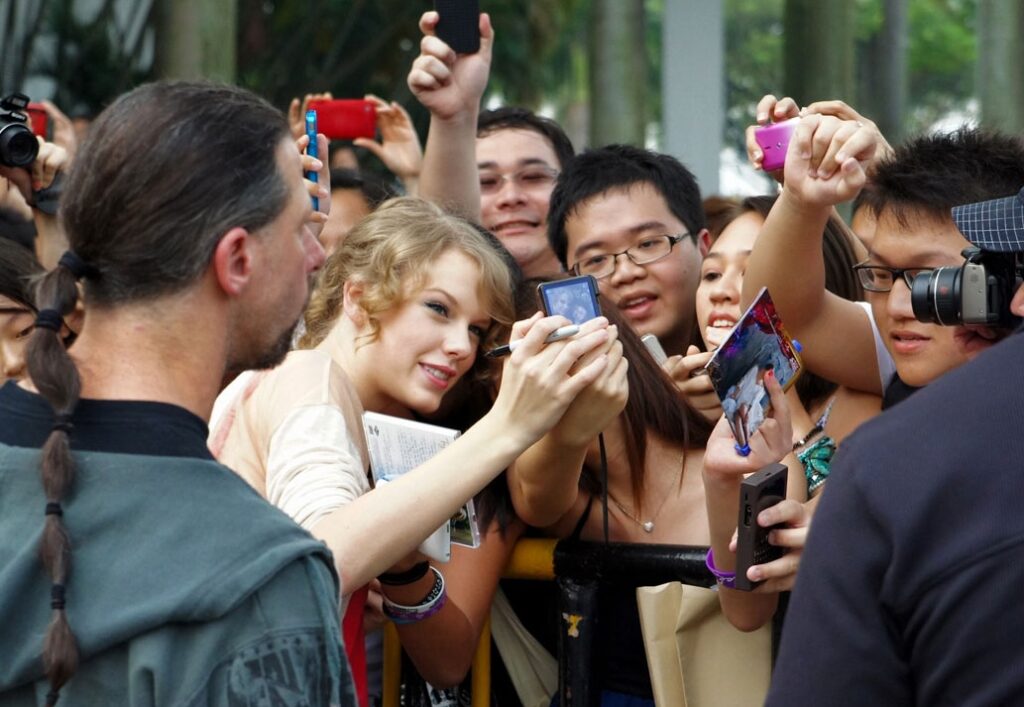
Taylor Swift takes selfies with fans in Singapore.
Swift’s engagement with religion is, to be sure, proportionately speaking, a minor matter within her oeuvre, whose songs most frequently revolve around the amorous ups and downs of her biographically inflected personae. (What daffodils were for Wordsworth, romantic breakups are for Taylor Swift.) Still, these engagements are not nothing, and—for reasons I will set out in concluding—they deserve attention. So, where in Swift’s work is this religiosity, faute de mieux, and what forms does it take?
One might begin with her most conventionalized references, as in the chorus of ‘Our Song’ from Taylor Swift (2006):
And when I get home, ’fore I say ‘Amen’,
Asking God if he could play it again.
In this case, the lines evoke a sort of soft-focus piety or what she elsewhere calls a ‘good girl faith’ (‘Style’, from 1989 [2014]). Yet this isn’t the primary concern of the passage, and the speaker’s religiosity appears to belong to the generic architecture of the country-ish ballad.
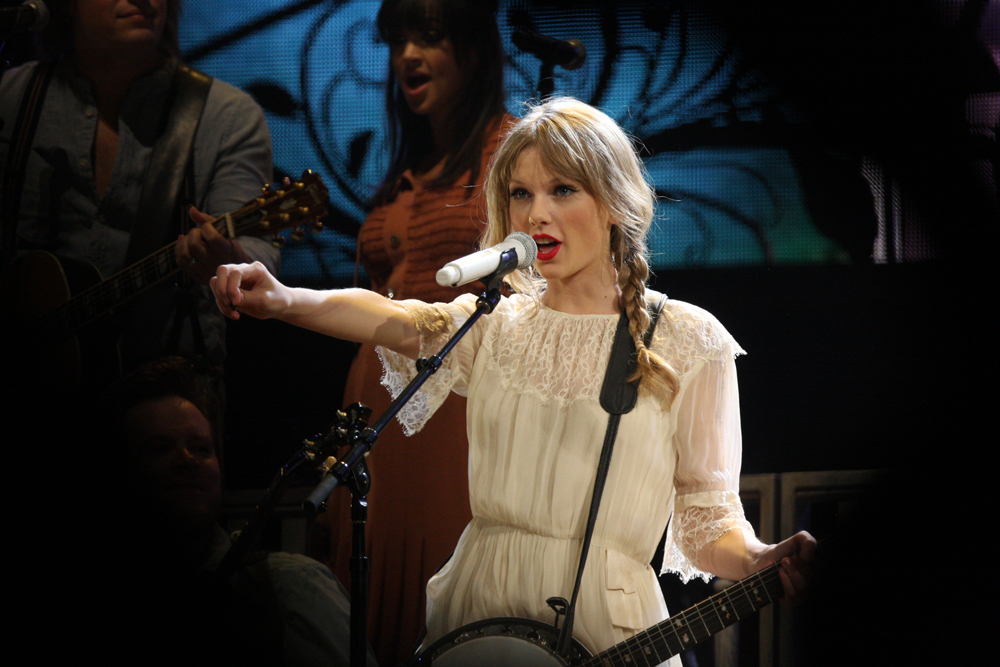
Taylor Swift plays her banjo—an instrument heavily featured on her early country albums—for a live crowd.
Such casual or conventional references are to be found in a number of other songs, such as ‘Cruel Summer’, from Lover (2019), which contains the line ‘Devils roll the dice, angels roll their eyes’; ‘Style’, in which she sings ‘Long drive, could end in burning flames or paradise’; and ‘Change’, from Fearless (2008), which includes the refrain ‘we’ll sing hallelujah’. Many of her songs are also bestrewn with religious interjections or divine vocatives, typically involving ‘Lord’ (for instance, ‘Holy Ground’, ‘Nothing New’, ‘Is It Over Now’, ‘Don’t Blame Me’, ‘Would’ve, Could’ve, Should’ve’, ‘But Daddy I Love Him’, ‘I Can Fix Him (No Really I Can)’). However, in some cases, it’s hard to say how casual such references are—and even harder to know if ‘casual’ in art is opposed to ‘meaning it’—all of which is further problematized by the death, semiotically speaking, of the author. For example, how are we to take the following? ‘God smiles on my little brother’ (‘The Best Day’, from Fearless) or ‘So here’s to the birthday boy who saved our lives’ and ‘So here’s to Jesus Christ who saved our lives’ (‘Christmas Must Be Something More’, from her EP, Sounds of the Season: The Taylor Swift Holiday Collection, [2007]).
‘Our Song’ is also of interest for another reason though; for it includes a moment of demure sauciness—which would become a more prominent, and more risqué, feature of Swift’s work—which helps to illustrate what I am referring to as a wider pattern of textual discretion. This coyly conveyed sauciness, which wouldn’t be out of place in a Carry-On film, is all but invisible if one only reads the text (‘He’s got a one-hand feel on the steering wheel, / The other on my heart), since the innuendo is a prosodic performance, communicated by the suggestive pause in Swift’s delivery before the melismatic ‘heart’.
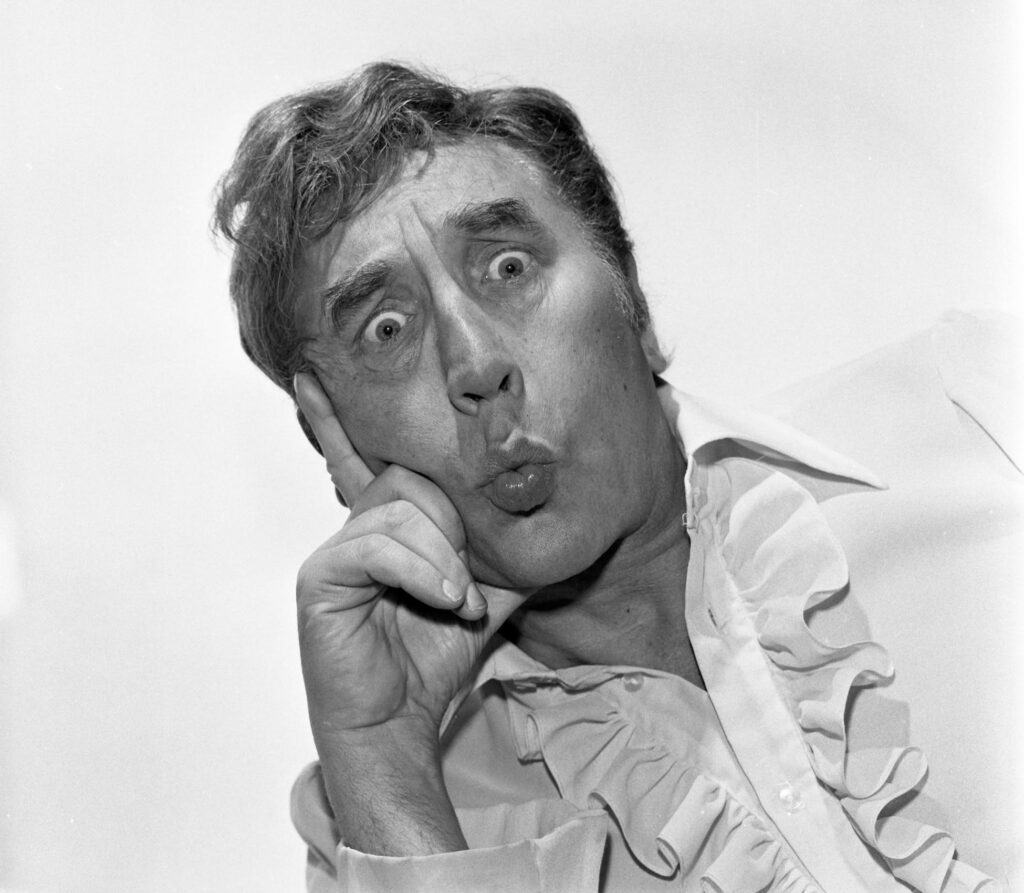
Frankie Howard, British comic legend of Carry On film fame.
Next, in tracking her textual engagements with religion, we might consider her spiritual questioning or complaints against God, briefly in ‘Bigger Than The Whole Sky’, from Midnights (2022): ‘Did some force take you because I didn’t pray?’; or more extensively in the officially unreleased track ‘Didn’t They’, which appeared online in 2013, but was apparently written when Swift was 11 or 12, and reflects on the terrorist attacks of 9/11:
And didn’t they call you, didn’t they need you bad enough?
Was there some reason I’m not aware of?
Did you not write it down? Just one more thing to do
Where were you, where were you
And didn’t they pray, too?
I include these apparently negative examples, as they have been cited in support of a claim that Swift has lost her faith.3 Against which, it should be pointed out firstly that, although these are barbed questions that don’t hold back in challenging the divine, it isn’t irreligious to ask them—or to feel beset by a sense of dereliction. Such things are part of a believer’s life and are modelled for example in the Psalms of Lament. Secondly, I think we should be extremely wary of drawing conclusions about an author on the basis of things that are said in her songs, as if their artful contrivance, their textual reserve and their use of personae made no hermeneutical difference.4
This textual reserve is particularly important in ‘Bigger Than The Whole Sky’—which is a disconsolate elegy that directly addresses its lost, deceased or unborn subject, who hovers spectrally on the verge of being, as an absent yet textually conjured presence (‘I’m never gonna meet / What could’ve been, would’ve been / What should’ve been you’)—as its intimate description of traumatizing grief is at the same time so underdetermined, in its withholding of specifying details about the harrowing event to which it responds.
This may well of course be a matter of tact or a sign of the ineffable darkness of trauma (the song begins with an acknowledgement of the indescribability of what it seeks to convey: ‘No words appear before me in the aftermath’). But it is also importantly an affordance structure, in that the lack of a specified referent expansively invites the imaginative investment of the listener’s ‘personal associative context’.5 The song, we might say, contains a ‘blank space’, in which the listener is invited to write their own name. In other words, the textual reserve of the song is paradoxically part of its affective allure.
Sometimes Swift’s engagement with religion, or at least avowedly religious people, is openly hostile, as for instance in ‘Cassandra’ and ‘But Daddy I Love Him’, both from The Tortured Poets Department. But even here things aren’t so straightforward, since her hostility appears to be directed towards what her character-speaker considers to be hypocritical Christians or un-Christian behaviour. There is a scene in Swift’s 2020 Netflix documentary, Miss Americana, in which she discusses religion and politics that may help to explain this sort of stance. Speaking with reference to Marsha Blackburn (a Republican senator), she remarks: ‘I can’t see another commercial and see her disguising these policies behind the words “Tennessee Christian values”. These aren’t Tennessee Christian values. I live in Tennessee. I am a Christian. That’s not what we stand for’.
Swift’s lyrical engagements with religion are perhaps most complicated—and most intriguing—when they are intertwined with erotic concerns, as for example in ‘False God’, from Lover, ‘Would’ve, Could’ve, Should’ve’, from Midnights, or ‘Guilty As Sin?’ and ‘Down Bad’, from The Tortured Poets Department. In the first of these, which is sung from a first-person-consonant perspective by an ‘experiencing’ subject, the religious and the erotic are positively conjoined; however, it is hard to tell if the former serves simply as an audacious metaphor or a set of analogies for discussing the latter (‘Religion’s in your lips’, ‘The altar is my hips’) or if the singer is claiming that something divine may be disclosed in the erotic. In the second case, by contrast, which is sung from a first-person-dissonant perspective, looking back on a damaging relationship, eros is negatively related to religion, as it seems to have led the singing protagonist away from the divine (‘You’re a crisis of my faith’, ‘If you never touched me, I would have gone along with the righteous’).6
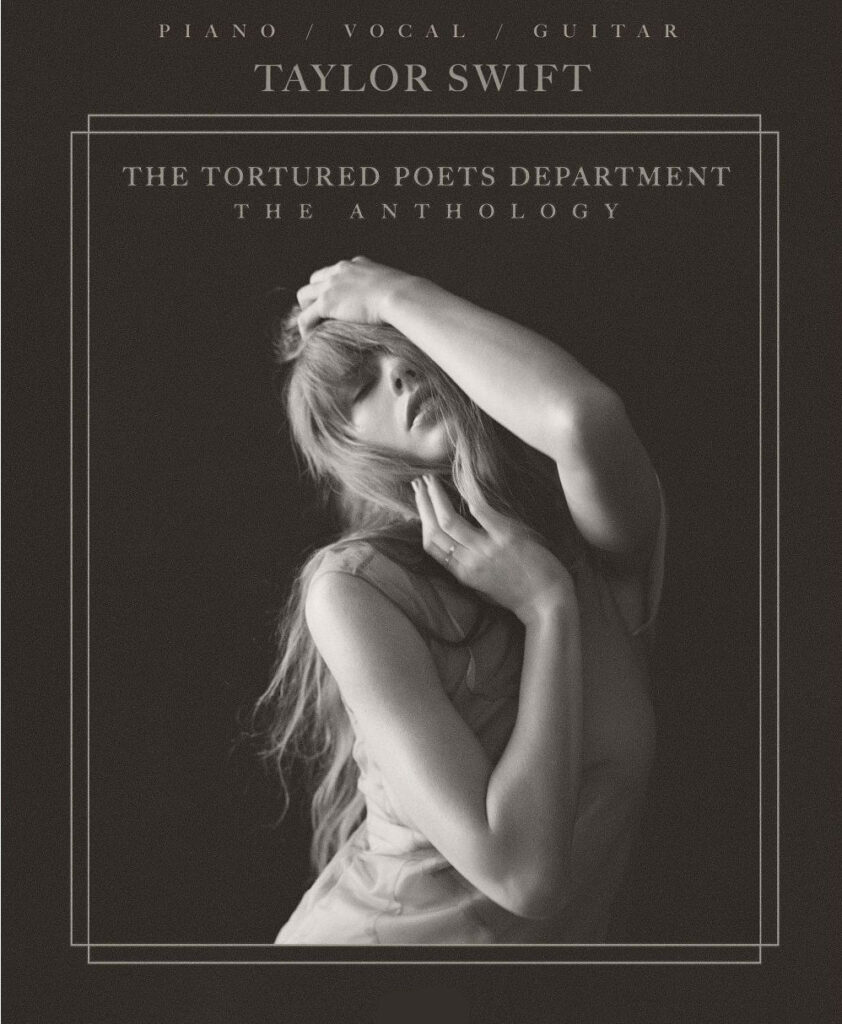
Album cover of Taylor Swift’s The Tortured Poets Department (2024)
Yet the break with the past isn’t perhaps as absolute as it might at first seem, since the conditionalized imaginings that give the song its title (‘Would’ve, Could’ve, Should’ve’) preserve a shadowy regretful sense of the life, self and trajectories she has lost. What’s more, the damage and enduring trauma are themselves expressed by means of religious imagery (‘The tomb won’t close, stained glass windows in my mind’) in a way that suggests she remains complicatedly attached to the perspective she has lost.
Since most commentators on ‘Would’ve, Could’ve, Should’ve’ tend to try and look through the lyrics to discover a biographical story ‘behind’ them, it might be worth dwelling momentarily on the artistic achievement of the text itself, and especially the complicated temporality it envisages as well as the evocative oddity of its imagery. For it seems to me that what these features help to accomplish is a dramatized portrayal of the traumatized psyche, at the centre of which is the refrain ‘The tomb won’t close’. What are we to make of this enigmatic phrase?
In one sense, its referent is fairly clear, as on each occasion the line is rhymed with ‘The wound won’t close’ (the original meaning of trauma is ‘wound’, initially one inflicted on the body, and then through its use in psychiatric literature, a wound inflicted upon the mind). However, there is something uncanny or darkly surreal about ‘The tomb won’t close’, which seems to belong to another genre, but which—paradoxically because of this—is appropriate to the situation; for the image doesn’t just describe the experience; rather, it presents us with the experience as perceived by a traumatized consciousness from within. The macabre character of the image—which suggests something incompletely dead or something dead that spectrally lives on—is thus phenomenologically fitting, since it vividly conveys the sense of being haunted that is commonly associated with the aftermath of trauma. (Despite its epigrammatical irony, there is a chilling subtext to Swift’s line ‘Now that I’m grown, I’m scared of ghosts’.)7

A scene from Taylor Swift’s music video ‘Fortnight’ (The Tortured Poets Department).
Another common feature of traumatic experience that is evoked through the dramatized subjectivity of the song is a distorted or fragmented perception of time, typically involving a sense of being trapped in a timeless, disaggregated moment or of the past refusing to remain in the past, remnants of which seep into the present—in a manner at once transfixing and elusive—with a malicious agentive capacity of their own. This sort of traumatic temporality is portrayed in the song by the speaker’s feeling that part of her self has died (‘God rest my soul’) and by the presentation of her relationship with the past as a sort of gothic warfare with interior assailants (‘why won’t this die?’, ‘Memories feel like weapons’, ‘I can’t let this go, I fight with you in the night’), but also by means of the song’s past conditionals, which evoke a state of self-alienation through a consciousness that is sundered from yet fixated upon a self prior to the traumatic experience. (This self-estrangement is also disturbingly conveyed—in a manner that recalls the violent imagery of Sylvia Plath—by the reference to ‘the stained glass windows in [her] mind’, which, in addition to bringing glass inside the self, wrenches a sinister meaning out of ‘stained’.)
‘Guilty As Sin?’ returns to the conjunction of the erotic and religious explored in ‘False God’, though it is both bolder and more circumspect in its approach. For, on the one hand, it more explicitly considers the possibility that the erotic may open up a form of religious experience, daringly bringing the two perspectives into closer alignment with the mosaic rhyming of ‘hold me’ and ‘holy’ (‘What if the way you hold me is actually what’s holy?). On the other hand, however, in contrast to the activities described in ‘False God’, what we are presented with in ‘Guilty As Sin?’ is a series of fantasized ‘what if’ scenarios. This is important to note not only because it is easy to lose sight of the song’s questioning, wondering character, but also because worrying that having erotic fantasies might be a sin is surely quite a religious thing to do.
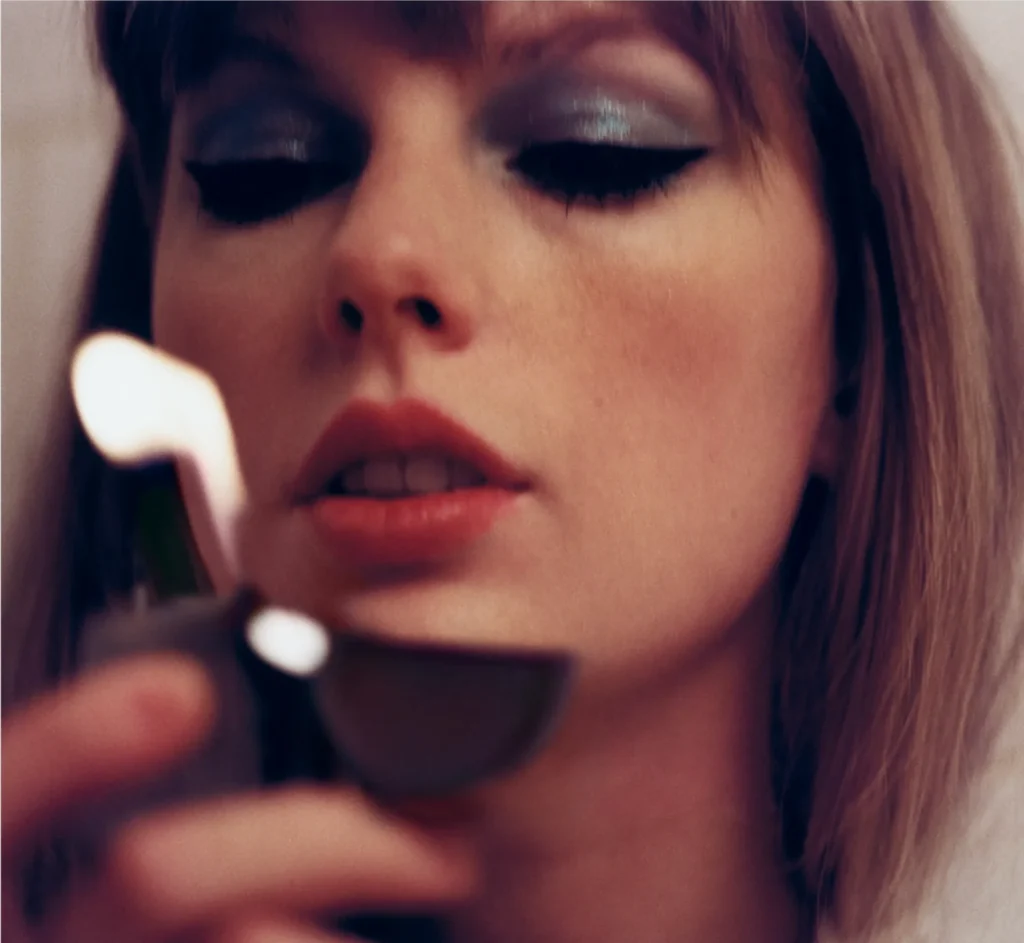
Portrait of Swift from her album cover for Midnights (2022)
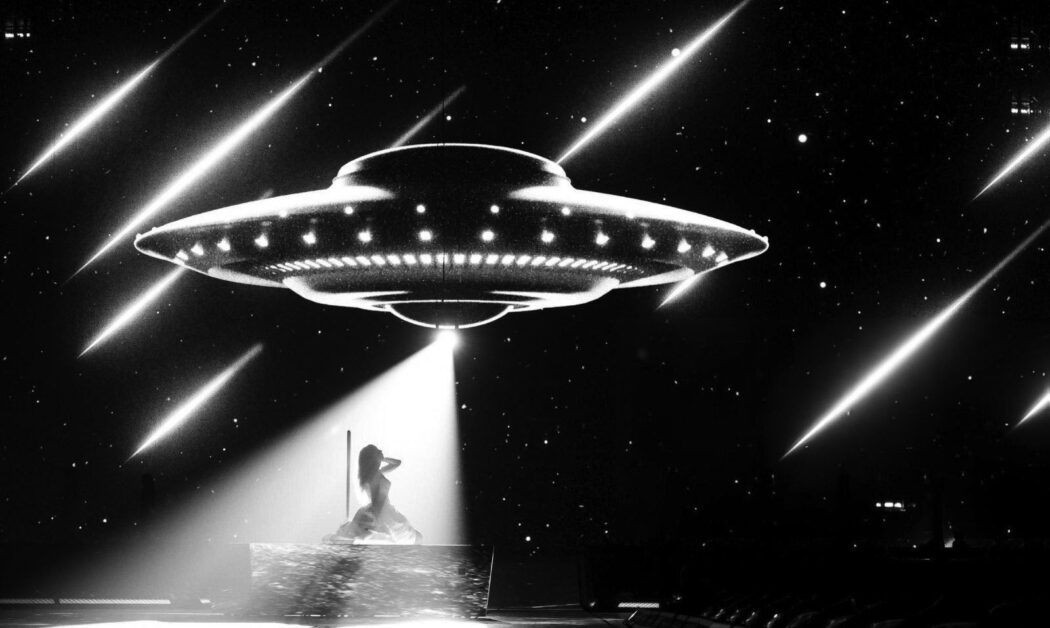
‘Down Bad’ is perhaps the most intriguing of the aforementioned songs, not least on account of the opening section:
Did you really beam me up?
In a cloud of sparkling dust
Just to do experiments on
Tell me I was the chosen one
Show me that this world is bigger than us
Then sent me back where I came from
For a moment I knew cosmic love.
In keeping with the Disneyfied sci-fi experience they depict, these lines are sung to a minimalized ambient musical loop, with gentle synthesized vibrato effects, akin to the wavy screen of a dream sequence, which abruptly cuts with a musical drop to ‘Down bad crying at the gym’. How should we understand this opening section?
According to Swift’s own account of the song, in her track-by-track commentary on The Tortured Poets Department, the alien abduction narrative is a metaphorical way of describing the fleeting intensity of an amorous liaison (she speaks of the song’s character being ‘love bombed’ and abandoned). Yet the extended metaphor allows in other, suggestive resonances as well. Swift has herself endorsed this sort of interpretive divergence in affirming the polysemic amenability of her lyrics to the listener’s personal appropriation—that is, what we might call their ‘mirrorball’ quality. In the ‘Foreword’ to 1989, for example, she writes: ‘These songs were once about my life. They are now about yours’; and after The Tortured Poets Department was released, she wrote on Instagram ‘And now the story isn’t mine anymore … it’s all yours’. In the words of Paul Ricoeur, her songs have a ‘semantic autonomy’, in that they escape their author’s intentions and control, which liberates a ‘surplus’ of possible meaning8—which in Swift’s case is peculiarly fruitful, given the generative underdetermination of her lyrics. So, what other resonances do the metaphorical sections of ‘Down Bad’ elicit?
Not surprisingly, given the focus of this essay, I want to suggest that these metaphorical imaginings allow a sense of epiphanic or revelatory experience into her description of the romantic affair. There are several aspects of the song that invite this reading.
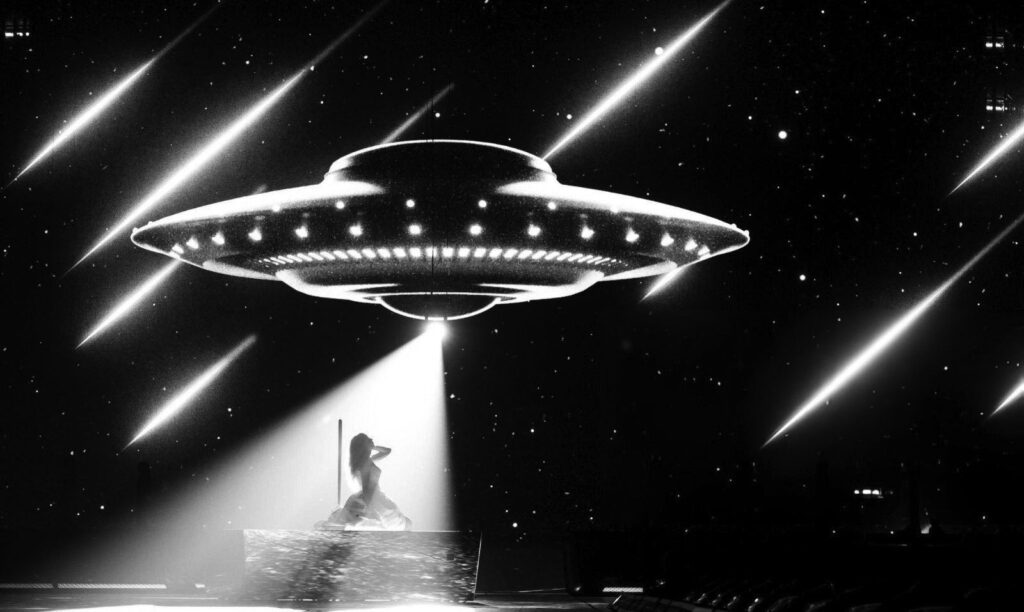
Firstly, although it is conveyed in a cartoon manner, involving a teleportation beam and ‘a cloud of sparkling dust’, the lines describe a fleeting ecstatic experience of transcendence. This textually conveyed experience is also performatively underwritten by the quivering stasis of the ambient music, which evokes a discontinuous temporality or a dilated moment out of time. Secondly, the experience of transcendence, as the song presents it, engenders a profound expansion of vision that alters how the speaker sees the world and humankind’s place in it. Thirdly, as the established sequence of chords is suspended by the music’s ‘extrametrical’ hovering, and time seems to stand still, the speaker tells us in a dazed manner that the experience involved the disclosure of a sort of ‘higher’ love, which is described in a strikingly depersonalized way, as though it went beyond a relationship with an individual (‘For a moment I knew cosmic love’). It is also finally worth noting that this miniature ‘space opera’—and the subsequent trance-like recollection sequence—is presented as an I-Thou encounter (with a mysteriously unidentified ‘you’), whereas the ‘down bad’ sections are narrated from an I-It perspective, which further accentuates the portrayal of the former as a fugitive but elevated epiphanic moment.9
On the face of it, the second fantasy or ‘visionary’ sequence, in which the music is again pared back to a pulsing stillness and the speaker addresses the otherworldly ‘you’, appears to fit less neatly with this epiphanic reading. In particular, whilst the final two lines support this interpretation (‘They’ll say I’m nuts if I talk about the existence of you’ is perfectly poised in its openness to divergent readings, as is the enraptured recollection of being ‘heaven struck’), the reference to the speaker’s clothes being taken seems to steer the narrative in a direction that lacks a spiritual or epiphanic parallel:
Did you take all my old clothes?
Just to leave me here naked and alone
In a field in my same old town
That somehow seems so hollow now
They’ll say I’m nuts if I talk about the existence of you
For a moment I was heaven struck
Yet I wonder if there might not be certain parallels here, too, which are suggested by the generality of the first line’s phrasing ‘Did you take all my old clothes’, since the idea of being divested of one’s ‘old clothes’ is a traditional way of speaking about a radical change in one’s mode of existence (in Ephesians, for example, Paul speaks of ‘putting off’ clothing as a way of describing a personal transformation and the setting aside of an old way of life). Swift’s lines might thus be read as metaphorically referring to the shedding of an old self, as a result of a radically transformative event, in light of which quotidian experience—without the involvement of this otherworldly ‘you’—‘seems so hollow now’. Here is how Martin Buber describes the aftermath of such epiphanic moments:
the moments of the Thou appear as strange lyric and dramatic episodes, seductive and magical, but tearing us away to dangerous extremes, loosening the well-tried context, leaving more questions than satisfaction behind them […].10
In ‘Down Bad’, the lack of satisfaction is swearily clear. However, the rest of the foregoing epiphanic reading needs to be put into perspective; for what I am suggesting is much less pronounced and much more tentative—which is that, wittingly or not, in describing the romantic liaison in otherworldly metaphorical terms, Swift discreetly accords it a spiritual dimension, which aligns it with her other songs in which the religious and the erotic are interwoven.
*
My primary aim in this compressed essay was to highlight the surprising prevalence of religious references in Swift’s writing, whilst acknowledging that her engagement with such subjects is rarely central, straightforward or wholly affirmative. By way of conclusion, I want to say something briefly about the value of ‘minor’ engagements with religion. This appears to be necessary, as Swift has been severely criticized online by religious commentators for writing such ‘adulterated’ songs, in which sacred and profane things are intermingled—the implication being that it would have been better either to write cloudlessly secular pop or hygienicized Christian Contemporary Music.
Yet it seems to me that Swift’s inchoate and un-tidied-up engagements with religion are valuable because whilst singing about such things as love, sex, sexism, trauma, grief, aging, addiction, longing, loneliness, enmity, self-loathing and hope, she wonders about God, transcendence and guilt. Which is to say, into the midst of quotidian experience—which for so many is a sphere of unsundered secularism—she subversively brings thoughts and questions about religion.
This sort of subversive stirring of the ‘minor’, which constitutes a form of resistance and creates the potential for new lines of flight, has been championed, amongst others, by Deleuze and Guattari; though this defence of the disproportionate value of the ‘minor’ also has another source: the widow’s mite, the mustard seed, and the small cloud, no bigger than a hand, rising over the sea.
All concert images taken by Eva Rinaldi Photography and licensed for public use under the Creative Commons Attribution-Share Alike 2.0 Generic license. Images taken from WikiCommons.


.jpg)