
Whether viewers of DreamWorks’s iconic film The Prince of Egypt notice its rich take on the story of Moses depends on how the movie was encountered: was it a part of religious instruction in Sunday School or enjoyed among friends after school? Does the viewer come from a religious, and if so Jewish or Christian, or secular background? These and any number of other factors shape how the Hebrew Bible comes alive in the film. Amidst the stories explored in the movie, there is a scene that strikes me every time I consider it: the burning bush. In this episode, God gives a metaphorical paradigm for his own self-revelation: fire. Fire is a motif used throughout the Scriptures, and this investigation will be anchored in the burning bush explicated through The Prince of Egypt and the work of Martin Heidegger and Abraham Joshua Heschel. Fire is not an extensive or exhaustive picture of God’s revelation, but it powerfully shows how God’s self-revelation is generative through its enmeshing of absence and presence, hiding and revealing.
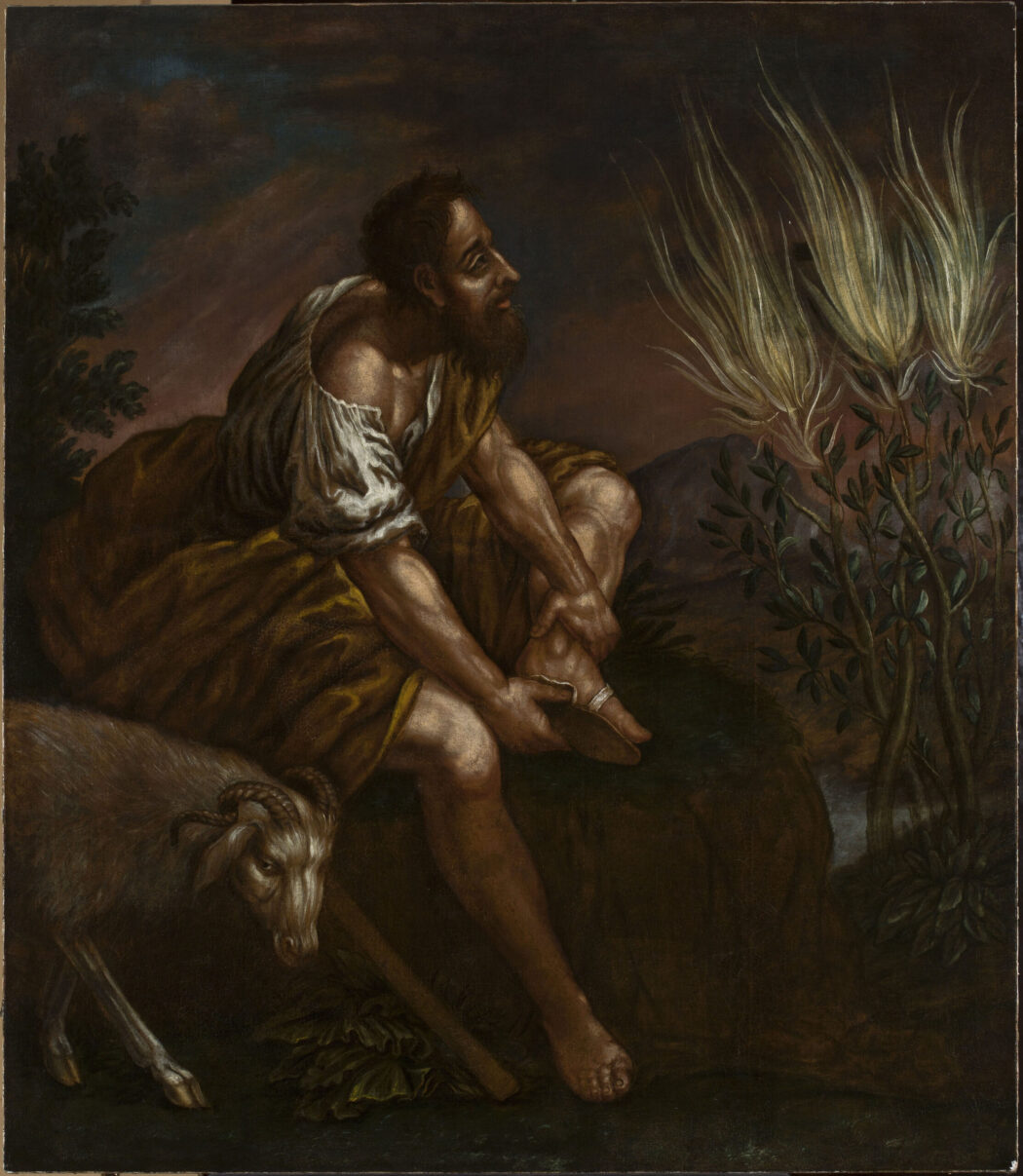
Exodus 3 tells us that Moses encountered an ‘angel of the LORD’ while tending a flock of sheep on Mount Horeb, ‘the mountain of God’.1 After turning his attention to the ‘marvelous sight’ of the ‘bush that is not burning up’, Moses hears the address of God and responds ‘here I am’. Little does Moses know that, by the end of his encounter, Yahweh, the eternal ‘I AM’, will commission him to rescue the people of God from captivity in Egypt. The story remains one of the few examples of common biblical knowledge, so it is easy to become overly familiar with the radicality of a God described as ‘consuming fire’, both in Hebrews 12 and Lamentations 2, revealing himself through a static un-consumptive flame.
In The Prince of Egypt, the dynamism of the event is at play in the bush itself, the voice addressing Moses, and the auditory memories and prophecies shown to Moses. The fire, in accord with what we discussed above, is present surrounding the bush but does not consume it. After being beckoned by a whisper, Moses sees the bush with a single flame around it. A ‘still small voice’ whispers Moses’s name. Initially, it seems that the voice is coming from all around him. As he turns to hear, he realises that the fire itself is speaking. After drawing near to the flame, it addresses him in full voice as the ‘I AM that I AM’. As God speaks, the flame brightens and flickers to match the rhythms of God’s voice. In this visual and auditory dynamic, God reveals himself through flame, voice, and the space between them.
Further, as the voice of God resonates loudly in Moses’s ears and causes waves in the sand, the whisper remains. God’s voice does not cease to whisper as it speaks to Moses; it remains quiet and grows louder simultaneously. As God manifests his presence, he speaks through two distinct but unified voices. Each inflection is unique and fulfills a distinct purpose, framing the address as occurring across and within two distinct boundaries. In this, much like the fire encompassing the bush itself and the interrelation of fire and voice, it is the univocal intent of God in the contrasting, even contradictory, expressions that constitutes the event as an encounter with the ‘I AM’.
Interspersed between God’s speech are soundbites from Moses’s experiences—cries from his siblings, the crack of whips, and a foreshadowing of his ministry to come, notably the ‘let my people go’ uttered before Pharoah. God is showing his presently visible but eternally original plan to Moses through both memories and projections. In God’s self-revelatory event, the limits that bind human perception, namely time (the memories and prophecy) and space (the fire and the voice), are collapsed by God in a movement of dynamic revelation. In a conclusion more akin to Job than Exodus, God responds to Moses’s doubt with a question of his own: ‘Who made man’s mouth? Who made the deaf, the mute, the seeing, or the blind? Did not I? Now go!’ From here, Moses is brought into the fire of the bush itself, which expands as God promises to be present with Moses and ‘smite Egypt with all my wonders’. The scene in the film ends with the bush silenced and God’s engulfing presence departed, leaving Moses to fulfil his mission from the ‘I AM that I AM’, the living God who goes behind, with, and before him.
“Taken together, these two authors reveal that the encounter with reality is both ontologically (Heidegger) and theologically (Heschel) dynamic and invitational.”
What does the episode of the burning bush, originating in Exodus and interpreted by Prince of Egypt, tell us about God and fire? Two profound voices from the twentieth century help to illuminate the dynamics of God’s presence at play in the burning bush: Martin Heidegger and Abraham Joshua Heschel. Although the former is under great scrutiny for his affiliations with the National Socialists in Germany and the latter is one of the paradigmatic Jewish intellectual voices of his generation, these two thinkers taken together helpfully elucidate the eventfulness of God’s self-revelation. Heidegger’s descriptions of truth’s revelatory function help show how encounters with truth and reality are profoundly generative in their dynamism. Heschel helps us to see that experiences of God’s presence are dynamic by virtue of God’s self-revelation in time as the one who both exceeds and grounds it. Eternity welcomes the finite and temporal into fellowship in the human encounter with God in Heschel’s vision of ‘Sabbath’, a ‘holiness in time’.2 The witness encounters God’s essential dynamism in the blurring, expansion, and occasional explosion of categories common to the human experience. Taken together, these two authors reveal that the encounter with reality is both ontologically (Heidegger) and theologically (Heschel) dynamic and invitational.
For Heidegger, at least in his earlier career, truth is not a category where discussions of facticity occur, but an unveiling of reality itself. In ‘On the Origin of the Work of Art’, he argues that truth itself operates in works of art. Art unveils the essence of things, and this revelatory act is itself truth. Accordingly, art does not reveal truth, it is truth. This move derives from the etymology of the Greek word for truth itself: aletheia. In rough literal approximation, it is the ‘negation of those things which stand in the way’. Heidegger calls this ‘unconcealedness’.3 Truth is an act of revelation, the shining through of the ontological depth of things manifest in the encounter of the audience with the thing itself. In a work, Heidegger’s term for art and other localisations of truth, ‘[things] stand in the light of their being’.4
God’s presence as the burning bush, the meeting of eternity and time in the unending flame which exists without destruction, grounds a vision of history that is eventful. Heidegger himself argues that time is not a purely linear process but the historical motion of truthful events appearing, ‘gathering’ (creating conversations and audiences),5 and ending. History, thus, is the process of humanity’s dynamic engagement with events of revelation. Heschel makes a like-minded point in his book The Sabbath. He says, ‘To Israel the unique events of historic time were spiritually more significant than the repetitive processes in the cycle of nature, even though physical sustenance depended on the latter’.6 Seasons exist, time is real, but they are backdrops for human encounters with God, the ushering in of the timeless into time.
Sabbath, God’s rest after creation, is the eternal rest pictured and expressed in the seventh-day rest of God’s people. This is the ‘climax of living’ for Heschel; it is when ‘all that is divine in the world is brought into union with God’.7 The event of creation, and God’s restful delight in it, is the event from which all reality derives its meaning. The cycles and celebrations of the Jewish people, then, reframe seasonal celebrations and re-ground them in events in their own history; Spring and harvest festivals came to mark the Passover and the giving of the Commandments at Sinai.8 God’s consecration of the Sabbath is the archetype of this phenomenon. On the Seventh Day, God made a way for the finite to join with the infinite. For Heschel, this ‘holiness in time’, is both creational and personal; it anchors and directs humanity’s fellowship with God.9 The event of God’s revelation, paradigmatically in his post-creational rest and recurrently through his relationship to the people of Israel, structures the fabric of human history.
Truth is a happening, a revelatory event that shapes the world around it. The event of the burning bush is a unity of revelation and concealment in generative and dynamic tension. Evident in both Prince of Egypt and the Exodus narrative, there is a dynamic of God’s presence and absence at play. God, through the angel of the LORD, is truly present as the fire in the bush and the voice which speaks to Moses. However, God’s revelation as fire highlights the tension present here: God’s presence as fire and voice is equally demonstration and restriction of his power and character. Prince of Egypt highlights this by having the earth shake and the bush’s radiance explode after Moses doubts his sufficiency to complete his mission. The fire does not consume the bush, which is contrary to fire’s fundamental redistribution of atoms and molecules for sustenance, yet it is truly, as the Scriptures say, a fire. It is in unified though contrasting voices, God’s going forth in speech and remaining distant via whisper, that God speaks. God shows his own work across Moses’s life in a single dynamic event bringing past, present, and future together.
Rather than being accidental, it is in the unity of discrete and oppositional functions, whisper and shout, past and future, that foreground the dynamism of God’s revelation to Moses. Who but God could speak in two voices, fuel a flame without fuel, and reveal decades of time in a single moment? Who but a God who delights in communion with humanity would bridge such gaps in communication with humanity? This God is the ‘I AM that I AM’.
This inbreaking of God reflects the essential and necessary dynamism at play in his self-revelation. God is as truly present in the restricted fire of the bush and the light that threatens to blind Moses. It is equally God’s voice in the ethereal surrounding whisper and the direct powerful address of the bush. God’s presence in the space between radiance and repose is helpfully explicated using Heidegger’s framework for truth as a revelational event. Humanity meets God as dynamism per se, the ultimate event of revelation paradigmatic for the encounter with truth. It is in the inter-conditioned interplay of God’s self-revelation and hiding, accommodating and elevating, coming and going, that man encounters Yahweh. This dynamism is not impersonal; it is merely the condition through which finite persons encounter the infinite Trinity. It is what Jean-Luc Marion calls ‘saturated phenomenon’, where the appearance of a thing as itself ‘exceeds the categories and the principles of the understanding’.10 This revelation necessarily precedes and goes beyond the appearance and its horizons.11 God’s revelation is the dynamic excess of his own appearance. God’s Word is living and active not in abstraction or spirit alone, it is sharp and penetrating as a generative record of God’s revelational dynamism.12
From the event of the burning bush, Moses begins his journey to free the Israelites. From God’s whisper after the fire and the earthquake, Elijah continued to prophecy. From the revelation of Christ at the Transfiguration, he and his students journeyed towards a death and resurrection that would set the world aflame. From the crowns of fire above the Apostles at Pentecost, the Church began to expand in a manner that no hellish fire could stop. These events, these moments of God’s inexhaustible depth shining forth structure salvation history.13 The Church’s calendar is defined by Pentecost, Easter, and Christmas. By marking her days by God’s appearing, she joins with Jewish believers in treating time as a backdrop and outgrowth of God’s self-revelation. Such activity generates the gathered worship found across the globe today, which stretches back to Creation and forward to the Eschaton. To meet God is to meet him in-between. It is to be surrounded by a God hidden in visibility, to be looked at and along as if a bush aflame.