In this essay, Josh Larsen reflects on the ecological, theological, and eschatological dimensions of one of Italy’s most famous buildings, asking how it is both a harbinger and partial or penultimate sign of the world to come, a world made new.
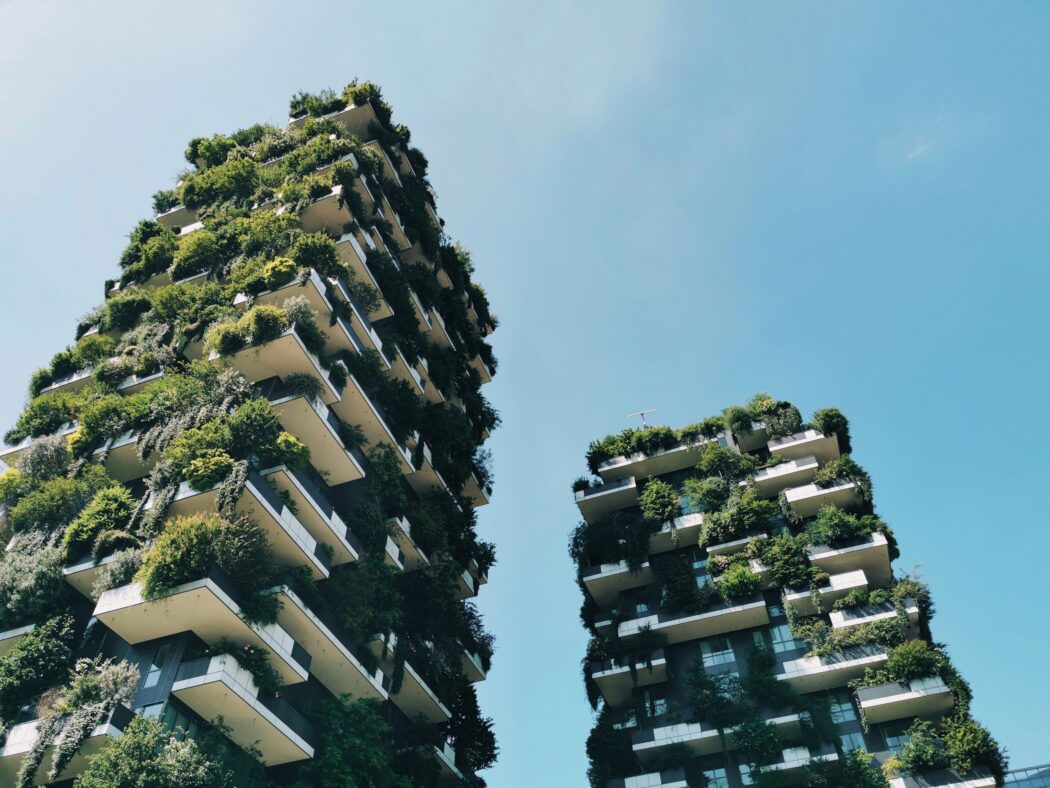
Rising high in the metropolis of Milan, Italy are twin residential towers unique to the world of skyscrapers: Bosco Verticale (Vertical Forest), completed in 2014. The buildings’ signature features are their balconies, which have been designed and constructed to support not only plants and shrubs, but trees—including trees up to three stories high. The effect, even in photographs, is startling, whether you walk among high-rises every day or have never seen one in person. Greenery isn’t supposed to exist in quite this way. Neither are buildings.
Bosco Verticale was designed by Stefano Boeri Architetti (Stefano Boeri, Gianandrea Barreca, Giovanni La Varra). On the firm’s corporate website, the structure is touted as ‘a model of a green residential building, a project for metropolitan forestry contributing to the regeneration of the environment and urban biodiversity without expanding the city’s footprint.’1 In a sense, the project is a contemporary demonstration of the intimate connection between architecture and the natural world noted by John Ruskin in the mid-19th century:
I have always considered architecture as an essential part of landscape; and I think the study of its best styles and real meaning one of the necessary functions of the landscape-painter; as, in like manner, the architect cannot be a master-workman until all his designs are guided by understanding of the wilder beauty of pure nature.2
In Bosco Verticale, an opportunity arises to not only consider architecture and ‘pure nature’ in uniquely intimate proximity to each other, but to also explore the theological implications of that nearness. ‘The earth brought forth vegetation, plants yielding seed according to their own kinds, and trees bearing fruit in which is their seed, each according to its kind. And God saw that it was good’ (Gen. 1:12, RSV). Humankind came shortly thereafter and, for a time, was also deemed ‘good.’ In the wake of the Fall, what do we make of our place—and our making of place—amidst the vegetation of today?
Eden Imagined
No mere green roof, Bosco Verticale hosts across its two buildings a total of 800 trees, 4,500 shrubs, and 20,000 plants. Each unit has space for at least two trees, eight shrubs, and 40 plants. Stefano Boeri Architetti’s vision for the project is stated in bold terms, with ambitious claims of its environmental benefits. Described as a ‘self-contained ecosystem,’ Bosco Verticale ‘offers significant benefits in terms of fine dust and CO2 absorption, oxygen production, optimization of water management, reduction of noise pollution, and improvement of the life quality—for humans, plants, and animals.’3
Such language echoes recent theological considerations of how humanity and nature might coexist. Reflecting on Pope Francis’ 2015 encyclical letter Laudato Si‘, theologian Denis Edwards proposed the notion of ‘sublime communion’, saying, ‘Francis makes the fundamental point that we humans ought not to think of ourselves as relating to nature as if we were separate from it (LS 139)’.4 In Laudato Si‘, Francis not only uses the term ‘ecosystem’ twenty-five times, he also discusses the same environmental realities that Bosco Verticale proposes to address: carbon-dioxide production, water usage, and the loss of biodiversity.5
What is being described by both Francis and Stefano Boeri Architetti is a reimagined Garden of Eden. The author of Genesis chose to describe God’s original creation as a garden: ‘And the Lord God planted a garden in Eden, in the east; and there he put the man whom he had formed. And out of the ground the Lord God made to grow every tree that is pleasant to the sight and good for food, the tree of life also in the midst of the garden, and the tree of the knowledge of good and evil’ (Gen. 2:8-9). Bosco Verticale—as architecture and theology—aims to be ‘pleasant to the sight’ (Gen. 2:9) by way of a ‘new format of architectural biodiversity,’ one which represents a ‘sublime communion’ between nature and humanity, as intended by the Creator.6,7
In its emphasis on the God-ordained relationship between humankind and the natural world, Bosco Verticale also evokes another key feature of Genesis: the cultural mandate. Originated by Dutch Reformed theologian Klaas Schilder, the term ‘cultural mandate’ references Genesis 1:26-30, where humankind is given ‘dominion’ over ‘every living thing,’ including ‘every plant yielding seed’ and ‘every tree with seed in its fruit.’8 Humanity is told to ‘Be fruitful and multiply, and fill the earth and subdue it . . .’ (Gen. 1:26, 28-29). In Created and Creating: A Biblical Theology of Culture, William Edgar offers a reading of the cultural mandate as it relates to flora and fauna. ‘Human dominion,’ Edgar writes, ‘is meant to be a form of caring responsibility over God’s creatures.’9 How is this a mandate? ‘Although the finished creation was “good” and “very good,” ruling and subduing were still a necessary part of directing the history of the world. At the most elementary level, tilling the earth and accepting God’s gifts of plants, trees, and animals requires labor and wisdom (Gen 1:29-30).’10 For Edgar, then—following Edwards’ reading of Laudato Si’—a design for human habitation in line with the cultural mandate would look something very much like Bosco Verticale.
How does Bosco Verticale encourage this? In a standard high-rise building, particularly those designed for residential use, optimizing the view from each unit is a priority. In contrast, surveying the interiors of the units in Bosco Verticale reveals that, while expansive views still exist, they are frequently limited, if not blocked, by the plants, shrubs, and trees on the unit’s balcony. Flora has an equal footing with—and in some cases, even priority over—human perspective.11 Introducing the collection Being-in-Creation, scholar Brian Treanor describes a similar dynamic: ’Being at home in the world requires a certain way of being that recognizes our creatureliness: its powers and limitations; its freedoms as well as its dependencies (including the dependence on an almost incomprehensibly complex web of relationships); its capacities and its vulnerability; and its transcendent yearning alongside its inextricably earthy and animal nature.’12 If the Garden of Eden was God’s way of placing humanity ‘at home in the world,’ Bosco Verticale can be seen as a contemporary attempt to do the same.
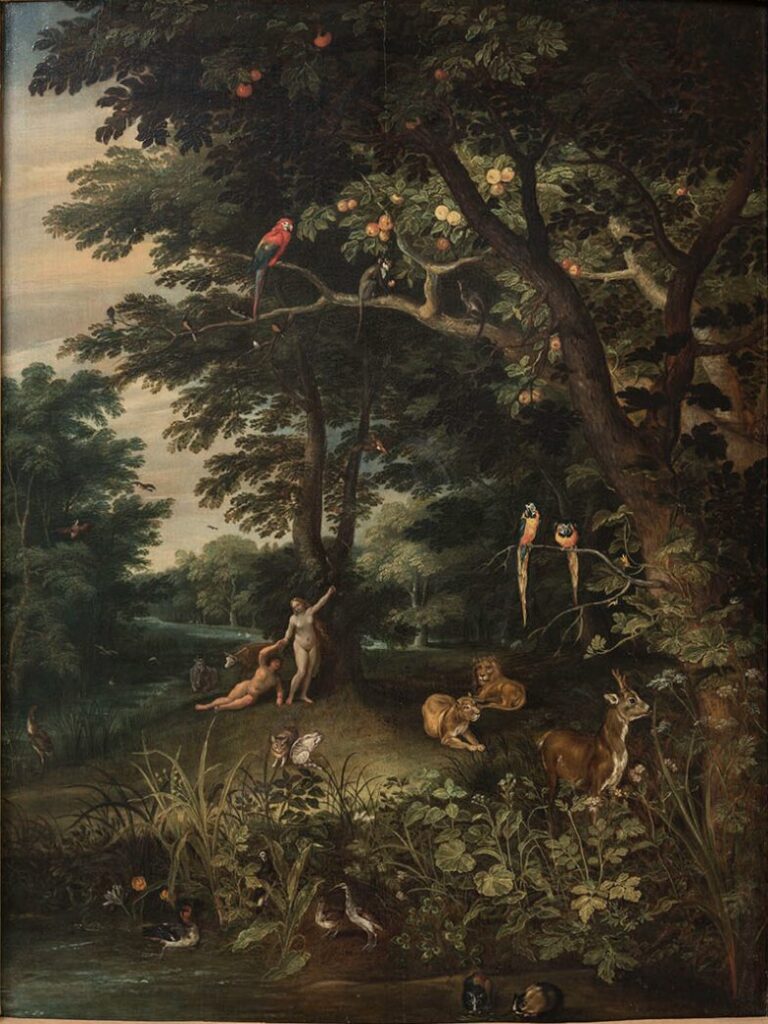
Adam and Eve in the Garden of Eden by Jan Brueghel the Younger
Eden Unfulfilled
The challenge, of course, is to realize such an Edenic vision in a postlapsarian world. After all, Bosco Verticale exists not in Genesis 1 or 2 but Genesis 3, after Adam and Eve had been expelled from paradise ‘to till the ground from which he was taken’ (Gen. 3:23).
Upon its completion, Bosco Verticale was initially recognized as something of a paradisiacal project. In 2014, the structure won the International Highrise Award.13 A year later, the Council on Tall Buildings and Urban Habitat chose Bosco Verticale as the Best Tall Building Worldwide, selecting it over the One World Trade Center in New York City, New York.14 By the time of a 2025 revisit of the project in The Architectural Review, however, significant criticisms had emerged. Describing Bosco Verticale as a ‘relic of neoliberal climate optimism,’ the article noted that significant scientific evidence of the project’s environmental benefits had not yet been produced and that the interior design of the units failed to work in aesthetic concert with the exterior elements.15 What’s more, The Architectural Review pejoratively placed Bosco Verticale within the context of the ‘uncontrolled urban expansion’ that was taking place in Milan, noting that it was part of a massive 2006 development plan, Porta Nuova, that rezoned a former industrial area for residential and commercial construction.16 The development rush continues in Milan today, described in The Wall Street Journal as a ‘push to develop high-end housing [that has] also led to a sprawling corruption probe,’ one that currently involves ‘more than 70 officials, developers, architects and others for alleged bribery, violations of permitting rules and other irregularities . . .’17 Can a newly imagined Eden arise from contaminated soil?
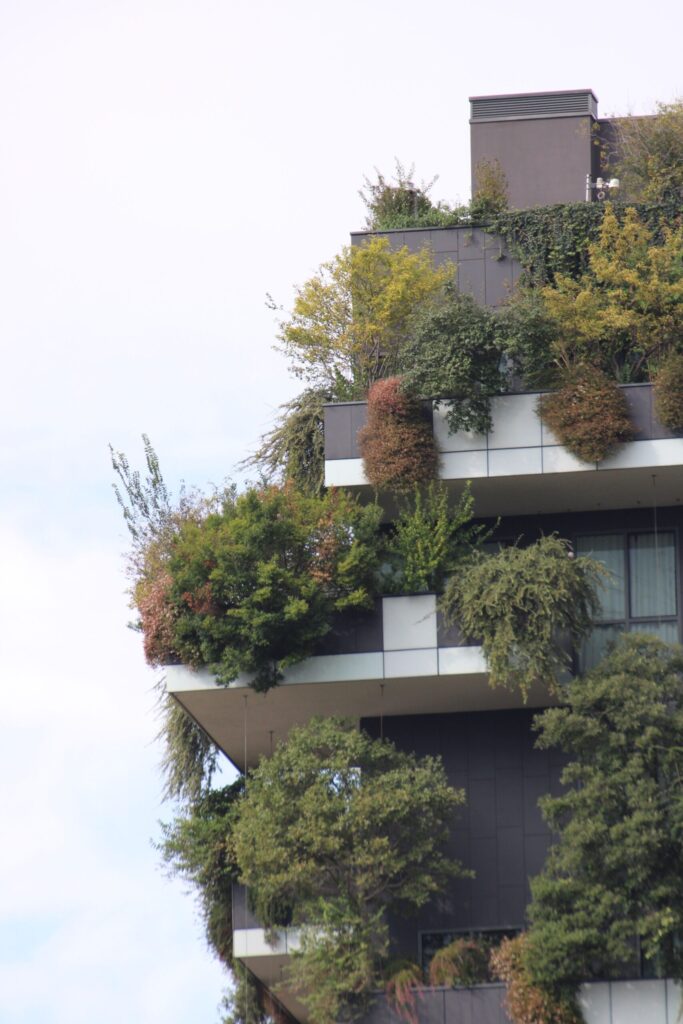
Returning to the notion of the cultural mandate, the maintenance of the building’s greenery raises further questions about its Edenic qualities. Tenants are not allowed to modify, remove, or replace any of the trees, shrubs, or plants. Any horticultural work required is performed by contracted ‘flying gardeners’ who scale the facade, while others tend to the greenery from the unit balconies. Even the irrigation is centralized and managed remotely.18 The cultural mandate seems to be set aside, considering notions of caring responsibility have been taken out of the residents’ hands. What is lost in such a scenario? Reduced to passive observers rather than caretakers of a marvelous place, the residents of Bosco Verticale experience a thin version—if any version at all—of Edwards’ ‘sublime communion.’
Eden Unfolding Anew
Even so, might there be ways that Bosco Verticale carries positive theological resonance? One possibility lies in John Chryssavgis’ understanding of the Earth as sacrament, which contends that the ‘incarnation, crucifixion, and resurrection of Jesus Christ have effected a re-creation of the world.’19 Every leaf that unfurls, then, can be seen as a symbol of this re-creation. Chryssavgis continues: ‘In a sense, the Genesis account of creation can be understood only in the light of the resurrection “that enlightens every person coming into the world” (John 1:9).’20
In this context, Bosco Verticale carries an eschatological quality. Its unfolding greenery—especially keeping in mind that the unfolding is taking place in a new way, on the side of a high-rise, no less—points to the New Creation that is already underway. Chryssavgis relates recognition of the New Creation to Orthodox liturgy, saying: ‘. . . on Good Friday, the Orthodox liturgy sings: “All the trees of the forest rejoice today. For their nature is sanctified by the body of Christ stretched on the wood [of the cross].” And on Easter Sunday the celebration reaches a climax: “Now everything is filled with the light [of the resurrection]: heaven and earth, and all things beneath the earth.”’21
In remarks given at the 1933 dedication of a house in Potsdam, Paul Tillich noted ‘the way space is filled in the vegetative sphere, in the being of plants, where the fulfilment is elevated to an evolving, or unfolding.’22 When incorporated into a building as intimately as it is with Bosco Verticale, the vegetative sphere’s ‘fulfilment’ overflows and intertwines with the everyday human experience. Indeed, it happens all around the resident enjoying their morning coffee on the balcony, despite their (non) efforts and perhaps at the expense of their view. Looking closer, that resident will witness a slow and steady growth that points to both the Eden that was and the Eden that is ahead.
Could this eschatological quality partly explain the sense of wonder that accompanies even a glimpse of Bosco Verticale? Perhaps it is not only the project’s singularity among the architectural typology of residential high-rises that transfixes, but also its ability to convey a sense—however limited by the ‘now’—of the ‘yet to come.’ If this is the case, it is worth noting that such an experience is available not only to those who can afford to live in one of the two buildings, but also to anyone who might pass by on the street—or even ‘see’ them via the Stefano Boeri Architetti website. It is a widely available vision not of Milan, but the New Jerusalem, displayed not only for the luxury class but for ‘a great multitude which no man could number, from every nation, from all tribes and peoples and tongues . . .’ (Rev. 7:9).
Considered in the light of a text such as Genesis, Bosco Verticale offers something beyond the natural ecosystem its designers envisioned. In describing the structure as Eden imagined, undone, and unfolding anew, something like a ‘spiritual ecosystem’ emerges. In such an environment, immanent architectural plans and intentions feed a religiously transcendent experience. For humans who hold imago Dei, such an ecosystem speaks to distant memories of Eden as it existed, present sorrow over our inability to uphold the cultural mandate, and deep, eschatological hope in the New Creation unfolding before us in every blossom and bud.
https://www.vatican.va/content/francesco/en/encyclicals/documents/papa-francesco_20150524_enciclicalaudato-si.html. ^
16, 2025, https://www.stefanoboeriarchitetti.net/en/news/bosco-verticale-wins-the-international-highriseaward-2014/. ^

