An Introduction to our Autumn Series
By Brendan Wolfe and Madeleine Meyer
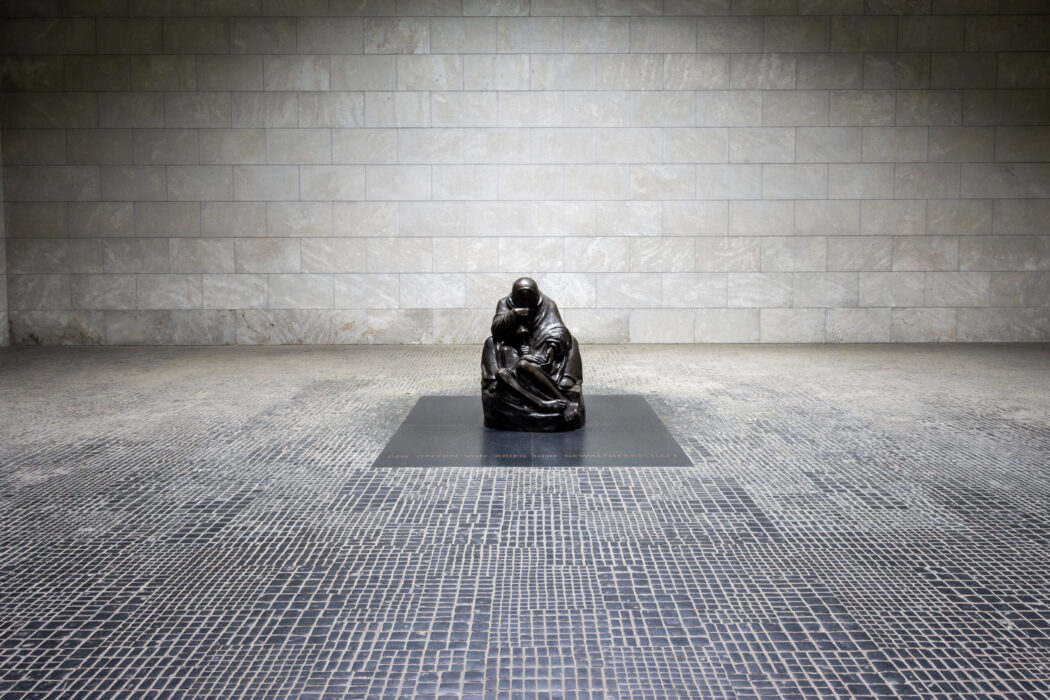
To commemorate 13,000 Soviet soldiers buried in Berlin after the city’s capture in 1945, the officially atheist Soviet state constructed a memorial whose visual and textual language draws heavily from Christian tradition. At its centre, a statue of the corpus of a Soviet soldier is joined by a standing personification of the Motherland, unmistakably evoking the Pietà. Around it, inscriptions include the injunction to uncover one’s head, descriptions of the soldiers as ‘in eternal rest’, and the statement that their ‘love of homeland and devotion to their people were stronger than death’. The result is a striking example of a broader phenomenon: the deployment of Christian symbols and narratives by individuals, movements, and institutions that stand outside the Christian faith itself.
Christianity has supplied much of the symbolic vocabulary through which Western societies have represented suffering, sacrifice, hope, judgement, transcendence, and redemption. The richness of the Christian aesthetic tradition has also attracted artists from non-Christian or post-Christian contexts. Yet relatively little attention has been paid to what happens when these symbols are detached from their original theological frameworks and redeployed in new artistic, political, or cultural contexts. With those appropriations in mind, researchers here hosted a conference titled Religion from the Outside in June 2026. Led by Brendan Wolfe and co-organized by Madeleine Meyer, Religion from the Outside sought to explore how Christian symbols are reinterpreted, reframed, and redeployed in non-Christian settings across literature, music, visual art, film, television, and digital media, as a first step in a larger programme of research towards a typology. The conference addressed questions arising from Dr Wolfe’s research in the earlier Text & Image and Art as Revelation projects concerning the ways in which artistic forms shape perception, imagination, and the relation between artwork and viewer.
To invite the wider Transpositions community into this conversation, a selection of papers from Religion from the Outside will be published here in the coming months. Together, they demonstrate some of the various ways in which artists have appropriated and redeployed Christian imagery and already suggest several recurring modes in which Christian symbols function outside explicitly Christian contexts.
Christian Symbols as an Aesthetic Resource
One such mode is the use of Christian symbols as an aesthetic resource. Aidan Hart’s paper on Kandinsky and Brancusi shows how both artists pressed at the boundaries of their respective art forms by drawing upon elements of the Orthodox tradition, including transfigured light and the understanding of the material world as symbol. Christina Eickenroht, writing on Robert Macfarlane and Jackie Morris, considers how Christian iconographic practices can alter habits of perception and imagination. Rebecca Walker considers a related phenomenon in Italo Calvino, whose narrative practice appropriates theological functions in a form of what might be called “atheist God-talk” that assists in making sense of reality. In each case, Christian traditions provide more than a collection of recognizable images: they offer aesthetic resources capable of reshaping how the world is perceived.
Spiritual Experience and Repurposed Language
Spiritual experience provides a second context in which Christian language is repurposed. Gracie McBride and Adeline Heck argue, in their respective papers on musical theatre and the Bayreuth Festival, that Christian language and symbolic forms are essential to understanding the experiences these settings seek to create. McBride’s analysis of Gospel music and Heck’s account of Bayreuth’s visual culture show how Christian forms can contribute to ecstatic or quasi-spiritual experiences even outside ecclesial settings. Their papers suggest that the continued use of Christian symbolism cannot always be explained by cultural inheritance alone: at times, artists and audiences turn deliberately to Christian forms because of their perceived capacity to express transcendence.
Christian Images as Existential Questions
Artists have also used Christian symbolism as a means for theological wrestling. In some cases, this manifests itself as a form of exploration that does not demand an answer within the boundaries of Christian orthodoxy. Ian DeGroot shows how Christian imagery enables Wes Anderson’s film The Phoenician Scheme to address suffering within a postmodern framework and to explore the limitations of that framework. In other cases, appropriation becomes critique or inversion. Andrew Birch and Kieran Collery examine, respectively, Francis Bacon and Russian prison tattoos, showing how recognizably Christian imagery can be retained even as the theology of grace to which it traditionally points is emptied out or transformed. Adelaide Hannum similarly considers how Neon Genesis Evangelion deploys Christian symbols while questioning or displacing the soteriological meanings conventionally attached to them. Finally, David Brown shows that art popularly deemed “blasphemous” can actually shock us into reconsidering certain theological understandings. Together, these examples demonstrate that there are diverse ways in which artists from outside the Christian tradition borrow from the load bearing capacity of Christian imagery and grammar to participate in theological questioning.
Inherited Language as an Interpretive Framework
Finally, several papers show Christian language functioning as a means by which artists interpret and articulate their own experience. Melody Schwarting examines how Ruth Pitter, before her conversion, could employ Christian language imaginatively to approach the experience of faith from a position outside it. Taylor Worley identifies a related dynamic in Robert Gober’s attraction to Christian symbols as resources for confronting paradox, tragedy, and the mysteries of faith. In such cases, Christian symbolism becomes a language where the representations of inherited religious ideas become essential keys for understanding the self and its relation to the world.
Conclusion: The Enduring Life of Christian Symbolism in the World Today
It is evident from this initial sketch of a typology that there is a variety of ways in which artists reuse Christian imagery in their attempts to make meaning and make sense of the world. In doing so, they reveal to theologians much about the weight of Christianity’s symbols as an active influence in the world—and, conversely, the world’s significance in interpreting Christian symbols.
John Henry Newman wrote in his Development of Christian Doctrine that ‘[Christianity’s] home is in the world; and to know what it is, we must seek it in the world and hear the world’s witness of it’. His observation suggests a further reason for attending to Christianity ‘from the outside’.
The appropriation of Christian symbols by those who do not share the beliefs from which they arose is itself part of Christianity’s life in the world. Such appropriations reveal which elements of its symbolic language remain intelligible, attractive, troubling, or powerful when removed from their original confessional settings. The essays gathered here therefore invite attention to the persistence of Christian imagery beyond the Church and to the varied work that imagery continues to perform in art and culture.
Authors
Madeleine Meyer is a researcher and writer based in Atlanta, GA. She studied History at Berry College before relocating to St. Andrews for the Theology and the Arts MLitt. While living in St. Andrews, she assisted in organizing multiple academic conferences, including Art as Revelation’s Religion from the Outside. Her writing interests lie at the intersection of art history, theology, and culture.
Feature Image taken by Mike Peel. This file is licensed under the Creative Commons Attribution-Share Alike 4.0 International license.

