The following reflections explore a few ways in which my discipline as a violinist on gut-strung period instruments facilitates meditation on the Pentecost imagery of rushing wind and flame, connoting movement and emanation, respectively. This imagery represents a God who, like Moses’ burning bush, blazes without consuming, contingent on nothing—and yet, unlike Aristotle’s deity, is not unmoved. At Pentecost, Jesus’ disciples are empowered to go and bear witness to this God, whose being moved in spirit by the brokenness of his creation has emanated into act in the incarnation, passion, and resurrection of the Son, the ‘radiance of God’s glory’.1 At Pentecost, the disciples are likewise sent out into a world whose forces, personal and impersonal, operate in ways largely contrary to God’s own.
The present-day form of this world is marked by a certain lack of movement that goes far beyond our increasingly sedentary lifestyles. Our devices feed us both a stressful flood of solitary responsibility and, for relief, a funnel-web of social media that curves us inward on ourselves.2 We lack the space—and, more alarmingly, we often lose the inclination—to exercise the intellectus by which the mind seeks to move beyond the confines of the self in empathetic connectivity with what lies beyond. Perhaps unsurprisingly, we seem to have increasing difficulty connecting the dots between data and concepts we encounter. And at the most basic level of consciousness, our sense of connectivity of motion across space and time rarely escapes rupture by our ubiquitous devices, whether for solitary work or solitary relief (to whatever extent the distinction is ultimately meaningful).
Of course, I do not pretend that such rupture is an entirely contemporary phenomenon. Nonetheless, it is interesting that the digital forces which contribute so significantly to the contemporary extent of this rupture operate according to a paradigm of binary digits that is a perfect foil to the connectivity of which they rob us. It is almost as though we become like what dominates our attention—which should hardly be surprising, given the pervasiveness of this idea in Scripture.3 In any case, the lamentably dehumanising effect of this rupture of connectivity, whether in this or any age, may have something to do with why music can be so medicinal for the soul.
Music affords a profound sense of connectivity at many levels, from the relational (among collaborators or listeners, or between performers and listeners) to the purely sonic (as in the relationship among notes in vivid Baroque gestures or legato Romantic cantilena). In fact, something I love about playing on plain gut strings is the way in which they lend themselves to both vivid gesture and a particularly compelling legato within an earthy vocality that feels to many as though it taps into something mysteriously (and quite literally) visceral. As players and listeners share that experience in common, sonic connectivity fosters relational connectivity through the mysterious bond of music.
How interesting, then, that the Holy Spirit, who binds the Church together in mysterious unity, is described in both name and imagery in terms of wind (ruach/pneuma), the embodiment of motion and thus of connectivity.4 The instrumentalist might almost sense a role as herald, in some small way, of the Agent of creation and new creation, the ‘Lord and Giver of Life’, who stands ontologically opposed to the fragmentation that assails our humanity as bearers of the divine image.5
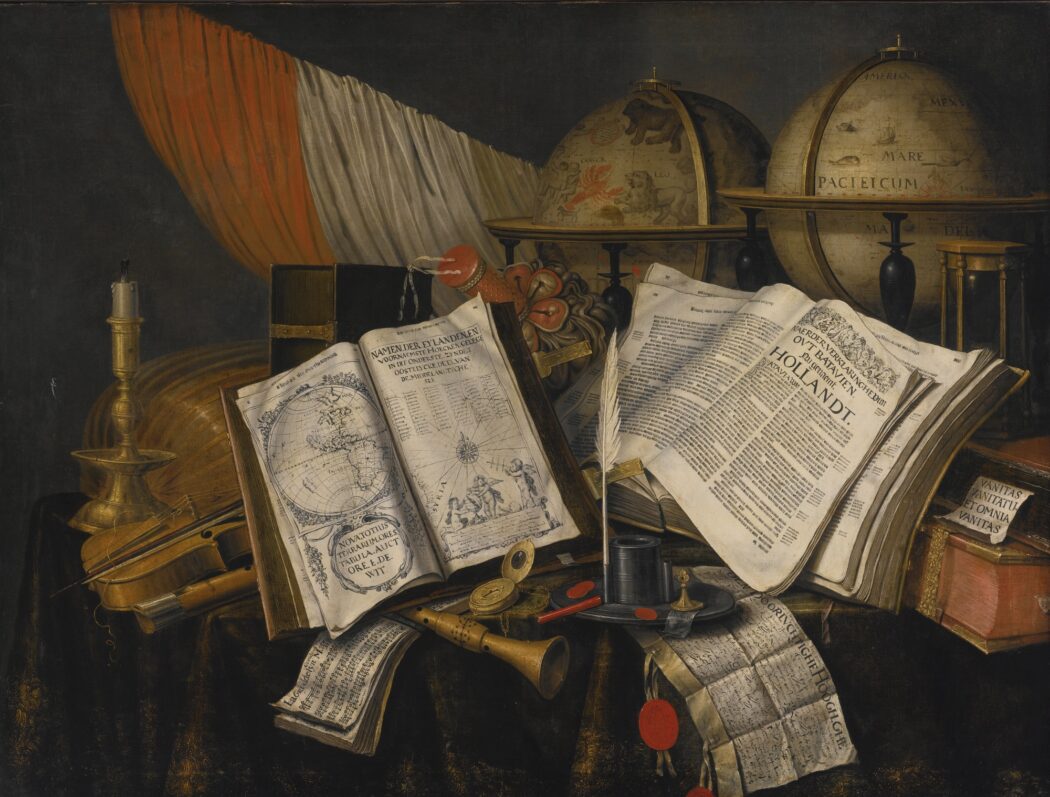
The flame imagery of Pentecost also invites us to consider a transformation of the mortality topos long associated with the broken violin string, as in vanitas paintings. When playing on a gut-strung instrument, one can scarcely fail to notice the humanlike qualities of the medium, not only the pleasing vocality of the sound but also a certain temperamental quality, even downright incorrigibility at times, that is of course rather less pleasing but equally reminiscent of what St Francis would have recognised as ‘Brother ass’.6
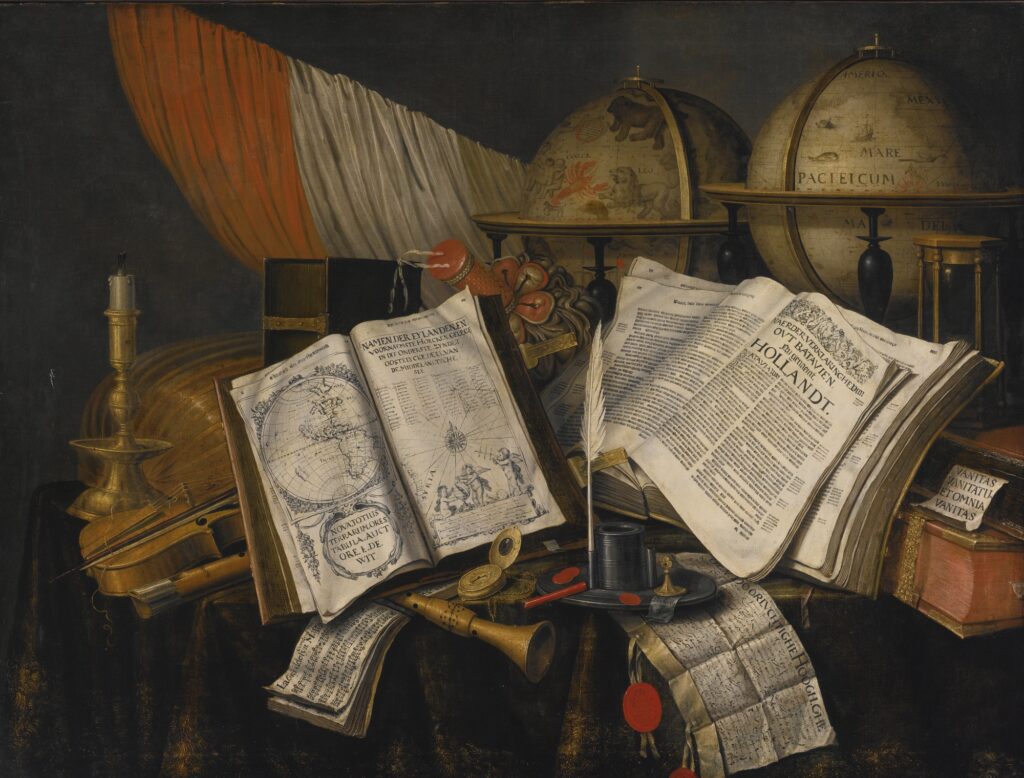
Evert Collier, A Vanitas Still Life (1662)
And then, of course, there is the spectre of mortality itself. While the divine flame of Pentecost or Moses’ burning bush might burn without consuming, we mortals are poured out in our labours. But when we are poured out in service and witness to the gospel, our mortality becomes transfigured flamelike into radiant (or, with a nod to Begbie and Guthrie, resonant) witness.7
Likewise, it is scarcely possible to play a gut-strung instrument without a pressing awareness that the more zealously one plays, or the more all-consuming the thing to which one seeks to bear witness, the more the strings hasten along ‘the way of all flesh’, with the distinct possibility that especially the violin’s thin e-string might startlingly, disruptively, even painfully snap mid-performance.8
But it is especially in these most spirited moments, when musical expression burns brightest, that the mortal ‘life’ of the string is transformed by the emanation of sound-waves into something that outlives itself, a sonic structure that resonates with some aspect of the human experience, which we hold in our minds and hearts after the string’s mortality has run its course: its mortal life is expanded to the compass of our own.
Perhaps this is part of what it means to bear the image of the God in whose bosom we rest when our mortality has run its course, as our life is expanded to the compass of his immortality, through Christ, the radiance of God’s glory, who kindles us not with consumptive conflagration but with the (re)generative fire of life.
. ^