To kick off our autumn series on Religion from the Outside, icon writer Aidan Hart assesses the line of influence — and natural divergences — between Orthodox iconography and the work of Romanian sculptor and painter Constantin Brancusi and Russian painter Wassily Kandinsky.
Most of the founders of twentieth-century abstract art came from Christian Orthodox countries. Is this a coincidence, or did the worldview of the Orthodox Church and its icon tradition inspire their art?
Constantin Brancusi (1876–1957), the father of modern abstract sculpture, came from Romania, while Wassily Kandinsky (1866–1944), the founder of modern abstract painting, came from Russia. To these we might add Kazimir Malevich (1878–1935), Natalia Goncharova (1881–1962), and Igor Stravinsky (1882–1971), a key figure in modernist music.
The extent of Orthodox influence on Brancusi and Kandinsky’s art, if any, begs the question of what extent they were familiar with Orthodox doctrine and iconography.
Brancusi’s exposure to Orthodox life was certainly deep. He told his friend Petre Pandrea that all he had done in Paris was to set up a branch of his homeland’s Tismana monastery.1
According to the biography by Vasile Paleolog,2 Brancusi had ample opportunity to imbibe the Church’s spiritual tradition through his many years from the age of eleven as a church server.3 He was also a chanter while an art student in Bucharest and again in Paris, from 1906 to 1908. The hymns he chanted over these years are profoundly theological and would have influenced his thinking. He was also devout; before departing Romania for Paris in May 1904 he stopped by Tismana monastery to ask a priest’s blessing for his journey and future.4
Although Kandinsky was raised and remained a member of the Orthodox Church, his relationship with it was, it seems, more distant than Brancusi’s. However, the subject-matter of his early paintings drew heavily on Christian themes, such as the Apocalyptic visions of St John, Noah’s Ark, Jonah, and Christ’s Resurrection, as well as icons such as of St George.
The Influence of Orthodox Thinking and Iconography on Early Abstract Art
The biggest influence of Orthodoxy on these two artists consists primarily in the belief that the material world is a manifestation of the spiritual world. They considered the artist’s role was to discern and manifest the spiritual ‘essence’ of their chosen subjects.
We can, for example, find a close correspondence between the following words of the seventh-century saint, Maximos the Confessor (c. 580-662) and those of Brancusi. First, St Maximos:
Do not stop short at the outward appearance which visible things present to the senses, but seek with your intellect to contemplate their inner essences (logoi), seeing them as images of spiritual realities.5
And now Brancusi:
The artist should know how to dig out the being that is within matter and be the tool that brings out its cosmic essence into an actual visible essence.6
For his part, Kandinsky repeatedly stated that he wanted his art to ‘klingen’ or resonate with the human soul and thus help elevate the spirit.
Like the icon tradition, these early abstractionists asserted that realism requires affirmation of the subject’s spiritual essence as well as its materiality. They saw imitative naturalism as the very opposite of realism. In the phrase of Brancusi, such art was ‘beefsteak’, mere flesh with no soul.7
Of necessity, illuminating the invisible logos of each thing requires a degree of abstraction, a word that literally means to ‘draw out’ something already there. In the words of Brancusi:
They are imbeciles who call my work abstract; that which they call abstract is the most realist, because what is real is not the exterior form but the idea, the essence of things.8
Through empathy for the material, Brancusi asserted that ‘the artist should dig out the being that is within matter.’9
Abstraction and symbolism are close relatives, for symbol literally means something that throws together. In its most noble meaning, a symbol introduces high realties through something material. Symbolism for both the Orthodox tradition and our two abstractionists is not therefore an optional artifice but a way of seeing the world. According to both, such symbolic vision is in fact the only way of seeing the world if an individual and cultures are to live truly. Any other vision is materialist and, in effect, idolatrous.
For Kandinsky, this impulse to see the world symbolically was natural to the healthy human. He often wrote of ‘inner necessity’. This was the human urge to find and express the spiritual core of things:
The creative spirit (which one can designate as the abstract spirit) finds an avenue to the soul, later to other souls, and causes a yearning, an inner urge… From this moment on, consciously or unconsciously, the human being seeks to find a material form for the new value which lives in him in spiritual form.10
Kandinsky’s inner necessity loosely relates to the Christian teaching that since humans are made in the image of God it is in their nature to yearn for their prototype and see all things as bearers of divine reality.
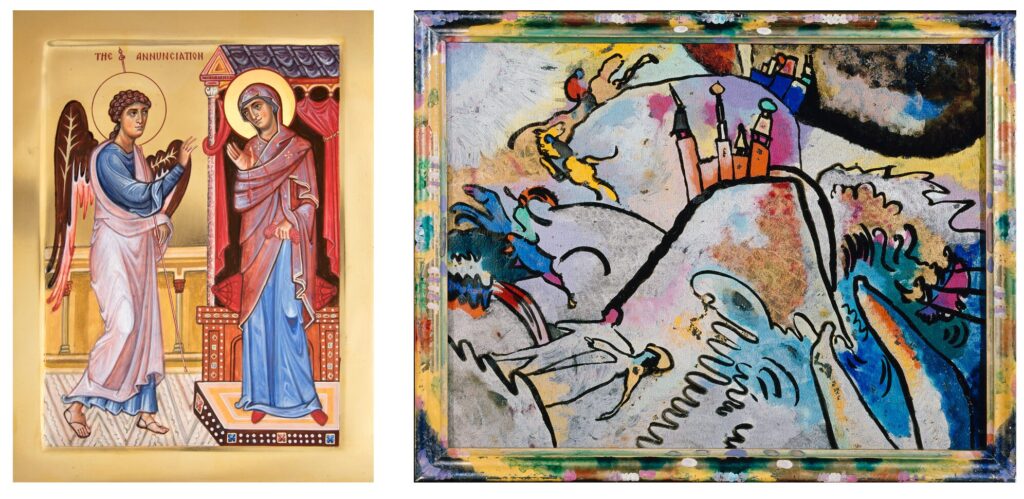
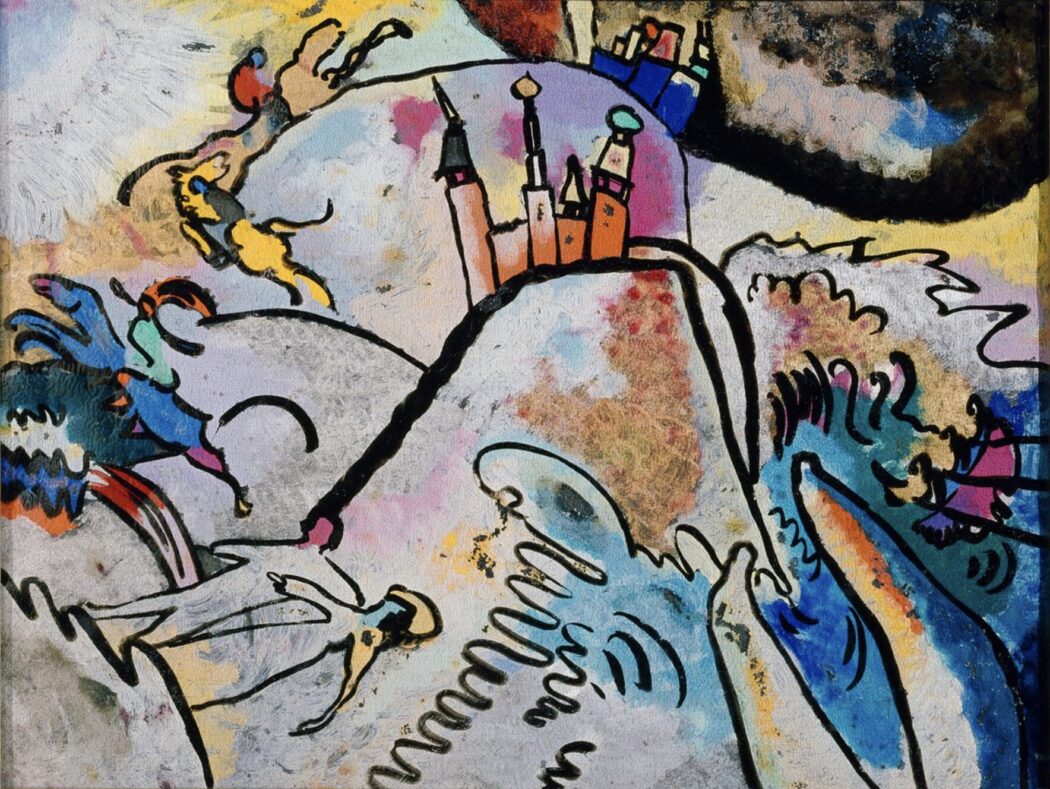
Aidan Hart, The Annunciation (right). Kandinsky, With Sun, 1911, Lenbachhaus, Munich (left).
Some Key Differences
So much for some overlaps between our two artists’ worldview and that of Orthodoxy. How did it differ? We know they drew inspiration from a variety of traditions other than Christianity, so some departure is to be expected.
A key difference concerns personalism versus impersonalism. Traditional theology understands the essence of created things as personal because they are logoi or words spoken by the Logos, the Son of God. This is suggested by the following passage from the book of Hebrews:
The Son is the radiance of God’s glory and the exact representation of his being, sustaining all things by his powerful word. (Heb 1.3)
The Greek translated here as word is rhemati which denotes the spoken word. The writer is therefore asserting that the Logos continues to speak through each thing that He has created. These logoi or essences cannot therefore be impersonal; they are spoken by the Son of God. This is not pantheism – God is everything – but panentheism, God is in (en) everything and everything is in God. This explains why any abstraction of form in icons is always directed towards person. An icon is after all a likeness of someone, be it Christ, saints, or angels. Icons use abstraction like a garment, to express the wearer.
By contrast, Kandinsky seems to have viewed his spiritual essences somewhat vaguely. Although he did write that ‘everything shows me its face, its innermost being, its secret soul, which is more often silent than heard,’11 the dominant impression he gives us is of impersonal forces or ideas. Certainly, the theosophy that influenced Kandinsky (although he was never a member of the group) disavows belief in a personal God and instead promotes a Universal Divine Principle. If he did believe that the source of all is impersonal, then Kandinsky must have also believed that its essences were impersonal.
Brancusi had a more personalistic view than Kandinsky. He wrote very little and so we are more dependent on his recorded aphorisms than on any written manifestos such as Kandinsky liked to pen. In these aphorisms we see that Brancusi was quite open about his belief in God. Perhaps the most revelatory is this:
Do not seek obscure formula or mysteries. That which I give you is pure joy. Contemplate my works until you see them. Those close to God have seen them.12
Another difference between the icon tradition and Kandinsky—albeit not in direct conflict—is that he saw the artist’s work as that of the lone prophet. The tradition of Iconography by contrast exists within a liturgical and therefore also communal context. Its symbolic language grows iteratively out of the Church community, while Kandinsky and Brancusi had to create a new language. That said, they both asserted that what they did was not novel, but an outgrowth of great traditions of the past. Brancusi:
I never burned my boats, nor pulled out my roots in order to roam giddily. My art profited from that.’13
And Kandinsky:
I have always … been put out by assertions that I intended to overthrow the old [tradition of] painting. I could never see such intention in my works: in them I could only feel the inwardly logical, outwardly organic, inevitable further growth of art.14
Instead of existing in conflict, perhaps this difference is precisely because the ‘gallery’ artist’s role is in the world, while the liturgical artist’s is within the liturgy. At the risk of over-simplification, the former is primarily prophetical, while latter is primarily priestly.
Examples of Works Inspired by Orthodox Symbolism
What concrete examples do we have of Kandinsky’s and Brancusi’s works being inspired by actual icons? We know from his book Looks on the Past that Kandinsky was deeply moved by the interiors of the Orthodox churches that he encountered on an ethnographic expedition to Vologda in 1889. Surrounded by their shimmering colours he wrote that he felt he was inside a painting, an idea that became central to his later painting.
Not only the aim but also the structure of some of Kandinsky’s paintings are clearly based on icons. His ‘Sketch with Horseman’ is very similar to icons of St George and of the prophet Elijah being assumed into heaven, but his most obvious borrowing is seen in his Unentitled, which is graphic version of the ‘Ladder of Divine Ascent’ icon.
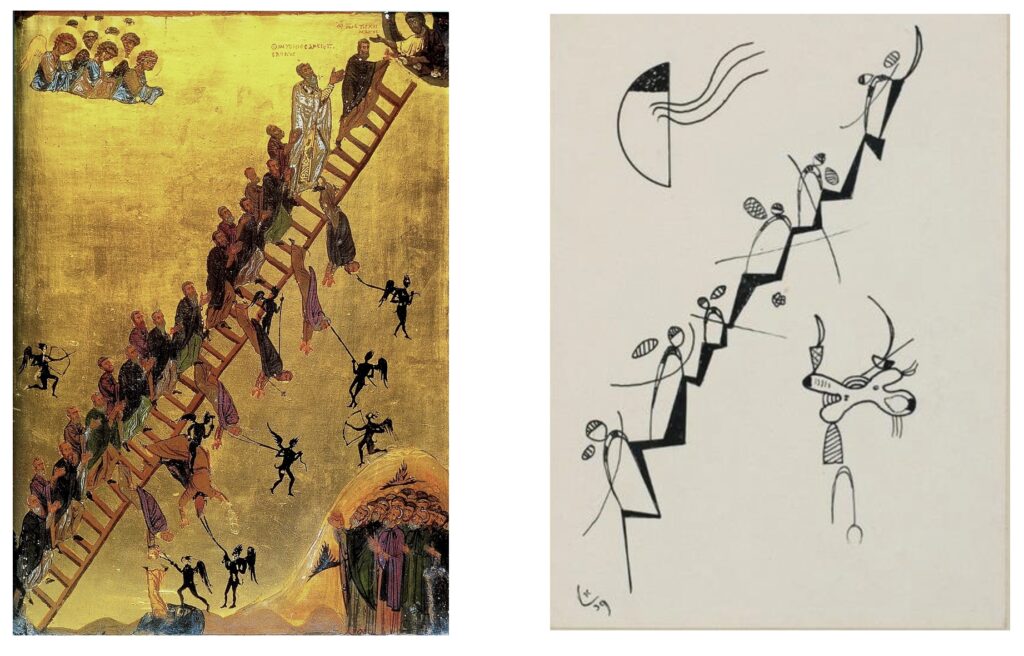
The Ladder of Divine Ascent, Monastery of St Catherine’s, Sinai, 12th century (right). Kandinsky: Unentitled, 1939. Musée National ‘Art Moderne, Centre Georges Pompidou, Paris (left).
Stylistically, the icon tradition also influenced Kandinsky’s tendency to honour the flatness of the picture plane rather than trying to simulate spatial depth. Icons are designed to be portals to a higher reality rather than imitative replacements of it. Their role is to encourage viewers to pass through them towards their prototypes and for this reason iconographers deliberately flatten and make the icon ‘imperfect’. Compared to Greek Byzantine icons, Russian panel icons in particular tend towards flat fields of colour. This undoubtedly influenced Kandinsky’s style.
Similarly, especially in his earlier more figurative works, Kandinsky used the multi-view perspective system found in icons. This system depicts things as they are known rather than as they appear to the retina, which can only be from a single viewpoint.
It is more difficult to find overt borrowings from the icon tradition by Brancusi. This is in large part because he was a sculptor working in the round, while sculpted icons favour bas relief. His stylistic influences are more to be found in Romanian folk traditions, though these were in turn often inspired by liturgical art and practice. The concept of his Endless Column in Târgu Jiu, created precisely as a memorial to Romanian soldiers, is surely based on the carved commemorative pillars called kopjafák found in graveyards in some regions of Romania. More broadly, his carved wooden sculptures and pedestals are largely inspired by the carved columns found in wooden monasteries and houses throughout Romania.
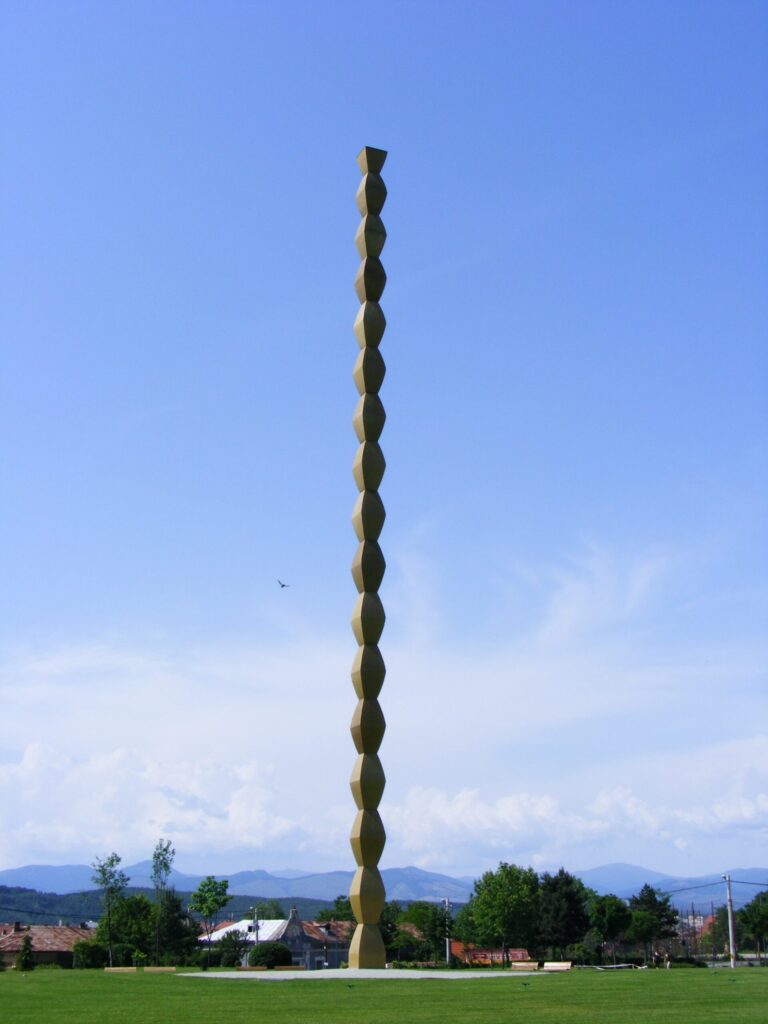
The Endless Column, Constantin Brancusi, Târgu Jiu, Romania.
The interaction of light and matter is perhaps the paramount symbol used by Brancusi, as seen especially in his highly polished bronze works, such as Bird in Space. Of course, many religions apart from Christianity consider light as a symbol of divinity. However, the Orthodox Church is particularly known for its emphasis on the transfiguration of the created world by uncreated light, and this undoubtedly influenced him. As one hymn of Transfiguration puts it:
Christ has shone as lightning with glory upon the mountain, filling the whole world with light.15
The priority Brancusi gave to light is affirmed by the extraordinary lengths he went to polish his bronze and marble sculptures, and also the masterly photographs he took of his work. In one photo of Bird in Space, light seems to emerge from within the bronze sculpture.
-
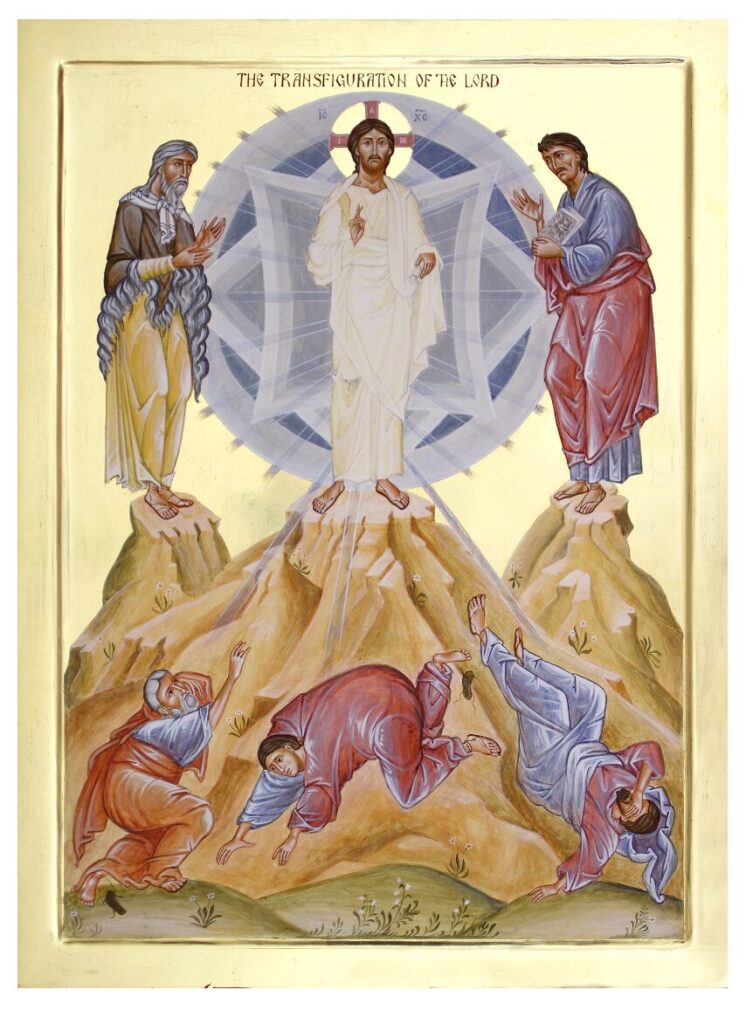
- The Transfiguration Icon. The transfiguration of matter is a theme common to both icons and Brancusi’s work.
-
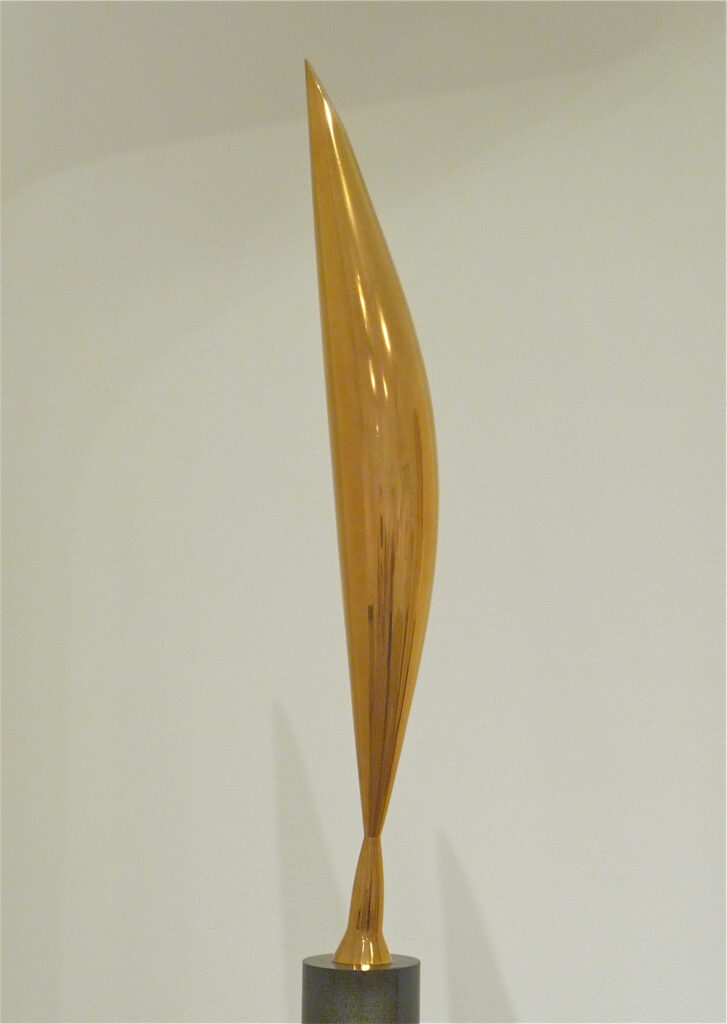
- Constantin Brancusi, Bird in Space, Image by Art Poskanzer.
Conclusion
Over the past millennium Western theology has tended to prioritise legal imagery and rationalistic processes. Consequently, many scholars seeking sources for any mystical currents within recent art have too often overlooked Christianity and assumed that this stimulus must have come from elsewhere, such as far Eastern religions, tribal art, or recent esoteric movements like theosophy. Though all these certainly have been a stimulus for many modern artists, secular art historians seem embarrassed by the eastern Christian mystical tradition. But how otherwise could we explain why most of the early modernists came from Orthodox countries? As we have seen, Orthodoxy’s teaching and liturgical art promotes many of the things dear to these and some other early abstract artists,16 such as transfiguring light, direct encounter and participation rather than narrative, truth to material, and a vision that sees the whole material world as a symbol of a higher heavenly world.
Some would say that art has somewhat lost its way over the past few decades, that it has prioritised novelty over all else. Has the wisdom of the early abstractionists been fully mined? Might it not shine a light for a clearer way forward? I suggest more work needs to be done on Brancusi in particular. While Kandinsky’s writings have all been translated into English, very little literature written by people who knew Brancusi has been translated into English. This needs to be addressed. There, I am sure, lies a mine of wisdom that can give fresh direction and inspiration to a contemporary art world that needs new focus and meaning.

