Introduction
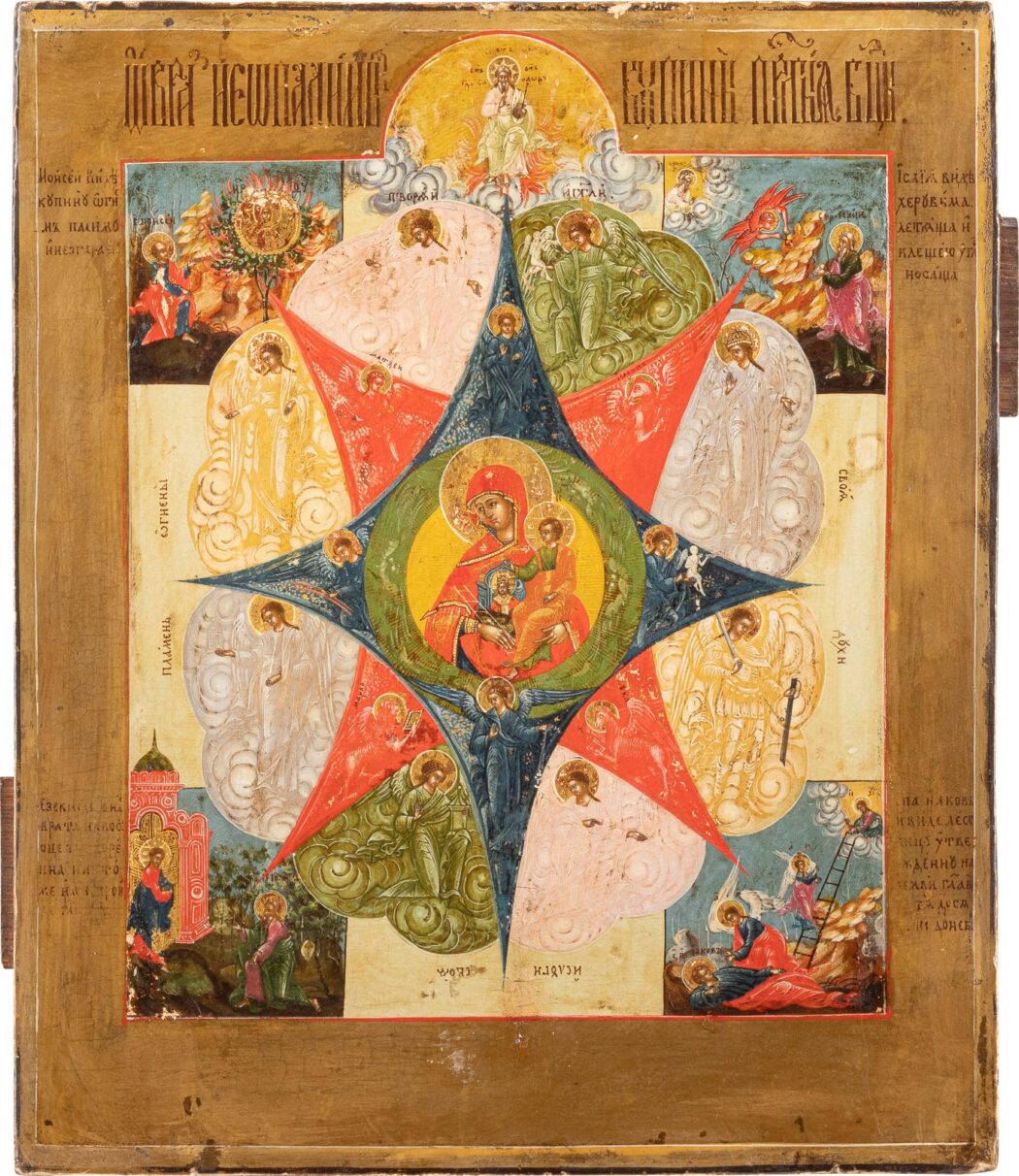
In Crime and Punishment, Demons, and The Brothers Karamazov, candle-lit Magdalenes blaze into burning-bush Madonnas, whose fiery presence proves to be redemptive. In each novel, Dostoevsky fans candle flames into redemptive fires through a series of shifting associations: he initially associates Mary Magdalene figures with candles, then transfigures these Magdalenes into Mother of God figures through grand conflagrations, both symbolic and literal. The Magdalene-to-Madonna transfiguration occurs in part through Dostoevsky’s subtle allusions to art historical depictions of Mary Magdalene with candles—such as Georges de la Tour’s The Penitent Magdalen1—and through his subtle allusions to liturgical and iconographic depictions of Mary the Mother of Jesus as the burning bush, the Theotokos who bears God and yet is not consumed.2
Crime and Punishment
In Crime and Punishment (1866), Dostoevsky casts Sonya as a candle-lit Magdalene who is transfigured into a burning-bush Madonna, a fire which burns to redeem the murderer Raskolnikov. Before she is a Mary Magdalene figure, however, Sonya is cast as a firebird, a phoenix that rises from the ashes. When Raskolnikov first encounters Sonya upon her father Marmeladov’s death, Raskolnikov notices that Sonya wears a straw hat with a ‘flame-colored feather’.3 As he later describes the scene to Razumikhin, he recalls Sonya as a ‘being… with a flame-colored feather’.4 Objectively speaking, Sonya’s fiery feather marks her as a prostitute; allusively, it marks her as a firebird, a phoenix—a harbinger of resurrection.5
Dostoevsky then further transforms Sonya from the pagan symbol of a phoenix into the Christian figure of Mary Magdalene. By casting Sonya as a prostitute, Dostoevsky invokes traditional Christian understandings of Mary Magdalene as such. Moreover, he also invokes traditional artistic depictions of Mary Magdalene—such as those of Georges de la Tour—by associating Sonya with candles. When Raskolnikov encounters Sonya at Marmeladov’s deathbed, the narrator observes the single candle-end that lights the whole scene.6 When Raskolnikov later visits Sonya and they read the Gospel together, it is by candlelight that ‘the murderer and the harlot’ come together in the ‘reading of the eternal book’.7 As they read the biblical account of Lazarus’s resurrection, Raskolnikov notices Sonya’s ‘meek blue eyes’, which ‘[flash] with such fire’.8 Over the course of the novel, Raskolnikov draws ever closer to this fiery Magdalene figure as a moth to a flame.
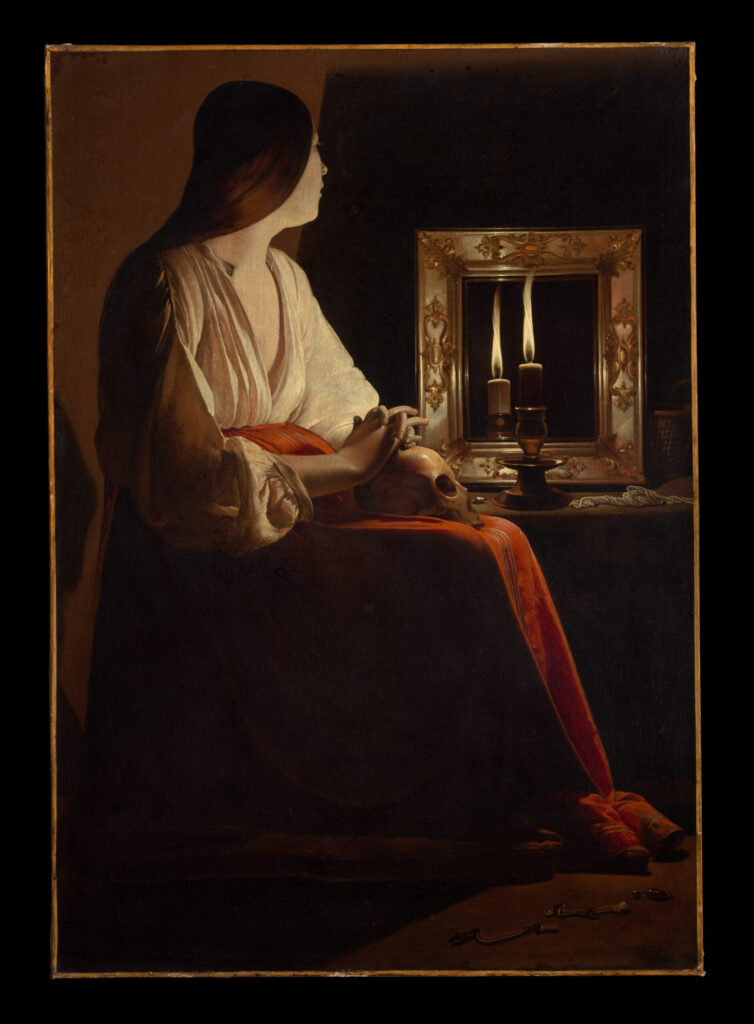
The Penitent Magdalen, Georges de La Tour, c. 1640
Sonya’s candle flame finally blazes into a redemptive fire through the kindling of a subtle but powerful biblical allusion. In the Epilogue of Crime and Punishment, the still-unrepentant Raskolnikov carries out his sentence of hard labor in Siberia. On one particular day, Raskolnikov goes outside, sits on a pile of wood, and looks out over the distance. The narrator describes the scene as follows:
Early in the morning, at about six o’clock, [Raskolnikov] went to work in a shed on the riverbank, where gypsum was baked in a kiln and afterwards ground. Only three workers went there. One of them took a guard and went back to the fortress to get some tool; the second began splitting firewood and putting it into the kiln. Raskolnikov walked out of the shed and right to the bank, sat down on some logs piled near the shed, and began looking at the wide, desolate river. From the high bank a wide view of the surrounding countryside opened out. A barely audible song came from the far bank opposite. There, on the boundless, sun-bathed steppe, nomadic yurts could be seen, like barely visible black specks. There was freedom, there a different people lived, quite unlike those here, there time itself seemed to stop, as if the centuries of Abraham and his flocks had not passed.9
Sonya comes and sits beside Raskolnikov, and he then begins to weep, to repent, and to undergo some sort of resurrection:
How it happened he himself did not know, but suddenly it was as if something lifted him and flung him down at her feet. He wept and embraced her knees. For the first moments she was terribly frightened, and her whole face went numb. She jumped up and looked at him, trembling. But all at once, in that same moment, she understood everything. Infinite happiness lit up in her eyes; she understood, and for her there was no longer any doubt that he loved her, loved her infinitely, and that at last the moment had come… They wanted to speak but could not. Tears stood in their eyes. They were both pale and thin, but in those pale, sick faces there already shone the dawn of a renewed future, of a complete resurrection into a new life. They were resurrected by love; the heart of each held infinite sources of life for the heart of the other…10
From one paragraph to the next, Raskolnikov has gone from sitting on a pile of logs, with Sonya beside him, to weeping in repentance and finding some sort of resurrection.
The interpretive key to this passage lies in its biblical subtext—namely, Abraham’s near-sacrifice of Isaac as recounted in Genesis 22.11 The details that link this passage to its biblical subtext include the time of day, the kiln located on a high place, the firewood, the men mounting the high place, one character being situated on a pile of logs, unaware of the significance of his being there, and the ‘resurrection’ that comes. Moreover, in the original, the language here shifts from Russian to liturgical Church Slavonic. This biblical subtext is further confirmed by that little simile which mentions Abraham: as Raskolnikov looks out over the opposite bank, it looks to him ‘as if the centuries of Abraham and his flocks had not passed’.12 Thus, Abraham’s near-sacrifice of Isaac becomes the interpretive key to Raskolnikov’s repentance and resurrection. In this moment, Raskolnikov experientially takes the place of the sacrificial victim—or, rather, the one in whose place the substitute ram (typologically, Christ) is sacrificed.
As Raskolnikov is resurrected upon the altar of sacrifice, Sonya’s fiery persona is transfigured from Magdalene to Madonna. Earlier in the Epilogue, Sonya is subtly cast as a saving mother. In Siberia, ‘[the convicts] would all bow to her: “Little mother, Sonya Semyonova, our tender, fond little mother!”’13 With the subtext of Genesis 22 in view, as Raskolnikov sits upon the firewood as a burnt offering, Sonya appears beside him as a redemptive fire—a fiery Madonna whose loving flame does not consume but rather redeems Raskolnikov.
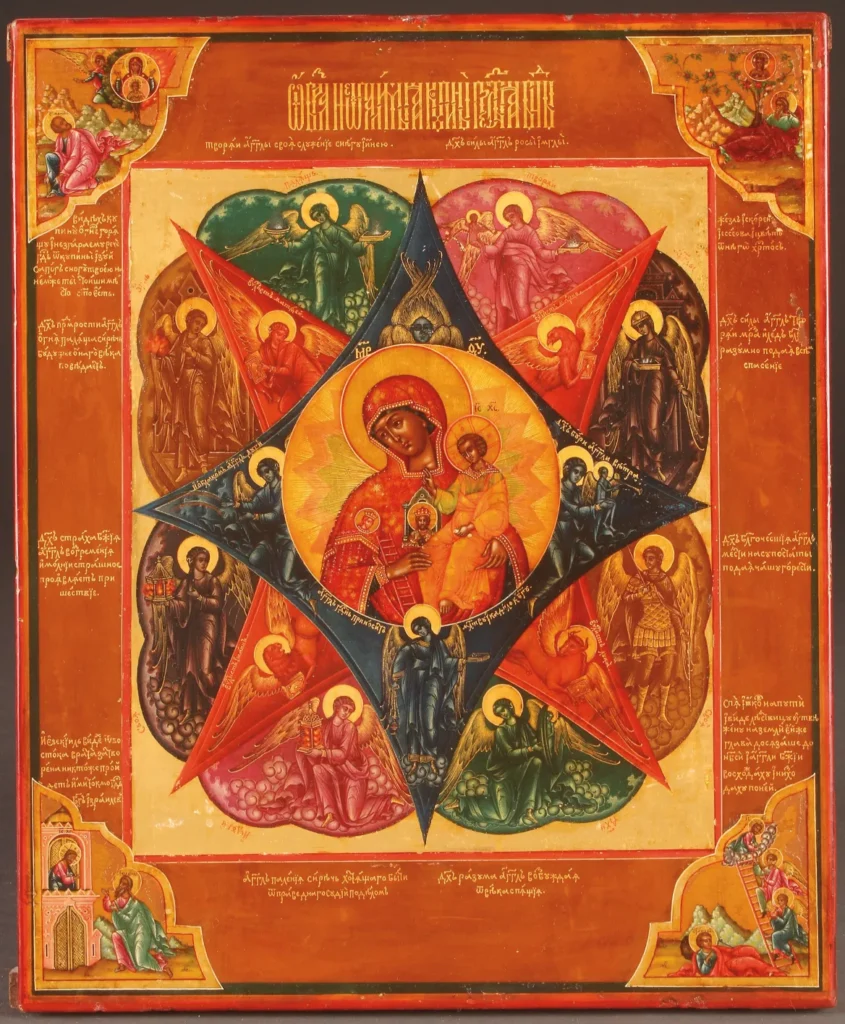
The Unburnt Thornbush, (Neopalimaya Kupina) Russian Icon. In this famous icon, which was almost certainly known to Dostoevsky, Mary is enrobed in flames in ways that evoke imagery of the Burning Bush in Exodus 3.
Demons
The pattern established in Crime and Punishment finds new permutations in Demons (1871-1872), as here again candles become redemptive fires as the Magdalene gives way to the Mother of God.
In Demons, Dostoevsky casts Marya Timofeevna Lebyadkin as the Magdalene by associating her with candles. When the narrator and Ivan Shatov first visit Marya, candles pierce the darkness of her room. The narrator sees her first ‘by the light of a dim, slender candle in an iron candlestick’.14 In a scene that vividly recalls George de la Tour’s The Penitent Magdalene, Marya sits alone at a table with ‘a small rustic mirror’ and ‘candlestick’, among other items.15 The narrator describes a similar scene when the revolutionary Nikolai Stavrogin goes to visit Marya in her new lodgings, where she sits alone before a table with a little mirror and a burning icon lamp, among other items.16 Marya’s casting as a Magdalene figure is confirmed as the narrator describes Marya as a ‘God-afflicted creature’,17 recalling the biblical account of Mary Magdalene having been afflicted by seven demons before Jesus heals her.18
Partway through the novel, Marya is herself engulfed by flames as the Zarechye fires burn through the town. The fire appears to have started on a pile of burning logs that were stacked up against the wall of the house in which she lives with her brother, Captain Lebyadkin.19 The house becomes a grotesque altar of sacrifice, and after the fateful night, the charred bodies of Captain Lebyadkin and Marya are discovered in the lone, burned house.20 Unlike the sacrificial fire in the Epilogue of Crime and Punishment, this fire redeems no one.
Nonetheless, Marya and her candles are ‘doubled’ and fulfilled in the redemptive Madonna that Marie Shatov becomes. In Demons, Dostoevsky splits in two the Magdalene-turned-Madonna role that Sonya plays in Crime and Punishment: here, Marya Timofeevna Lebyadkin and Marie Shatov are cast as the Magdalene and the Mother of God, respectively.
The parallels between these two women are quite strong—even beyond their sharing the name of the biblical Marys. The key entrances of both women, for example, are very similar: Marya enters the cathedral in a hired droshky and then argues with the driver over the payment, and Marie bickers with the coachman over payment when she arrives at the home of her estranged husband, Ivan Shatov.21 Furthermore, each ‘Mary’ also asks about the other: when Ivan visits Marya, she asks him about his estranged wife; when the estranged Marie returns to Ivan, she asks him about the fire and the woman who had been killed in it.22 Perhaps the most striking parallel comes as the baby to which Marie gives birth incarnates the baby about which Marya earlier raves. Marya’s dreamed baby and Marie’s birthed baby each belong to a father other than the women’s respective husbands: Marya weeps for her imagined baby and also weeps because she ‘gave birth to it and did not know a husband’; Marie gives birth to a son who is not Ivan Shatov’s but rather Nikolai Stavrogin’s by blood.23
When read as Marya’s double—and fulfillment, in some sense—Marie becomes an even more potent redemptive figure. Indeed, as Marie gives birth to her son, she is cast as the Mother of God. The birth occurs at Ivan Shatov’s place on Bogoyavlensky Street—‘Epiphany’ Street.24 On Epiphany Street, Marie gives birth to her son while the suicidal atheist Alexei Kirillov pontificates on the joy and mystery of the appearance of the new being, on birth and resurrection.25 Although the infant is not biologically Ivan’s own, he nonetheless emphatically claims the boy, stating firmly, ‘he is my son’,26 recalling the divine proclamations at the Baptism and Transfiguration of Jesus.
27 Thus, Marie, Ivan, and the baby become a rather unlikely Holy Family. Furthermore, the birth of this baby boy also embodies—or, rather, incarnates—Ivan’s spiritual rebirth, as well as forgiveness and reconciliation between Ivan and Kirillov:
Everything seemed transformed. [Ivan] Shatov now wept like a little boy, now said God knows what, wildly, dazedly, inspiredly; he kissed her hands; she listened with rapture, perhaps not even understanding, but tenderly touching his hair with a weakened hand, soothing it, admiring it. He talked to her of Kirillov, of how they were going to start living ‘anew and forever,’ of the existence of God, of everyone being good…28
Thus, Dostoevsky brings about the same transfiguration that he has established with Sonya—here, through the doubling of Marya and Marie in the roles of the Magdalene and the Madonna, respectively. The candles blaze into an open flame, and the Magdalene is fulfilled in the Madonna, who gives birth to the hope of redemption.
The Brothers Karamazov
In The Brothers Karamazov (1880), Grushenka is cast as the Magdalene and then becomes a redemptive Madonna for Dmitri (Mitya) Karamazov.
Grushenka has lived as Samsonov’s kept woman, and many assume her to be a prostitute.29 Like the ‘Magdalenes’ of Sonya and Marya, Grushenka is also associated with candles. Katerina’s maid sets out two candles on the scene in which Grushenka appears from behind the curtain.30 Grushenka tells the apocryphal story of ‘The Onion’ by candlelight, and the lamp burns in her apartment as Mitya goes to look for her.31 Fire rushes to Grushenka’s cheeks as she reads a letter from a former lover by candlelight; as she rushes off at the call of this former lover, Rakitin mocks Alyosha, saying, ‘So you converted a sinful woman? … Turned a harlot onto the path of truth? Drove out the seven devils, eh?’—clearly casting her as Mary Magdalene.32
Like Sonya and Marya-to-Marie, Grushenka is transfigured from Magdalene into Madonna. As Grushenka comes to Mitya’s defense at his trial,33 she acts as the Mother of God who, in an apocryphal story told by Ivan in his preface to the ‘Grand Inquisitor’, descends into hell and intercedes for the sinners suffering in the burning lake.34 Mitya looks to Grushenka for his ‘redemption’, declaring that her love will bring about ‘a completely new Dmitri’.35 This hope is fulfilled as Grushenka actualizes Mitya’s dream of a mother and child in the aftermath of a fire. Mitya dreams of a fire-ravaged landscape in which a woman holds a crying baby in her arms.36 The sight of their plight sparks Mitya’s compassion and, arguably, awakens his sense of his own responsibility for the suffering he has caused throughout the novel.37 This soul-awakening vision of the mother and child—a Madonna and child in the aftermath of fire—again links the salvific work of the Mother of God with fire. Mitya awakens from the dream to hear Grushenka promise, ‘And I am with you, too, I won’t leave you now, I will go with you for the rest of my life.’ At the sound of these words—from the fiery Madonna that Grushenka has become for him—Mitya’s ‘whole heart blaze[s] up and turn[s] towards some sort of light’ as the desire to live a new life wells up within him.38
Conclusion
In what sense do these fiery Magdalene-turned-Madonna figures play a redemptive role? Just as Mary Magdalene stood beside Jesus as He endured the cross and then was one of the first to witness His resurrection, these women prove faithful to the end. Just as the burning bush brought the Word of God to Moses, so Sonya brings the salvific Word of God to Raskolnikov.39 Just as Mary, the Mother of Jesus, birthed the Savior of the world, so Marie gives birth to a son who ushers in Ivan Shatov’s redemption and reconciliation. Just as the burning bush brought the promise of deliverance, so Grushenka ushers in some promise of salvation for Mitya. Candle-lit Magdalenes blaze into burning-bush Madonnas, and men are saved thereby—even if only as through fire.40
1. According to Olga Meerson, Dostoevsky was likely familiar with such imagery from Georges de la Tour’s well-known seventeenth-century paintings of Mary Magdalene. ^
2. Cf. Exodus 3:1-12 ‘…behold, the bush was burning, yet it was not consumed.’ According to Olga Meerson, the association between the Mother of God and the burning bush—the ‘Unburnt Thornbush’ (Neopalimaya Kupina), the Theotokos who bears the presence of God and yet is not consumed—has been prominent throughout church history, particularly in the liturgy and iconography in the Russian Orthodox Church. ^
3. Dostoevsky, Crime and Punishment, 183. ^
4. Dostoevsky, Crime and Punishment, 191. ^
5. Per Olga Meerson, a feather like this was a culturally recognized marker of prostitution in nineteenth century Russia. ^
6. Dostoevsky, Crime and Punishment, 183. ^
7. Dostoevsky, Crime and Punishment, 328, 324. ^
8. Dostoevsky, Crime and Punishment, 324. ^
9. Dostoevsky, Crime and Punishment, 548-549. ^
10. Dostoevsky, Crime and Punishment, 549. ^
11. Olga Meerson, ‘Raskolnikov and the Aqedah (Isaac’s Binding),’ in Dostoevsky Beyond Dostoevsky: Science, Religion, Philosophy, edited by Svetlana Evdokimova and Vladimir Golstein (Academic Studies Press, 2016). ^
12. Dostoevsky, Crime and Punishment, 548-549. ^
13. Dostoevsky, Crime and Punishment, 546. ^
14. Dostoevsky, Demons, 141. ^
15. Dostoevsky, Demons, 141. ^
16. Dostoevsky, Demons, 217. ^
17. Dostoevsky, Demons, 142. ^
18. Cf. Luke 8:2. ^
19. Dostoevsky, Demons, 517. ^
20. Dostoevsky, Demons, 517. ^
21. Dostoevsky, Demons, 152; Dostoevsky, Demons, 567. ^
22. Dostoevsky, Demons, 146; Dostoevsky, Demons, 572. ^
23. Dostoevsky, Demons, 146; Dostoevsky, Demons, 594, 600. ^
24. Marie Shatov initially confuses Voznesensky Street and Bogoyavlensky Street (Demons, 567). Richard Pevear and Larissa Volokhonsky note that Voznesensky means ‘of the Ascension’ and Bogoyavlensky means ‘of the Epiphany’ (Part III, Chapter 5, note 1). These Orthodox street names underscore the Christological significance of the scene which occurs in this place. ^
25. Dostoevsky, Demons, 590-591. ^
26. Dostoevsky, Demons, 593. ^
27. Cf. Matthew 3:17; 17:5. ^
28. Dostoevsky, Demons, 594. ^
29. Dostoevsky, The Brothers Karamazov, 81, 667. ^
30. Dostoevsky, The Brothers Karamazov, 145. ^
31. Dostoevsky, The Brothers Karamazov, 346; Dostoevsky, The Brothers Karamazov, 305. ^
32. Dostoevsky, The Brothers Karamazov, 357-358. ^
33. Dostoevsky, The Brothers Karamazov, 506. ^
34. Dostoevsky, The Brothers Karamazov, 247. ^
35. Dostoevsky, The Brothers Karamazov, 368. ^
36. Dostoevsky, The Brothers Karamazov, 507. ^
37. Olga Meerson maintains that at this moment Mitya understands himself to bear some degree of moral responsibility for the suffering he has caused—particularly for Smerdyakov, Grushenka, Katerina, and other characters he has objectified—if not consciously, at least at the gut-level of his conscience. ^
38. Dostoevsky, The Brothers Karamazov, 508. ^
39. Cf. The scene in which Sonya and Raskolnikov read of Lazarus’s resurrection (Crime and Punishment, 328), as well as Raskolnikov’s return to the Gospels toward the end of the Epilogue (550). ^