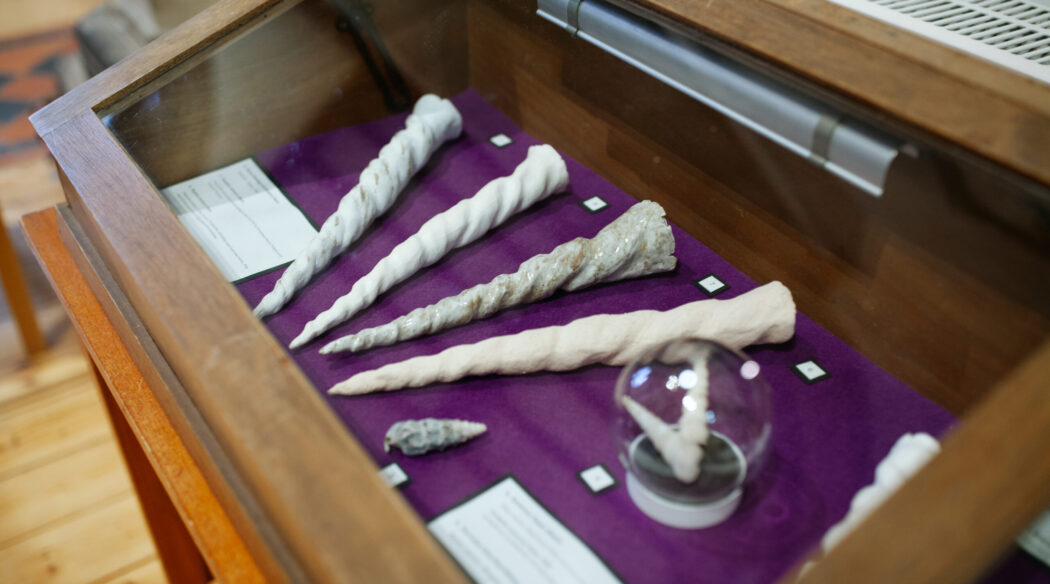
Every spring, Transept—a practicing artist’s group within the Institute for Theology, Imagination, and the Arts (ITIA)—hosts an art exhibit, culminating in an evening of performances and readings. This year’s exhibit ran from 17–22 March, 2026 and was curated around the theme ‘Immaterial Evidence’. In this article, Dr. Daniel Drage reflects on this year’s theme and the works it provoked in response.
The theme for this year’s Transept exhibition, Immaterial Evidence, carried the following introductory description:
A play on the double-meaning of the word, ‘immaterial’, can suggest either that which is non-material, or something considered irrelevant. When art presents ‘immaterial evidence’, then, it may be an attempt to capture the non-material, or alternatively (particularly when compared to the process of making art or the experience of encountering it) to highlight the irrelevant. Ways in which we think about the ‘evidence’presented by an artwork or performance—that which is perceived by our senses—will shape how we value the work. This may be particularly so in our experience of art forms such as music or ephemeral visual art that resists static display. This exhibition seeks to expand our understanding when we encounter a work of art to consider evidence which lies beyond the thing itself.
It bears commenting that, rather than any sort of comprehensive summary of the concepts or conversations guiding the art-making process, exhibition titles and descriptions tend to be curatorial frameworks or lenses through which the audience is invited to encounter and consider the works of art therein. These descriptive frameworks are never total, always limited, and will necessarily fall short of the possibilities opened up as we engage the works. Even so, they offer us a starting point from which to begin the encounter: what Hans-Georg Gadamer might have considered the ‘rules’ for this particular game in which we are invited to participate. The practice of the Transept group has long been to engage in expansive dialogue and idea-generation toward agreeing on a shared theme before the process of making art begins. In this way, the rules of the game offered to the viewers are in many ways the same as those by which the artists play. After all, ‘the act of playing,’ writes Gadamer, ‘always requires a “playing along with.”’1
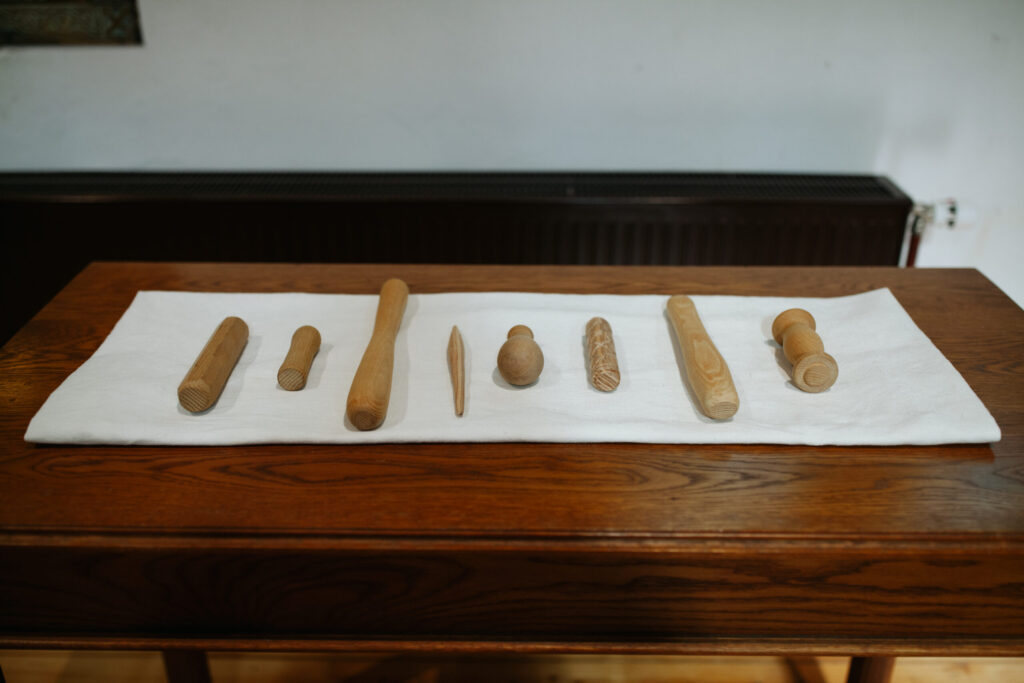
With Things by Daniel Drage (A series of hand carved wooden handles)
That this year’s Transept members chose a theme which at first glance resists material representation may provide a glimpse into the conversations which preceded this choice (and indeed the challenges which succeeded it). We had been considering characteristics of art which lie beyond the art object or performance; for example, identifying that in some cases the work of art may be located in the process of making, or in the dialogue between art object and viewer. Collectively, we were also interested in the tensions at play between material and non-material realities, and the capacity for art to hold more than what is ‘merely’ material. We asked ourselves questions around what is relevant and what is unimportant within the art event, and anticipated possibilities for art’s role in our various disciplines which other more traditional practices — such as discursive academic writing or science-based quantitative methods—are not as well situated to engage. The audience may have been forgiven for not recognising an undercurrent beneath many of the works — a presence which was resolutely (if implicitly) claiming that art can do what other modes of knowledge or inquiry cannot. It is precisely in this poetic irruption where we experience one facet of the power of art. Thus, the location of the exhibition in relation to both the Academy and the Church positions the art as questioning (or at least examining, perhaps occasionally confronting) these institutions’ own assumptions of how the game is to be played.
If we accept with Gadamer that ‘genuine reception and experience of a work of art can exist only for one who “‘plays along’”, the works and events presented as part of Immaterial Evidence offered ample opportunity.2 Many of the artworks elicited participation of the viewer: to handle, to arrange, to listen, to act, to believe. A pile of aggregate stones through which one could rake, zen-like, into contemplation; boxes of macaroni cheese which retold the story of redeemed childhood trauma, to be stacked and re-stacked; visual works with accompanying music or poetry heard through headphones; a session of Playback Theatre, with its improvisational reliance upon audience participation. As a whole, inasmuch as we played along, the unicorn became our unofficial heraldry.
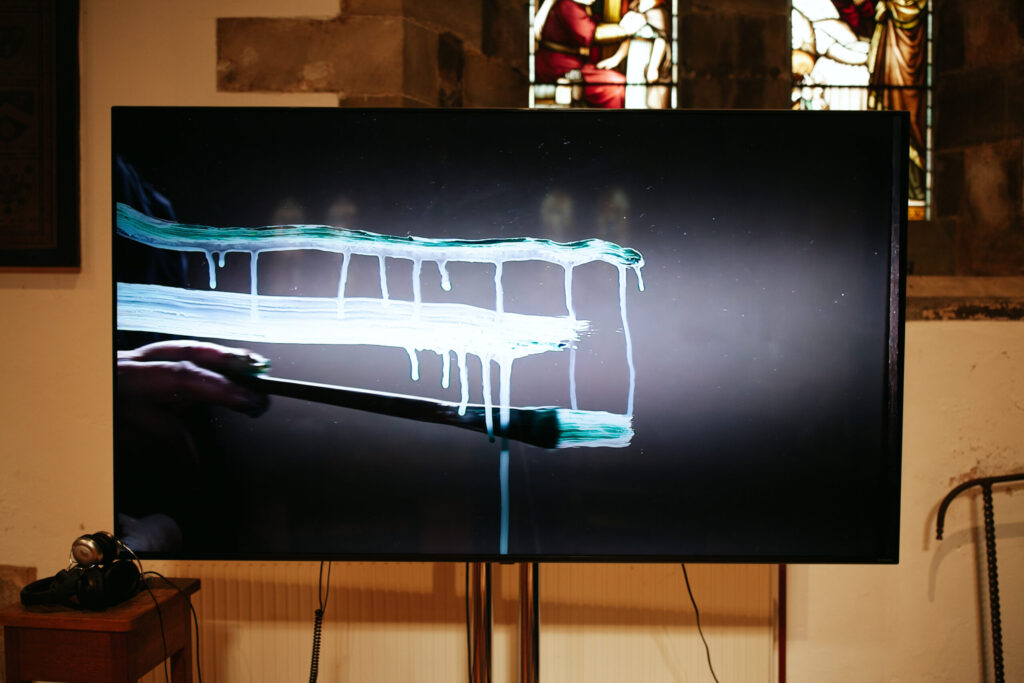
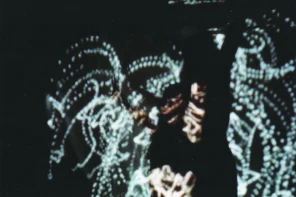
Spring by Judith Heald (Digital Projection with Sound)
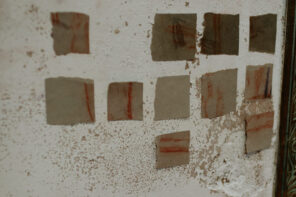
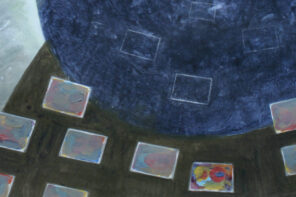
The impossible task of mentioning some and not all of the works is an injustice to artist and reader alike. Yet conversely to go on without mentioning any in particular would be a missed opportunity. So I humbly highlight too few pieces from our exhibition, while others could have served equally well. Wonderful in their own right, each of these pieces also provides example of different angles with which our group engaged the theme. Judith Heald’s offering this year was a video recording of herself painting on glass, with an accompanying audio recording (Adagio, from Beethoven’s Spring Sonata). A meditative and tranquil work, it also exemplifies process, a central concern inspiring this year’s group. In different ways, both Ben Ong’s and Gracie McBride’s pieces wrestle with what is typically considered the ‘evidence’ of an education, and how artistic practice may disrupt, inform, enhance or even supersede more traditional modes of academic output. Lauren McGinn’s piece, A Corner of an Angel’s Dream, highlighted everyday absences via a very human-formed, lived-in space evoking empty nests or shells, while Liz Crichton’s Iconic Horn, gave museum-grade ‘proof’ of that most elusive and magical of beasts.
-

- This is Not an Education by Gracie McBride (Study Materials and Mobile)
-
- Sticks, Stones and Pine Cones by Benjamin Ong (Assemblage)
One of my submissions, entitled With Things, was a series of hand-carved or lathe-turned wooden handles — handles with no tools or devices attached. Displayed on a narrow table at hand-height, these were perhaps the most obvious objects to pick up. We recognise their purposeful shape by feel, enabling the grip of a human hand to work at a tool; yet in this case the functional element does not exist and we are left with the ‘uselessness’ of a headless hammer or paintbrush with no brush. Here we are confronted by our expectation of purpose, not unlike some assumptions toward art in general, which attempt to make a tool of something which (I would argue) at its best, is non-deterministic and resistant to overtly utilitarian claims. These handles exist as objects in themselves, yet provoke evidence of our assumptions toward what is missing in the presumed hand-handle-tool assemblage. As in other works displayed, we encounter here a version of what Gadamer calls ‘an intricate interplay of showing and concealing’, that as finite beings we cannot ever grasp the whole, and that which we see does not necessarily serve to reveal, but often leads to greater mystery.3 If full understanding eludes us, does the material in art merely serve to deceive? Or might this dynamic of hiddenness and unveiling itself be of value?
As with art, the empirically material world of atoms and cells, objects and shadows, has always been an essential part of (while never wholly encompassing) the Christian faith. Art refuses to be reduced to the object, but always poetically stretches beyond the object or performance. As noted above, that which we are shown never reveals in totality, and that which conceals may paradoxically open forth. In an analogous way, the resurrected Christ both conceals and shows himself to Mary Magdalene; likewise to the couple on the road to Emmaus. Christian proclamation resides imminently enfleshed in the wounds of the risen Christ wherein the transcendent divine God is recognised, as the apostle Thomas testified. Yet faith is rarely given material things to handle (we might say, material evidence), and ‘blessed are those who have not seen and yet have come to believe.’4 Thus Balthasar can declare, ‘In the particular non-Evidence of Christian faith there always emerges something which… may be called the evidence of the Creator who reveals himself in concealment as the beginning and end of all the world’s paths.’5 Balthasar goes on to describe a ‘creaturely rationality’ to whose receptive capacity the God of faith remains beyond, but is rather ‘revealed in ever-greater concealment’.6 The more we come to know God, the more we realise how little we know. That ever-expanding gap between our comprehension and mystery could be called ‘wonder’, and it is what draws us onward in all our deepest relationships and most alluring works of art. Imagine that at some distant point the almost-parallel lines of art and faith eventually meet, and we discover both acting to dislodge us, pull us onward, outside, into the wilderness where we are not the centre of things, a place which positions us to encounter that concealed revelation for which we long.