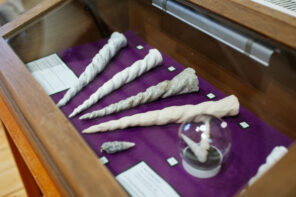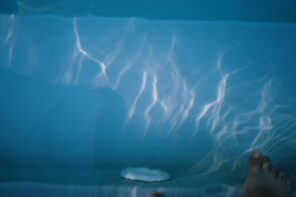
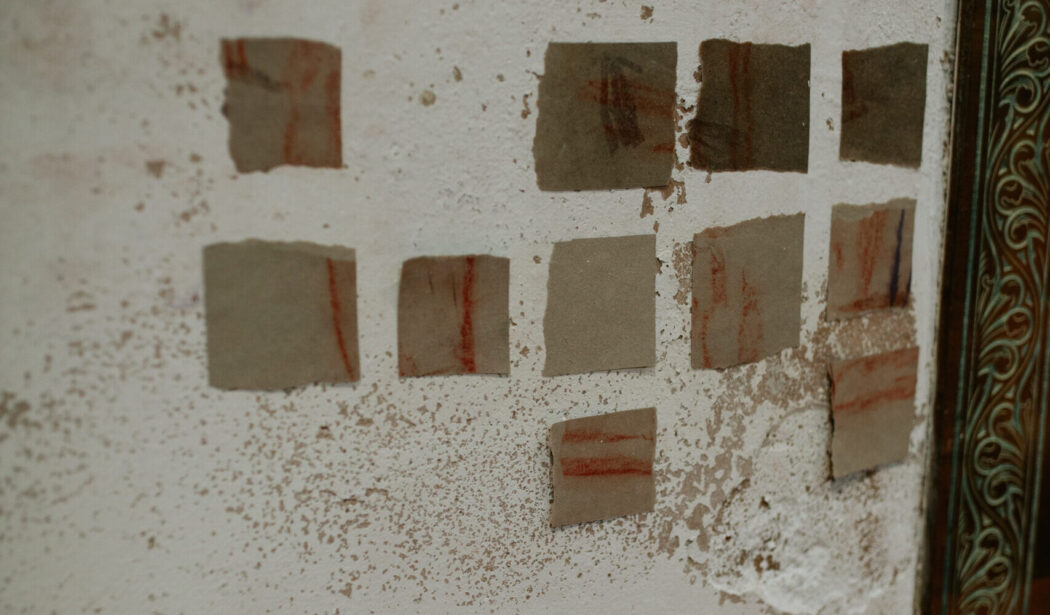
Every spring, Transept—a practicing artist’s group within the Institute for Theology, Imagination, and the Arts (ITIA)—hosts an art exhibit, culminating in an evening of performances and readings. This year’s exhibit ran from 17–22 March, 2026 and was curated around the theme ‘Immaterial Evidence’. In this reflection, Dr. Charles Howell offers some theological commentary on the theme, which we invite you to consider alongside images of the work.
Every angel is terrifying. And yet, alas,
I invoke you, almost deadly birds of the soul,
knowing about you. Where have the days of Tobias gone,
when one you, veiling his radiance, stood at the front door,
slightly disguised for the journey, no longer appalling;
(a young man like the one who curiously peeked through the window)?
If the archangel now, perilous, from behind the stars
took even one step down toward us: our own heart, beating
higher and higher, would beat us to death. Who are you?
— Rainer Maria Rilke, Duino Elegies (Second Elegy), trans. Stephen Mitchell
The incessant desire for ‘evidence’ threatens to destroy the very essence of art. It demands material to become subordinate to immaterial. It diminishes form and colour, perception and sign, to mere instruments in a quest for a ‘more real world.’
I do not see this exhibition as evidence. I see it as the strongest claim against evidence, a distraction from that cold satisfaction of proof. As I stood before the works, I did not ask them to surrender a secret or to act as confirmation of an invisible cause. Instead, I allowed them to remain in that ‘fragile space’ where the immaterial presses against the visible without collapsing into it. I allowed them to draw me within this immanent distance.
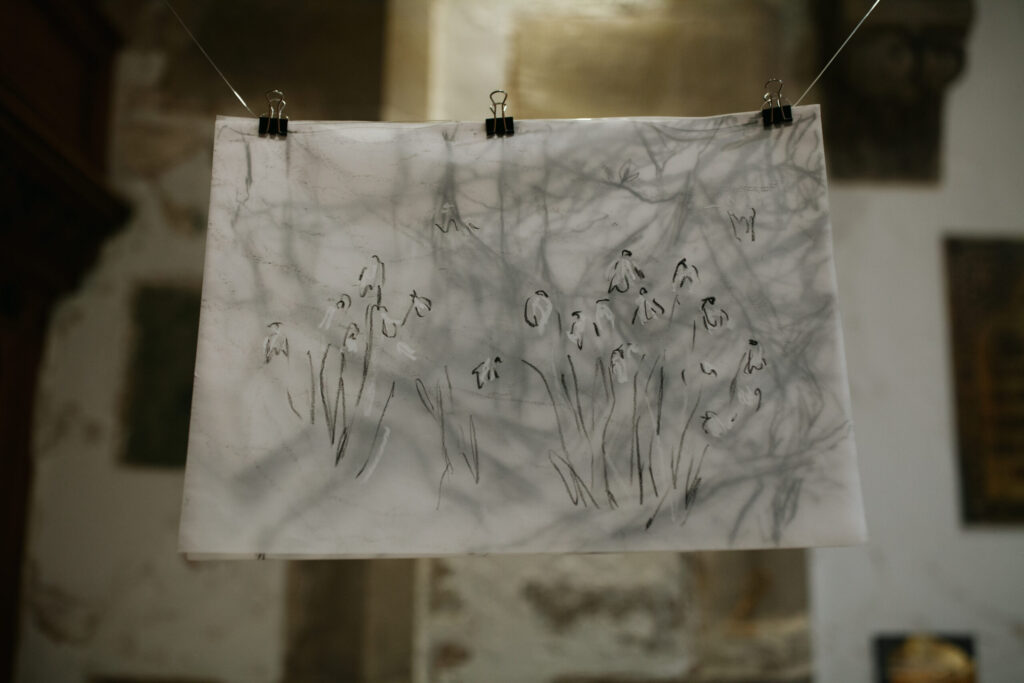
Rilke shows us the path we must follow.
Something in the human voice rises toward what should remain distant. The call asks the invisible to draw nearer, to cross the threshold that keeps the world bearable. Yet the poem trembles at its own invocation. Should the angel take even a single step closer, the heart would not endure the encounter. Desire would be extinguished. This is the terror of the angels.
Between longing and survival there must remain distance. It is within that interval that enchantment lives—the unseen hovering just beyond proof, near enough to be felt, never near enough to be possessed. The angel belongs to that fragile space: the immaterial pressing against the visible without collapsing into it.
But longing rarely remains patient. Again and again the unseen becomes something that must be seized, brought forward, made undeniable. In the stories of the unicorn—an animal long bound to the heraldry and imagination of Scotland—humans do not simply admire the creature’s distance; they attempt to capture it. The unicorn must be lured, trapped, held long enough to prove that it exists. Desire becomes pursuit. The immaterial must yield a body. The myths must be tamed.

And here the hunger for proof reveals its darker side.
As Max Weber observes in Economy and Society:
The Puritan wanted to work in a calling; we are forced to do so… The world is disenchanted. The Puritan’s God is a transcendent God… no magical means can compel Him. The very same Puritanism that most radically eliminated magical means nevertheless produced the last great witch persecutions in New England.1
Once the unseen must be proven, the air thickens with suspicion. Storms acquire intention. Invisible causes must be named and dragged into proof. In the reign of James VI of Scotland, violent winds nearly destroyed the king’s crossing from Denmark; soon afterward witches were accused of conjuring the storm. Trials followed. Confessions surfaced like wreckage from dark water. Out of this atmosphere emerges the fog-bound world of Macbeth, where the witches whisper, ‘Fair is foul, and foul is fair,’ until the air itself seems saturated with omen. And the ominous warning of Macbeth himself slips through the fog, saying: ‘And oftentimes, to win us to our harm, the instruments of darkness tell us truths’.2
The danger lies not in believing such voices, but in the restless desire to see their words confirmed.
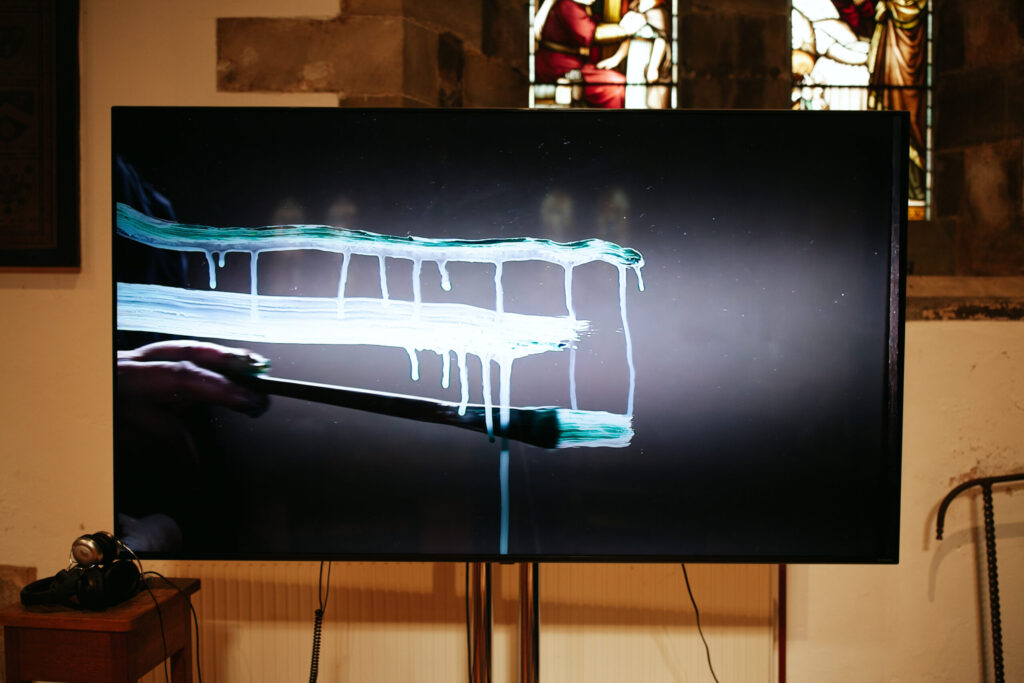
Art waits elsewhere. The work does not serve as proof of something hidden behind it. It simply appears—and in appearing establishes its own fact. No tribunal must verify it; no invisible cause must be dragged forward to justify its presence. No other end towers over it, blotting out its light with the darkness of an ever-greater shadow. The artwork proves only that it exists. This is its reality.
The moment art is asked to serve as evidence, the lid begins to shift again. The old box creaks open once more. What escaped once—suspicion, proof, accusation—stirs again in the air.
Art lives precisely where that demand is suspended. In its self-evident presence something immaterial gathers again: a charged interval between what is seen and what exceeds it.
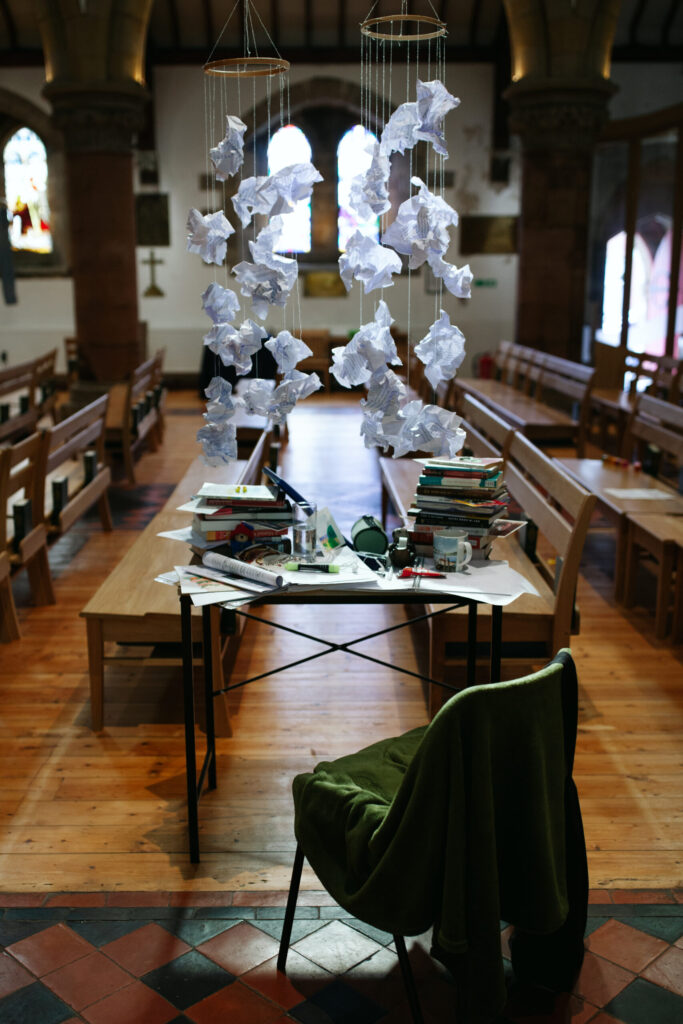
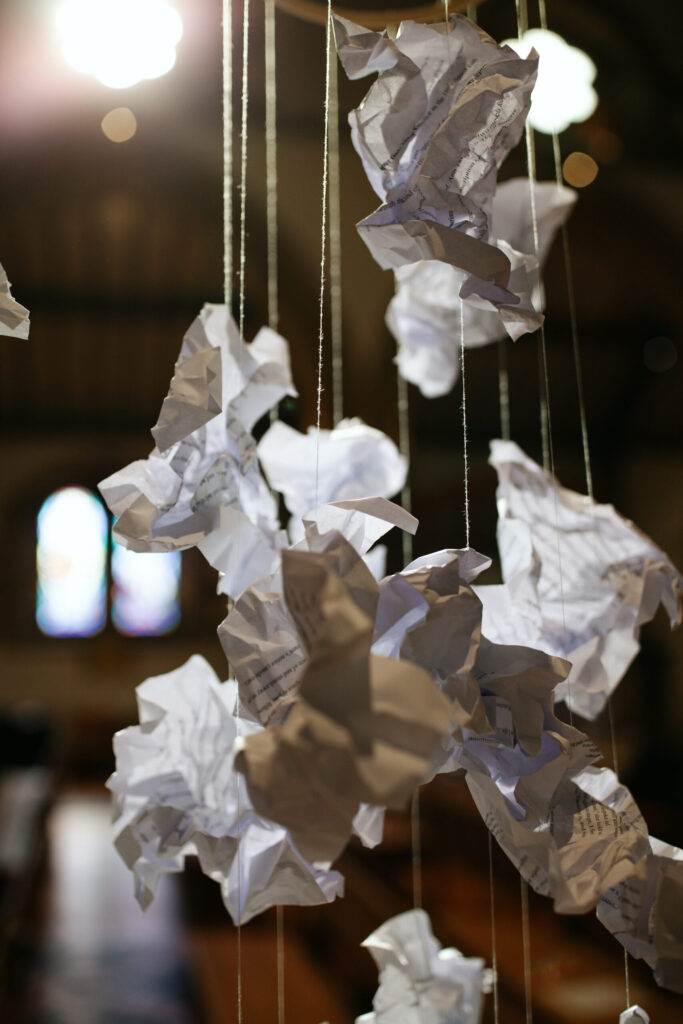
In that space opened by the presence of existence-itself, desire finds somewhere to stand—not in the annihilating nearness that would stop the heart, nor in the cold satisfaction of proof, but in the living distance where the immaterial still breathes. This is the presence of aesthetic; the interruption of art.
When a work of art—here or elsewhere—makes you pause, do not feel the need to seize or possess its meaning. Let it simply appear and, in appearing, establish its own fact. Let the work be the ‘living distance’ where the immaterial still breathes. The angel remains there—terrible, luminous—leaving behind the only evidence the immaterial ever offers: the tremor of desire.
1. Max Weber, Die Wirtschaftsethik und Weltreligionen. Hinduism und Buddhism. 1916-1920. Max Weber Gesamtausgabe, abteilung I: band 19 (Tübingen: Mohr Siebeck, 1996), p.450. ^
2. William Shakespeare, The Tragedy of Macbeth, 1.3.119-120. ^
All photographs by Blythe Kingcroft.
To learn more about Transept, visit here.