
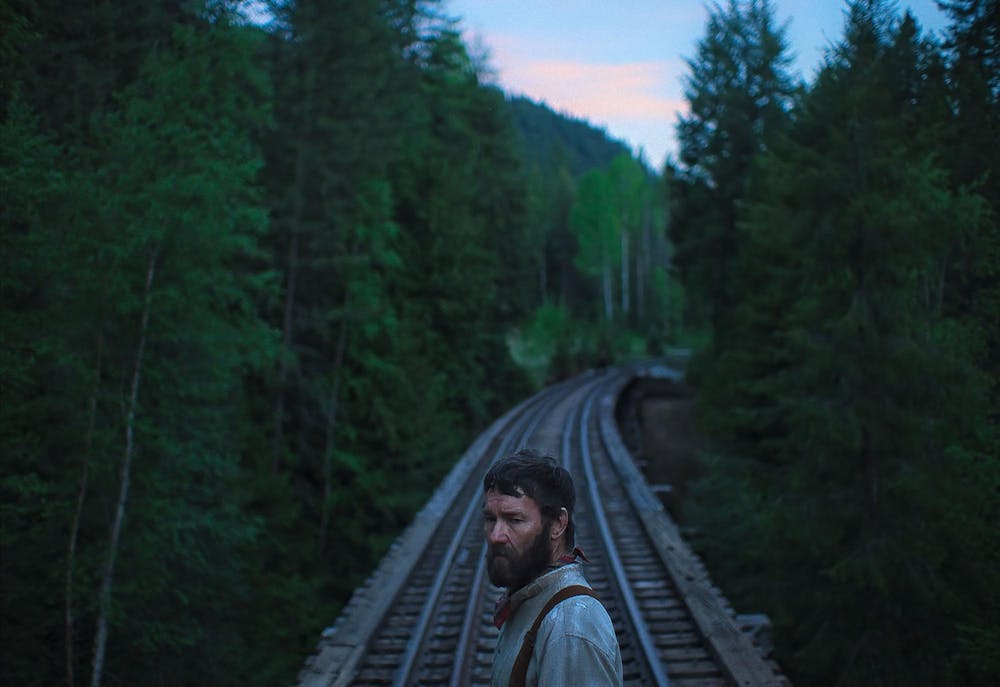
What are the roots that clutch, what branches grow
Out of this stony rubbish? Son of man,
You cannot say, or guess, for you know only
A heap of broken images, where the sun beats,
And the dead tree gives no shelter, the cricket no relief
— T.S. Eliot, The Waste Land 1
The new birth that the fire brings is unwanted. The flame arrives without warning; it doesn’t heed the townspeople’s pleas for cessation or even limit. If something new is created, it is only through destruction. If anything is to phoenix, it must do so from ashes.
The breadth of Train Dreams is crystallized in one of its smallest moments, reflecting the film’s beauty and tragedy: Robert Grainier lies under the stars one night and witnesses a comet igniting the sky. Narration tells us that elsewhere, those who have witnessed it have interpreted it as a cosmic omen, a harbinger of the apocalypse. In the space of a pause, the timing of a period and a breath, we must imagine them filled with panic. Clinging to their loved ones, praying for mercy and forgiveness, scattering about towns in violent mobs, taking advantage of the final opportunity for revenges. Hoping for the new creation, perhaps. Then the narration continues: ‘After two weeks, it faded away as quietly as it had come’. It was no sign of some great cataclysm, just another arbitrary thing playing out among the cosmos.
In Clint Bentley’s adaptation of Denis Johnson’s novella, there’s no indication that Grainier ever hears of these prophesies, doubling their randomness. This moment isn’t for or about him, he may not be aware of it at all. It is solely for us. For our imagination to suddenly cast out to consider these others who share this world with Grainier. They expected finality, the culmination of all their fears and hopes and dreams and secrets and rivalries and loves. However they lived those final moments, it must have been a shock to find that life was going to continue, uninterested in their drama.
When the Human Engine Waits2
This world is intricately stitched together, boys. Every thread we pull, we know not how it affects the design of things.
—Arn Peeples, Train Dreams
Grainier (Joel Edgerton) is a logger, a risky but sufficient way to earn money in the Northwest of the early 1900s. When his adulthood begins, the tools of the trade are simple saws, axes, and hatchets. Tools that become, through prolonged familiarity, like extensions of the body, joined to the body’s movements. They also give him the ability to build a cabin with his wife, Gladys (Felicity Jones). He makes his place in the world, and the world makes room for him.
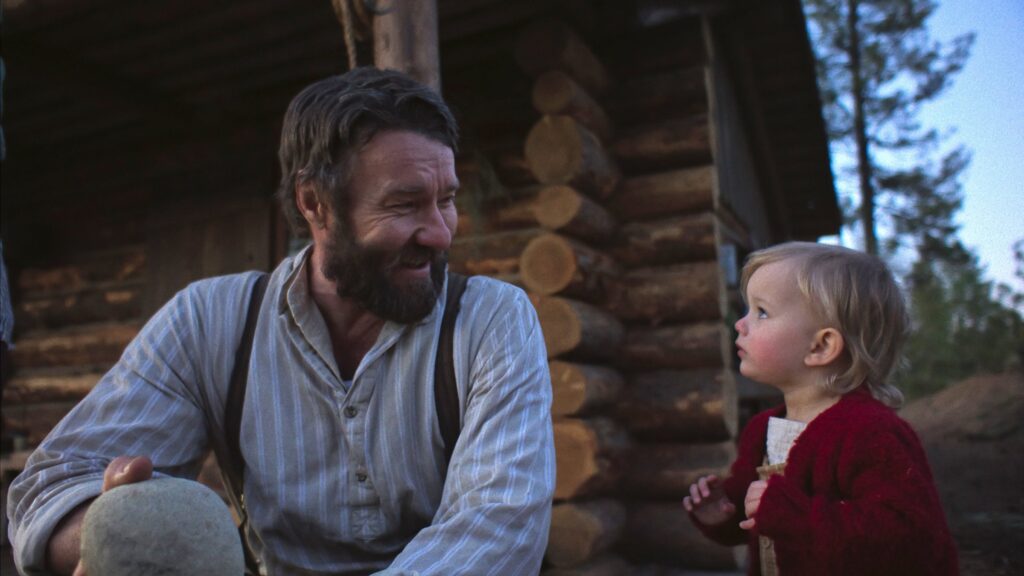
Robert Grainier (Joel Edgerton) and his daughter in front of the cabin he and his wife (Felicity Jones) built.
But the world changes as time marches on. The bridge he helped build is rendered obsolete after the construction of a concrete and metal one. Horse and wagon are replaced by automobiles. Eventually even his tools become outdated, his hands too uncertain with chainsaws to continue in the industry. He finds other work, but the world keeps changing in ways both thrilling and anguished. He lives through the advent of flight and the origin of the forestry service. He is swindled at a sad, local sideshow touting a wolf boy that is nothing but a kid in a costume. He watches the marring of the landscape as forests are torn down.
The world is undergoing re-creation in the images of humanity and machinery. Just as with fire, this re-creation demands destruction, requiring the earth and humanity’s efforts as its fuel. When fire sweeps through there is an opening for new life, but there’s no guarantee that this technological transformation will engender a good form of life. Though he doesn’t pay it much mind, Grainier plays an inevitable role in these transformations. His axe is part of the rapacious destruction of the Northwest forests, his blade one of the many that scars the earth. His labour furthers the aims of an industry that will only quicken the consumption and degradation of nature. The work wears him down, but it doesn’t seem to trouble him greatly.
It’s a world where the rapacity of industry overwhelms both human and natural resources. The work can’t stop for the day just because a man died. (It’s the company, you understand.) As Grainier moves from job to job, felling woodlands and building bridges, no one pauses to take an account of the extent of deforestation. A young logger predicts that they can keep cutting trees for a thousand years, by which time the new trees will have fully replenished where the old ones fell. Naivety, perhaps. But his foolishness cannot be extended to the companies that pay for this destructive labor. Greed, willful blindness, and callousness are the motivations to be found there. They will grow and expand, damn the world.
Not Even Solitude in the Mountains3
Not too many folks I cross paths with more than once in this life. I see it as a blessing when they’re brought back around.
— Arn Peeples
Grainier is frequently alone, though he’s no loner. When he’s away from home on a logging crew, he misses Gladys and his daughter, Kate. He connects with the other loggers, and he is amiable toward the folks in Bonners Ferry, but it’d be hard to say that he has friends. The one exception would be Arn Peeples (William H. Macy), an elderly explosives expert who is rarely without a mystic koan. Itinerant is the word used of Grainier and the men around him, and it’s an evocative one. They may have families, may have homes, but they roam. Bounce from here to there, looking for any possible work. Some are fugitives. Some are ambitious. But they’re all itinerant wanderers.
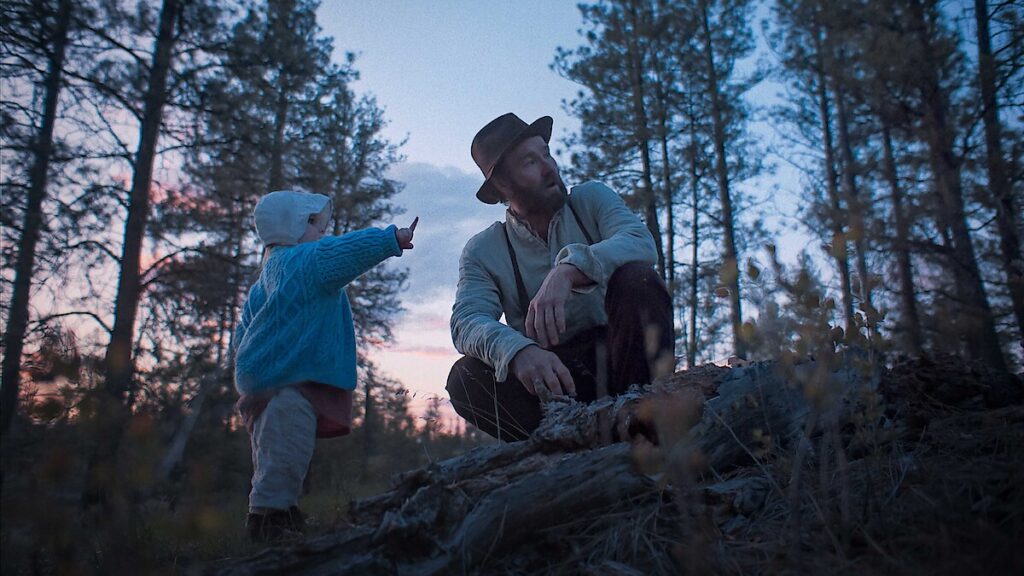
Robert Grainier (Joel Edgerton) and his daughter explore the woods near their home.
Train Dreams is (blessedly) not a film that proselytizes rugged individualism. Grainier may be lonesome and reserved, but he doesn’t disdain company, and neither does Bentley’s movie. As with most of the things that Adolpho Veloso’s camera turns its eye toward, such paeans to heroic solipsism have long been worn out. There’s reticence and weariness, but these qualities are softened, intermingled with the awareness of just how much ‘the world is intricately stitched together’. Life is once more arbitrary, as Grainier never knows who he’ll encounter on the next job, but that also means that a wild beauty is at work as these itinerant souls cross paths. ‘Though little note was made of them in this world, they left a lasting impression on Grainier’.
But the world of humankind mirrors the natural world in its fragility and danger. Just as the tools of industry warp and mar the northwest forests, the violence of prejudice and cruelty scar these tentative communities. The familiarity of human evil prevents Train Dreams from becoming a means of romanticizing a lost past. This is a world where an immigrant can be singled out and condemned without evidence, with hardly an accusation. As a Chinese labourer is thrown from a bridge in the forest, Grainier tries to help carry him, asking, ‘But what did he do?’
Humanity is in a constant state of fracturing. All communities are fluid and shifting; they either bend to welcome the other or they become brittle, ready to crack at the first sign of pressure. Fire sparks life, but it also ushers in death. The same is true for community. These evils hover around the edges of Train Dreams as Grainier lives through his days. Grainier even comes to be haunted by the ghost, or perhaps the mere memory, of the murdered Chinese logger. Through this haunting, the movie offers us a visage of America, an America haunted by its past injustices, foolishly accumulating more. It doesn’t know what it would mean to stop and ask why.
Dry Bones Can Harm No One4
We’re but children on this earth pulling bolts out of the Ferris Wheel, thinking ourselves to be gods.
— Arn Peeples
For those who saw the comet as harbinger of an apocalypse, the final shock was that life continues. But it doesn’t always. The world avoids a cataclysm, but Grainier doesn’t. The next time fire arrives, it claims the lives of his family along with his home and farm. That which gave structure to his life and hearth to his body is now ash. That which gave purpose to his days has been spirited away.
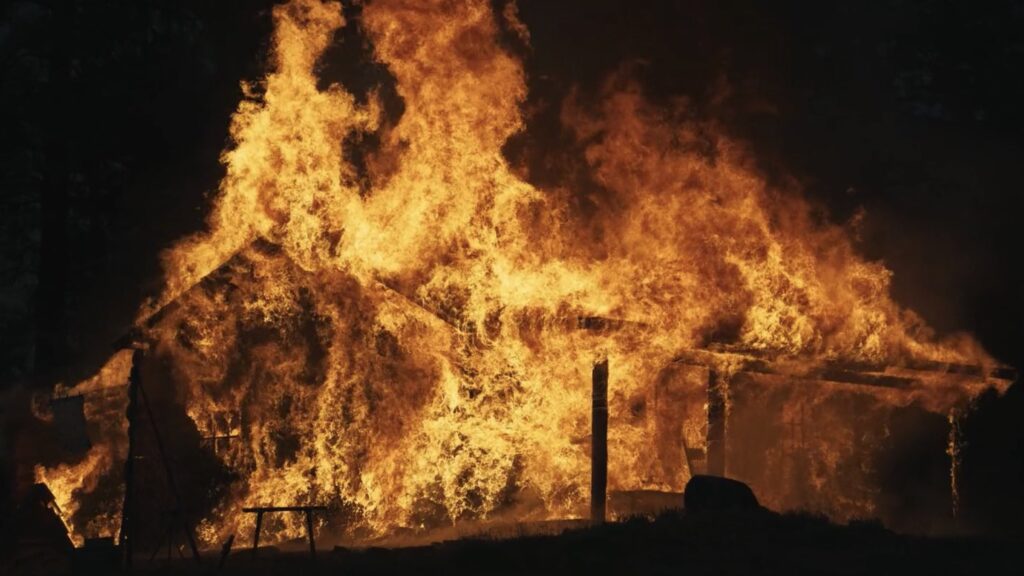
A fire consumes Robert Grainier’s family home.
It is here that fire makes its presence evident, though its breath is everywhere throughout Train Dreams. It is the ecological force that gives voice to creation’s moan, the symbol of judgment on humanity’s violent industries. Death rides through the sweeping forest fire, leaving Grainier to roam in the wake of it, his world just the ashen ghost of a home. At the same time, the fire represents the lurking outrage of humanity itself. Humanity has such creative force to reshape the entire world according to its ends—but we seldom weigh those ends with discernment. And that energy instead becomes the ferocity of racism, nationalism, colonialism, and terrorism. Our anger takes others as its fuel and spreads like a wildfire.
If there’s a romanticism at play in Train Dreams, it is primarily because its world simply feels different from our own. Yes, there’s a connectedness to nature envisioned that is hard to locate in this millennium, but nature’s arbitrary savagery is just as evident. The land is a source of beauty and provision up until that dead branch falls or the forest becomes an unquenchable fire.
Sometimes life’s persistence seems as cruel as its end. But in its persistence, we must also wrestle with beauty. For as much as Train Dreams is about nature’s arbitrariness and humanity’s greed, the movie is also about the moments of life that stun us in spite of it all. This is birdsong and river gurgle, pink clouds against sunset, light whispering through a dark forest, the simplicity of the flowers that bloom year after year. And why do they bloom; don’t they know how tragic this world is? Why do they punctuate this horror with the humblest, most ephemeral presence possible? Still, they bloom.
In the Faint Moonlight, the Grass is Singing5
Beautiful, ain’t it? Just beautiful. All of it. Every bit of it.
— Arn Peeples
We must attend to every bit of it. We must attend to the pounding heartbeats in the grip of love. We must reckon with the comfort of unexpected solidarity when someone we hardly know manages to understand our pain. We must see that, even as life continues, there is more to be surprised by, even with the immense toll the years have taken. At the opening of the movie, the narrator observes ‘that old world is gone now… rolled up like a scroll and put somewhere’. It is a reference to John’s vision in Revelation when he bears witness as ‘the heavens receded like a scroll being rolled up, and every mountain and island was removed from its place’ (Revelation 6:14). The narration listens for the echo of a world that has receded, an echo that promises that our world too will one day recede. All things go. People, towns, industries, landscapes, memories, stories. Prophecies, too, fade into the distance, whether through a failure that invalidates them or through a fulfillment that makes them redundant.
Train Dreams gives breath to the old adage about the universal in the particular: the film is simple and lovely and quiet, and perhaps nothing more than that. But it is also resonant. All films contain events, a plot arcing through the sky like a comet, but Train Dreams manages to evoke a life. The film is a reminder of our place in time. We are itinerant in this ever changing world. We’re all tilting through life, seeking our bearings. Yet our lives leave marks as we wander, be they the scars on this earth from our blades and our ambition, or the tender companionship we offer our fellow travelers. Train Dreams, like our moments and memories, resembles nothing more than a heap of broken images. Yet in those images there is life.