The Princess books, some of George MacDonald’s most memorable tales, tell the stories of two children who each encounter a wise old woman, known as the great-great grandmother (hereafter, “the grandmother”) of the princess Irene. There has been much speculation about who the grandmother is supposed to represent. Various scholars have argued that she is Mother Earth, Sophia (a feminine divine wisdom figure), or God himself. One need not, however, limit the grandmother to an allegory of one figure in exclusion to all others. Instead, it is best to read her as a figure of God described in pagan and Sophia-like imagery.1
One of the key images associated with her is a mysterious rosefire. Irene is the first to see it:
Then Irene looked again, and saw that what she had taken for a huge bouquet of red roses on a low stand against the wall, was in fact a fire which burned in the shapes of the loveliest and reddest roses, glowing gorgeously between the heads and wings of two cherubs of shining silver. And when she came nearer, she found that the smell of roses with which the room was filled, came from the fire-roses on the hearth.2
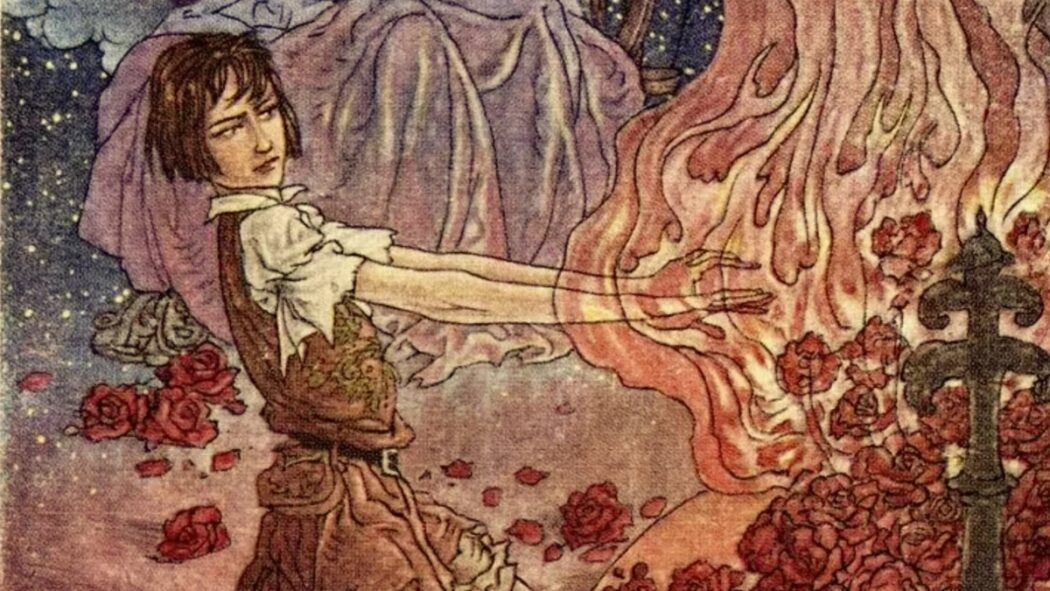
It is through this rosefire that the grandmother purges and prepares Curdie and Irene for their respective tasks. In The Princess and Curdie, the grandmother instructs Curdie to stick his hands in the rosefire as preparation to rescue Irene’s father (the king), defeat the evil men working to overthrow him, and restore the kingdom to justice again. Irene does not go through a similar trial in The Princess and the Goblin, but she is still prepared for her task to overcome the goblins wishing to capture her as a wife by the gift of a ring forged in the rosefire. Both events are significant in the purging and preparing of Irene and Curdie. Since the grandmother functions as a figure of God in the stories, the fire can be seen as God’s tool to purge people of their encrusted evil, revealing their true nature as his children, and enabling them to do his will in the world.

Illustration of Irene and the grandmother from The Princess and the Goblin by Jessie Wilcox Smith, 1920.
The purging fire of the grandmother lies at the heart of MacDonald’s theological endeavour in the Princess stories. Ever the pastor, George MacDonald clearly stated that he sought not merely to delight, but primarily to teach his readers.3 As both a writer and minister, he sought to awaken his readers’ imaginations in a way that turned them toward God.4 It was for this reason that all his works, as John R. de Jong has rightly observed, can and should be viewed as theological.5 Thus, it is important to recognise that the Princess stories are fundamentally about God, how he interacts with his children, and how we, in turn, respond to him.
MacDonald’s Theological Anthropology
To understand the role of the grandmother’s rosefire in the Princess stories, one must first recognise the theological anthropology behind MacDonald’s stories—that is, his understanding of what it means to be human. As scholars have noted, much of MacDonald’s writing was a reaction to the Scottish Calvinism of his youth.6 MacDonald is consistently at pains to demonstrate that people are not fundamentally the totally depraved enemies of God that the most intense varieties of Calvinism can paint them to be; rather, they are his beloved children whose true natures have been covered over by evil. As people go through life, they continually become either more true (children of God) or more false (variously grown-ups or beasts). A person’s fundamental problem then is not his or her inherent nature but rather the false nature that he or she has created and covered over their true selves with.7 This is embodied in the Princess stories first, by the children Irene and Curdie, who are the true people able to encounter the grandmother and be given missions by her, and second, by the miners and grown-ups of Gwyntystorm, who have made themselves beastly, and thus stand opposed to the grandmother.
The Purging Role of the Rosefire
The primary role of the grandmother’s fire in the Princess stories is to consume the evil, false nature built up within a person so that his or her true childlike nature can shine forth. After holding his hands in the rosefire as a trial of ‘trust and obedience’, Curdie finds that his hands have lost their rough exterior and become ‘white and smooth like the princess’s [the grandmother]’.8 The excruciating pain of the fire has purged away his false outer self and literally made him as pure as the grandmother. In his sermon on Hebrews 12:29, MacDonald argues that evil—all that is not pure and immortal—is that which the fire of God consumes.9 Only once all the evil has been consumed can ‘the essential nature of man, the image of God…appear’.10 While the fire is a literal one in the Princess stories, it is also a metaphor for suffering, which, for MacDonald, plays a crucial role in the Christian’s life as the primary tool by which God purges us and prepares us for his will.11 Any time a character faces suffering, whether from a fire or by some other means, he or she is facing God’s love, mercy, wrath, justice, and, indeed, his very presence. In his love, God uses our suffering to purify us.12 In his mercy, God uses suffering to strip us of sin. In his wrath, He uses suffering to burn up evil.13 Ultimately, He accomplishes his justice through our suffering because, for MacDonald, true justice can only take place when a person is cleansed of evil and made righteous in their very inner being.14
The Presence of God in the Fire
Remarkably, MacDonald suggests that God himself actually suffers with us in this process. When Curdie is finally able to remove his hands from the rosefire, he sees that the grandmother has been weeping. When he asks her if she felt the pain too, she replies, ‘Of course I did’.15 God does not merely inflict suffering on humans; he suffers with us. Christ’s suffering and death on the cross is, for MacDonald, paradigmatic for all humanity. He ‘suffered unto the death, not that men might not suffer, but that their suffering might be like his, and lead them up to his perfection’.16 Christ, as the ‘pioneer of [our] salvation’ was made ‘perfect through suffering’.17 In addition to suffering with us, God also takes our dirtiness upon himself. This is illustrated as the grandmother takes others’ dirtiness on herself. In The Princess and the Goblin, the grandmother does not reject a muddy Irene but scoops her up and hugs her. And when Irene’s dirt gets on the grandmother’s clothes, the grandmother cleans it by passing a burning rose over her clothes three times, thus signifying the cleansing work of the Trinity.18 It is reminiscent of Christ’s healing of the haemorrhaging woman and Jairus’s dead daughter in the Gospels. Instead of being contaminated by the ritual uncleanness of blood and death, Jesus’s own purity goes out and cleanses the woman and the girl, healing them and making them new by his very presence.19
In this sense, God’s very presence is the fire which purges us of our evil. MacDonald melds the agent of the purging—God’s perfect presence—and the tool by which it is accomplished—suffering—into one metaphor: fire. MacDonald scholar Rolland Hein describes this fire as ‘the very nature of God as it affects man’.20 It burns while one is distant to God, but as one draws ever nearer, that burning is transformed to warmth and joy. When Curdie’s hands are in the rosefire, the pain is at first intolerable until it ‘had risen to the pitch that he thought he could bear it no longer, [but then] it began to fall again, and went on growing less and less until by contrast with its former severity it had become rather pleasant’.21 MacDonald himself writes about it this way:
Such is the mercy of God that he will hold his children in the consuming fire of his distance until they pass the uttermost farthing, until they drop the purse of selfishness with all the dross that is in it, and rush home to the Father and the Son, and the many brethren—rush inside the centre of the life-giving fire whose outer circles burn.22
The true children of God are those who, like Curdie, ‘go toward God, cooperating with the process as best they know how’.23
The Preparatory Role of Fire
For MacDonald, the goal of God’s purging process is to prepare a person to be a true disciple of Christ. Once one is cleansed by the fire and returned to one’s true childlike nature, one’s imperative is to obey the will of God. Curdie’s hands are not merely purged by the rosefire. They are given a special ability to feel whether or not others’ hands are becoming more human or more bestial. This gift is necessary for Curdie to perform the mission the grandmother has given him to save the kingdom of Gwyntystorm. Thus, Hein writes that the preparation for a task given by God ‘consists first of purging and then of the bestowal of any strength or special gift required for execution of the task’.24 Hein argues that this perhaps is why Curdie’s hands are cleansed but Irene’s body in The Princess and the Goblin is not; Curdie has the greater task.25 The grandmother refuses to pass the roses on Irene’s body and her clothes because, as she says, ‘it is too hot for you yet’.26 Thus, in some way, Irene is not yet ready for the purging fire that Curdie will have to undergo.
Irene, however, is not without the presence of fire in the performance of her tasks. Kathryn Schmitz writes that the fire-opal in the special ring given to Irene by her grandmother ‘confirm[s] the spiritual ability to perform a task safely’.27 Even though, in this case, Irene herself is not purged by fire, she is still enabled to perform her task to rescue Curdie and guide him out of the mountain by the gift of her grandmother’s fire. In this way, the grandmother’s fire is reminiscent of the fire of Pentecost, in which the Holy Spirit is given to empower and equip the disciples of Christ.28
Along with the grandmother’s gifts, however, comes a warning. In The Princess and Curdie, if Curdie ever once uses his gift for his own selfish ends, it will cease to function correctly, so that, while he will continue to feel human hands and beastly hooves, he will not actually be discerning the truth, and so his final state will be worse than before.29 While Curdie remains faithful to the work the grandmother has charged him with, The Princess and Curdie ends on a rather sobering note. The people of Gwyntystorm remain faithful as long as Curdie and Irene are King and Queen; however, they are eventually forgotten, the people of Gwyntystorm return to evil, and the kingdom is destroyed. The purging work of the fire is not exactly a final state. Just as the people of Gwyntystorm should have remained faithful to the grandmother’s will, so too must one continue to be obedient to the will of the Father.
Conclusion
One does not, therefore, move from the purging fire of God to obedience to him in a straight line so much as in a spiral. We may go through a time of suffering in which we are purged of encrusted evil and thus freed to obey God, but, as we continue in life and begin fixating on ourselves again, the evil begins to build back up and must be purged again. Of course, this process is not hopelessly endless. We move not in a circle, but in a spiral. This, for MacDonald, is the process of sanctification. With each new round of purging and obedience, one moves ever closer to the heart of God, is made ever more righteous, and so needs ever less purging. Eventually, we will be perfect as he is perfect. We need only go willingly into the rosefire.30
1. Maria Davies has argued that the grandmother is a purely pagan Mother Earth figure. Deirdre Hayward has somewhat more convincingly argued that she represents Sophia, the ‘female revelation of God, a divine principle of wisdom, and the beloved of the alienated soul’, as understood by MacDonald’s influences Novalis and Jacob Böehme. Katharine Bubel argues for some combination of pagan and Christian influences, arguing that MacDonald recognizes the ‘feminine principle contained within ancient pagan metaphysics…as early intuitions of the Holy Spirit, which he in turn re-imagined as the Wise Old Woman’. Some combination of Hayward and Bubel’s thought is likely the best explanation. MacDonald was heavily influenced by mystics like Novalis and Böehme, and a Sophia-esque wise woman character is found throughout his writings, but this does not mean that the wise woman character is always meant to represent a feminine principle separate from the Trinitarian God. I think it most likely that he uses pagan and Sophia-like imagery when using women to image God. See Maria Gonzales Davies, ‘A Spiritual Presence in Fairyland: The Great-Great-Grandmother in the Princess Books’, North Wind 12, no. 4 (January 1993), 60-65; Deirdre Hayward, ‘The Mystical Sophia: More on the Great Grandmother in the Princess Books’, North Wind 13, no. 4 (January 1994), 29-33; and Katharine Bubel, ‘Knowing God “Other-Wise:” The Wise Old Woman Archetype in George MacDonald’s The Princess and the Goblin, The Princess and Curdie and “The Golden Key”’, North Wind 25, no. 1 (January 2006), 1-17.^
2. George MacDonald, The Princess and the Goblin (New York: William Morrow & Company, 1986), 96.^
3. Greville MacDonald, George MacDonald and His Wife (London: George Allen and Unwin, 1932), 375, quoted in Kerry Dearborn, Baptized Imagination: The Theology of George MacDonald (New York: Routledge, 2016), 2. To teach, for MacDonald, is to ‘wake things up that are in him [the reader].’ The goal of an imaginative story is to ‘move by suggestions, to cause to imagine.’ MacDonald insists that there are more true meanings to be found in his stories than he as an author intended because a true story has its source ultimately in the imagination of God. George MacDonald, A Dish of Orts (Columbia, SC: Odin’s Library Classics, 2021), 132. ^
4. MacDonald, A Dish of Orts, 17.^
5. See John R. DeJong’s treatment of MacDonald’s views on theology and literature in John R. de Jong, The Theology of George MacDonald: The Child Against the Vampire of Fundamentalism (Eugene, OR: Pickwick Publications, 2019).^
6. See Dearborn, Baptized Imagination; de Jong, The Theology of George MacDonald; and Michael Phillips, George MacDonald: Scotland’s Beloved Storyteller (Minneapolis, MN: Bethany House Publishers, 1987) for more about the role of Calvinism in MacDonald’s life and thought.^
7. George MacDonald, Unspoken Sermons: Series I, II, and III (Middletown, DE: 2016), 22.^
8. George MacDonald, The Princess and Curdie (New York: Puffin Books, 1994), 70. ^
9. MacDonald, Unspoken Sermons, 20. Hebrews 12:29 reads, ‘for indeed our God is a consuming fire’.^
10. Rolland Hein, The Harmony Within: The Spiritual Vision of George MacDonald (Grand Rapids, MI: Christian University Press, 1982), 33.^
11. While this is demonstrated throughout MacDonald’s stories, Mara’s house of sorrows in Lilith is perhaps the clearest example of this. Lilith must go to the house and suffer greatly before she can see the evil beast she has turned herself into and so begin on the path to redemption.^
12. MacDonald, Unspoken Sermons, 17. ^
13. Hein writes that ‘God’s wrath is hardly distinguishable from his love: both are creative’. Hein, 33.^
14. MacDonald, Unspoken Sermons, 252. There are few ideas MacDonald despised more than the notion of imputed righteousness; that is, that God would look at unrighteous humans and see Christ’s righteousness over them without actually making them righteous themselves.^
15. MacDonald, The Princess and Curdie, 70.^
16. MacDonald, Unspoken Sermons, 21. ^
17. Hebrews 2:10, NRSVUE. ^
18. MacDonald, The Princess and the Goblin, 97-98. ^
19. Matthew 9:18-26; Mark 5:21-43; Luke 8:40-48. ^
20. Hein, 32. ^
21. MacDonald, The Princess and Curdie, 70. ^
22. MacDonald, Unspoken Sermons, 262. ^
23. Hein, 32. ^
24. Hein, 40. ^
25. Hein, 40. A potential critique of this idea is that Hein seems to write as if Irene’s clothes were cleansed, but it is actually the dirt from Irene on the grandmother’s clothes that is burned away.^
26. MacDonald, The Princess and the Goblin, 98. ^
27. Kathryn Schmitz, “The Transformation from Law to Spirit in The Princess and the Goblin,” North Wind 34, no. 3 (January 2015), 66. ^
28. Acts 2:1-4. ^
29. MacDonald, The Princess and Curdie, 74. ^
30. While I focused on the purging and preparing powers of the grandmother’s fire, it is worth noting that her fire also heals the king near the end of The Princess and Curdie. One could certainly argue that the purging of evil by fire is a kind of healing, but that is not the sum of how the fire may function in the healing of the king and others more generally. There is, therefore, more work to be done in exploring how MacDonald uses fire and suffering to effect healing in God’s people and world.^