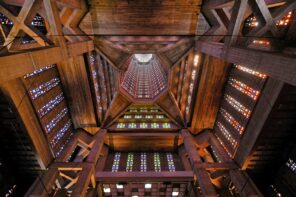
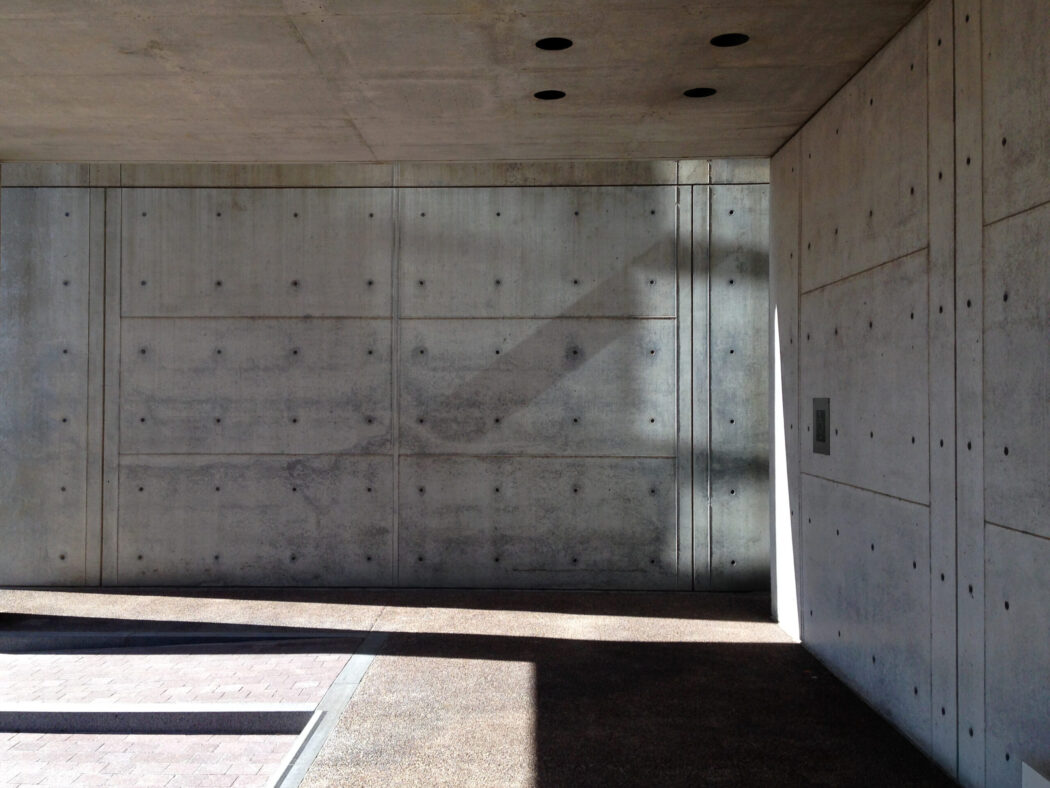
Inspiration is the feeling of beginning at the threshold where Silence and Light meet. Silence, the unmeasurable, desire to be, desire to express, the source of new need, meets Light, the measurable, the giver of all presence, by will, by law, the measure of things already made, at a threshold which is inspiration, the sanctuary of art, the Treasury of Shadow.1
– Louis Kahn
Silence and Light
Long before he spoke of Silence and Light, American architect Louis Kahn learned that radiance could wound. The lesson came three years into his life. As a child it was the light of the coals that captured his imagination. But, until his mysterious demise, he remembered the lesson by the scars on his face.
Kahn did not learn to harness light, however, until decades into a failed career. He only discovered this in a famed trip to the ancient worlds of Egypt and Greece. There, the colours of his pastel sketches refracted the light of the mediterranean as he frantically raced to capture the primordial forms of monumentality. Triangle, circle, square, and line are present; but so is light and shadow, presence and absence—the threshold between the measurable and its treasury.
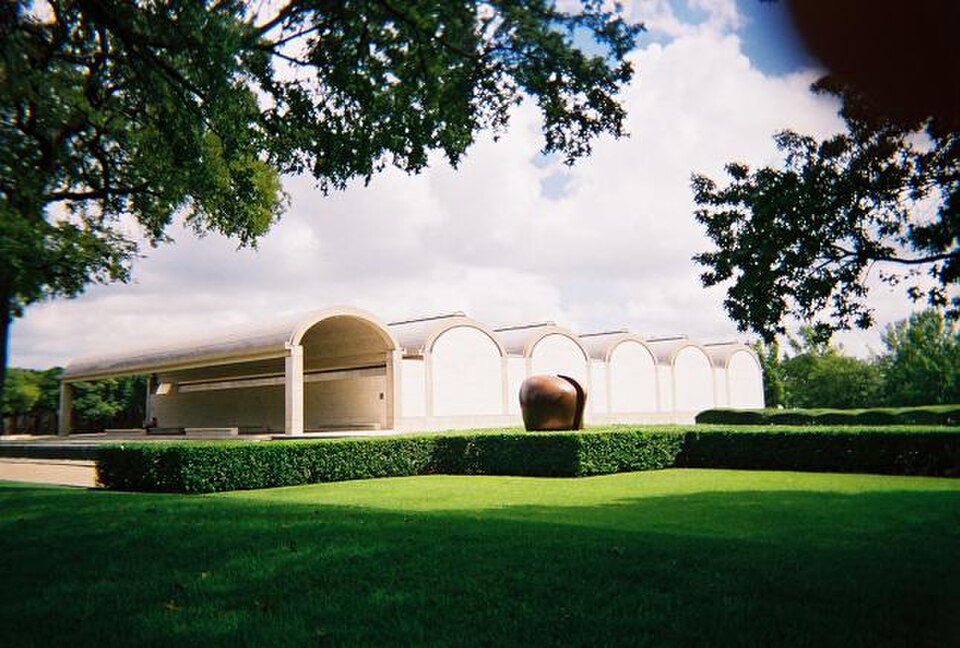
The Kimbell Art Museum, designed by Louis Kahn, 1972.
From there, his struggling designs became acclaimed masterpieces. Among the first projects completed upon returning from his travels was the Yale University Art Gallery (1953). This building begins to utilize diffused natural light in concert with artificial illumination, especially through the now-famous tetrahedral ceiling, where structure itself becomes a device for catching and tempering brightness. Here light is no longer incidental to architecture, but one of its materials. Kahn would perfect this discipline in the vaults and cycloid skylights of the Kimbell Art Museum (1972), where the gallery is lit only by the sun.
-
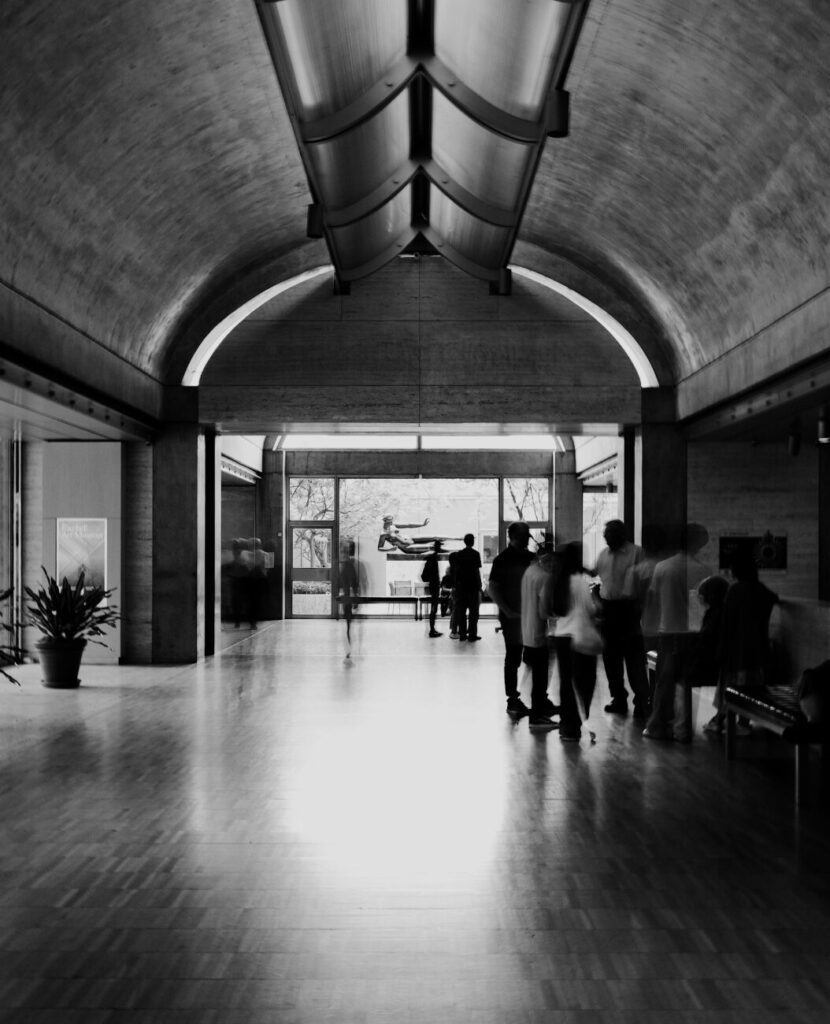
- Interior of Kimbell Art Museum. Image by Erick Reifer Marchak.
-
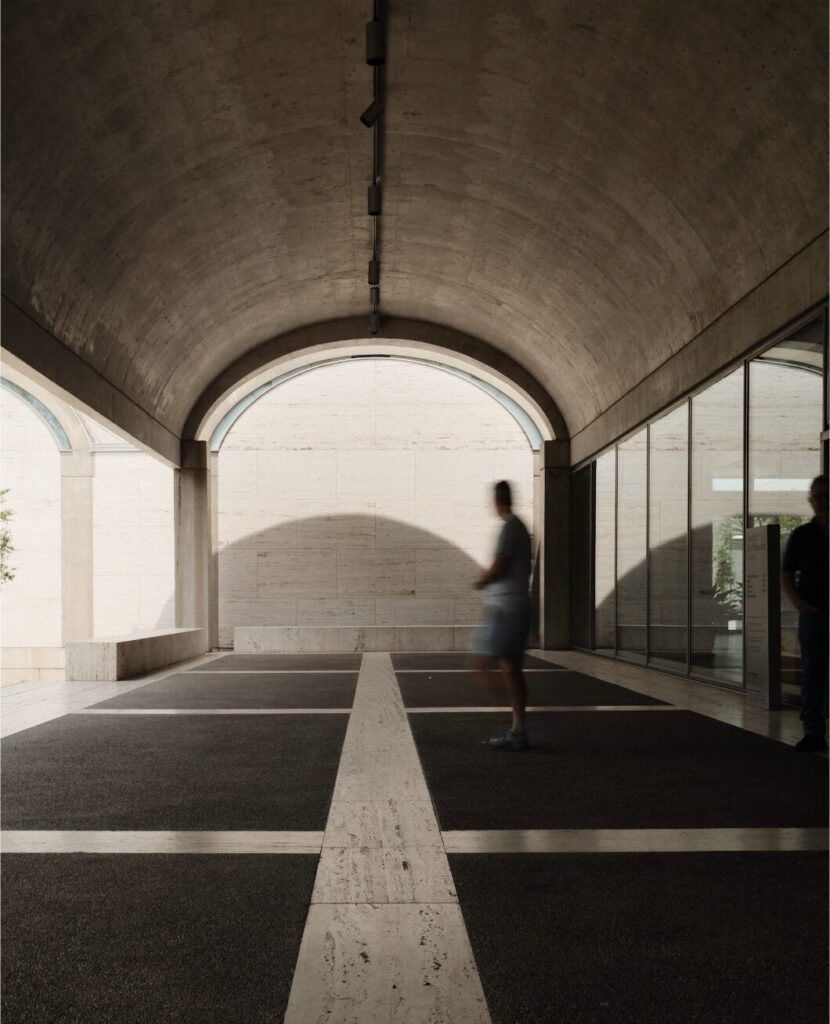
- Exterior of Kimbell Art Gallery. Image by Erick Reifer Marchak.
Even if Kahn discovered how to harness light in the ancient world, he continued to draw on the memory of his coals. His designs never strayed far from that fireplace in his childhood home.
Gaston Bachelard writes that fire is a primary means to recall the past: ‘Fire and heat provide means for explanation in the most varied domains, because they have been for us the occasion for unforgettable memories, for simply and decisive personal experiences’.2 In Kahn’s childhood, the wound of flame becomes, decades later, an architecture of measured light. Fire does not merely preserve the past; it transfigures the past into possibility. Its glow falls backward and forward at once.
Perhaps more importantly, though, is that fire stands as a multivalent symbol. Its hermeneutical possibilities radiate in excess. Bachelard writes:
Fire is the ultra-living element. It is intimate and universal. It lives in our heart. It lives in the sky. … It shines in Paradise. It burns in Hell. It is gentleness and torture. It is cookery and apocalypse. It is a pleasure for the good child sitting prudently by the hearth; yet it punishes any disobedience when the child wishes to play too close to its flames.3
This multivalence is readily apparent in architectural theory. From its inception by the Roman architect Vitruvius, to its contemporary interlocutors, fire repeatedly appears to signify what no other sign can. Only, what it signifies shifts with the dance of its flames. From an archetype of memory to a monument of transformation, the ambiguity of fire allows for a wide horizon of meanings in design. What appears consistent through them is that fire exerts a certain attractiveness. Just as Kahn was mesmerized by the glowing coals, architects see the emanation of flames to flicker at the heart of what it means to build, to design, and to dwell.
Fire in Architectural Theory
The symbolic importance of fire begins where architectural theory does, with Vitruvius. In De Architectura, he recounts that human beings were first drawn together by the accidental discovery of fire.4 Gathered around its warmth, they developed speech, society, and finally shelter. Architecture begins, in this ancient myth, not with a wall but with a circle of bodies around flame. Space is defined not by material bounds but by the diffusion of light, where the glow of the fire fades into the darkness of the night.
Hovering behind this account stands Prometheus. For if the first house shelters against storm, orders timber into proportion, or encloses a hearth with woven skill, it does so only after fire has been given—or stolen. Prometheus names the prior event without which no hut can become home: the arrival of technē, of craft, of warmth, of light, by which faces and materials become visible to one another. Every primitive hut is therefore already a house for Prometheus, built in the wake of an elemental gift that is also a transgression.
Later theorists would tell the story differently. Antonio Averlino Filarete, writing within the Renaissance tradition, imagined architecture arising from vulnerability before the elements: wind, rain, heat, cold, exposure.5 Yet for Filarete this elemental hostility was not simply natural circumstance. It belonged to a world wounded by the Fall; the condition of life after expulsion from Eden, where shelter must now answer to thorns, sweat, storm, and toil. While buildings appear as what preserves life, fire appears as what keeps paradise out of reach: God places ‘a flaming sword that turned every way to guard the way to the tree of life’ (Gen. 3:24). Fire here is a sign of judgment, rather than a gift from the gods to encourage human culture. And building appears as a reparative art, the wall and roof as late remedies for a fractured creation. Architecture is born from privation. We seemingly build from a lack of good.
What distinguishes Vitruvius from many of his successors is the mood of his beginning. In later primitive-hut theories, architecture often appears as remedy: protection from weather, repair for exile, defense against scarcity. In De Architectura, by contrast, building arises from a more affirmative scene. Human beings do not first scatter into huts; they first gather around warmth. Before the roof comes encounter, before enclosure comes speech, before fortification comes shared delight. Vitruvius remembers that dwelling may begin not only in fear of the world, but in gratitude for what the world gives. A house for Prometheus would therefore be nothing less than civilization itself. For architecture is not what protects us. It is what moves us by ‘Silence and Light’.
Kahn was not the only modern architect to find resonance with these myths. Frank Lloyd Wright repeatedly treated the fireplace as the moral and spatial center of the house. Wright saw in the fireplace the persistence of an older human drama: gathering, warmth, speech, protection against the night. Echoes of John Ruskin’s present-day primordial cabin live here, where the ‘cottage’ of a ‘hopeful and cheerful’ family was nothing more than ‘a large chimney on the ground, wide at the bottom, so that the family might live around the fire’.6 In Wright’s Prairie houses, rooms extend outward from the chimney mass as though daily life still radiated from a primeval blaze. In Fallingwater, the hearth is built upon living rock, so that flame appears less installed than discovered. A hearth of stone shapes the hermeneutic of the house. It blurs the border between inside and outside, between human created and the natural world. The modern home, for Wright, did not abolish origins; it measured them in a dialectic of revelation and concealment.
Neither Vitruvius nor Wright speaks in theological terms, yet both approach an old religious intuition: that human life depends upon receiving what it cannot produce. Fire arrives first as gift, accident, theft, grace—Prometheus, lightning, spark. Only afterward does architecture begin its patient labor of interpretation, placing stone, timber, and threshold around what drifts beyond our control. In this sense, the hearth stands near the altar. Both gather a people around a presence that can warm, illuminate, or consume. As Kahn says, ‘Light is really the source of all being’.7
Fire at the Cathedral
But there are more meanings buried in its embers. One is of transformation, perseverance, an undying hope. This finds even more contemporary examples. In a provocative move, Mathieu Lehanneur proposed a flame to replace the spire atop Notre Dame following the 2019 fire. He points out the contradiction for calls to rebuild the cathedral’s roof in its ‘traditional’ form—when that traditional form was itself a radical modification by Viollet-le-Duc in the 19th century. If the logic of conservatism is to return to some former point, ‘I proposed to rebuild the spire as it was, following the most conservative people’, Lehanneur says, ‘but as it was last week!’ He continues to explain the real inspiration for his proposal:
I love this idea of a frozen moment in the history that can remains for centuries. The project is a monumental permanent flame covered with golden leaves. For me, it’s a way to capture the catastrophe and turn it into beauty, turning ephemeral into permanency.8
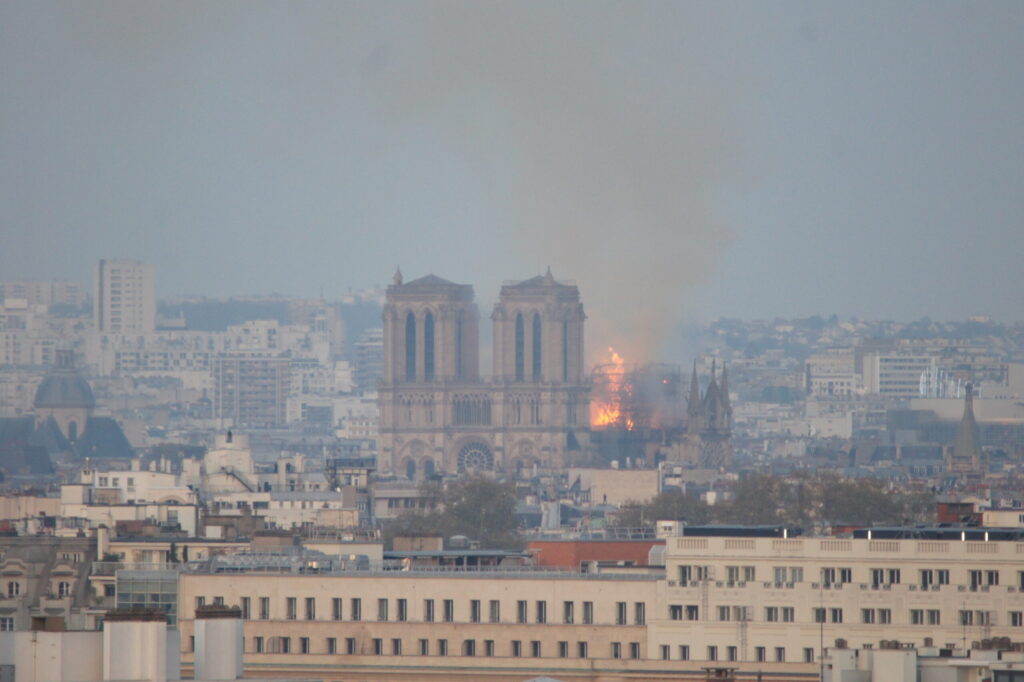
Fire at Notre Dame de Paris by Laure Petrucci
As a flame atop Notre Dame signifies, fire also looks forward, the way Kahn was inspired by his glowing coals, the way Prometheus was punished for his gift. Fire gathers memory; light solicits hope. If flame is the element of recollection, illumination is the medium of anticipation—the disclosure of forms not yet built, rooms not yet entered, futures not yet inhabited. Kahn understood this when he spoke of inspiration at the threshold where ‘Silence and Light’ meet. What arrives in light is not only visibility, but vocation.
Something of this inheritance appears in the work of Siamak Hariri. In designing the Bahá’í House of Worship of South America, Hariri has acknowledged the formative force of Kahn’s Yale University Art Gallery. He specifically remembered a moment where a security guard touched one of Kahn’s walls on his rounds. Hariri says he did so with love, as if he was touching someone dear to him. This is the effect of ‘Silence and Light’. There too structure becomes luminous instrument rather than inert frame.
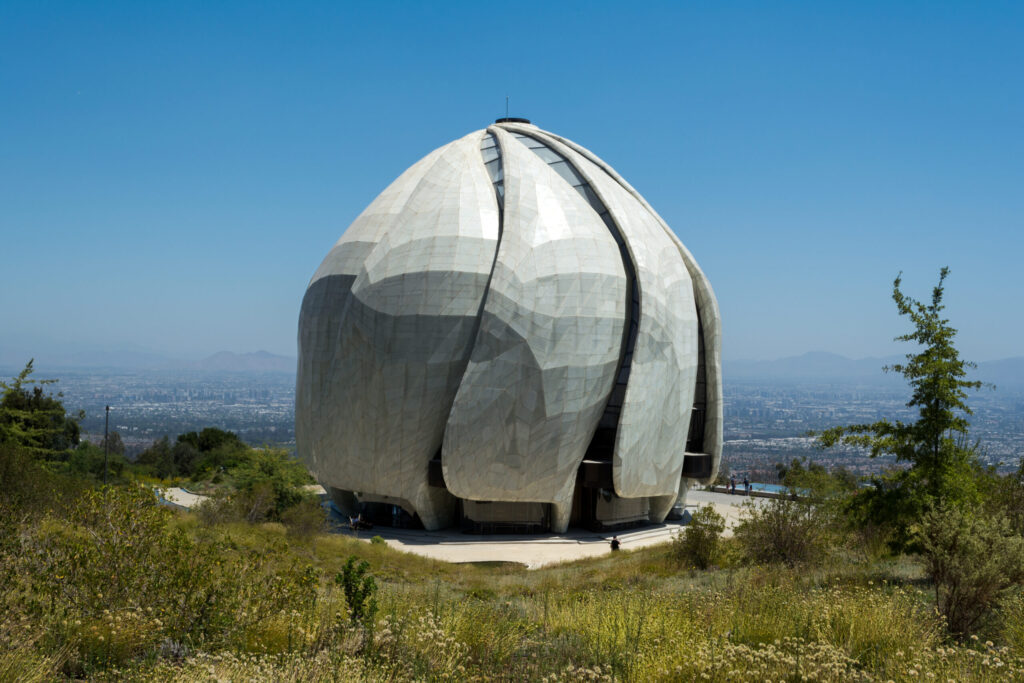
Bahai House of Worship in Santiago, Chile. Image by Carlos Figueroa.
Hariri brought this experience to his design in Santiago. He wanted to make a building a person could love. As with Prometheus, he offered the gift of light.
The building is constructed out of cast glass and translucent marble, materials that receive the day so that the building seems less constructed than kindled. At night, it glows from within like a lantern set against the Andes, a sanctuary whose walls do not contain light so much as release it.
Hariri discovers the opposite ‘form’ from closedness in a passage from the Bahá’í religious text: “if you reach out in prayer, and if your prayer is answered, … the pillars of your heart will become ashine.” Bringing day and night, ‘Silence and Light’, together Hariri uses a translucent borosilicate for the building’s exterior, allowing the entire structure to glow from within, lighting up a valley of the Andes. But it also illuminated Hariri’s own understanding of the passage. The glow of the building made Hariri realize that the passage above means that the person who prays and receives an answer is literally ‘radiant’.
Back to the Gods
Back to the gods, then—not as a return to myth, but as an acknowledgment of what fire has always already suggested. Its meanings never settle. Fire warms and destroys, gathers and scatters, illuminates and blinds. It resists reduction to a single sign. And it is precisely this instability that renders it theologically suggestive.
Back to the gods, then—not as a return to myth, but as an acknowledgment of what fire has always already suggested. Its meanings never settle. Fire warms and destroys, gathers and scatters, illuminates and blinds. It resists reduction to a single sign. And it is precisely this instability that renders it theologically suggestive.9
In the Christian theological tradition, this refusal becomes decisive. Augustine of Hippo speaks of divine illumination not as an object among others, but as the condition under which anything appears at all. Pseudo-Dionysius the Areopagite radicalizes this insight: divine light is not simply what is seen, but what exceeds sight, a radiance that both reveals and conceals in the same act. Thomas Aquinas will later distinguish between light as a physical phenomenon and lumen as a participated radiance—an analogical sharing in what surpasses created being. And for Hans Urs von Balthasar, light is precisely what bridges the ontological divide, rapturing subjectivity in the objective expression of being.
What unites these accounts is a shared recognition that radiance discloses without exhausting. It gives itself to sight while remaining irreducible to what is seen. If fire names the instability of meaning, radiance names its theological intensification—the moment at which what appears also signals beyond itself.
Architecture, at its most disciplined, does not resolve this tension. It sustains it. In the measured admission of light, in the shaping of thresholds and apertures, buildings participate in a logic that is neither purely functional nor merely symbolic. They become hosts for meaning.
Perhaps it is no surprise, then, that the Abbott Suger developed the Gothic style of building at the Abbey of St. Denis—in a quest to fill the space with light so that the visitor would be ‘transported’ to a heavenly realm. Nor is Auguste Rodin’s cry that ‘The cathedral is dying!’ because modern design has lost sight of the essence of the Gothic: to allow the ‘halftone’ to dominate.10 Not too much light; not too much darkness. Only a harmonious play between the two.
Directed squarely at Viollet-le-Duc’s ‘restoration’ of Notre Dame, Rodin screams: ‘Oh, I beg of you, in the name of our ancestors and for the sake of our children, break no more, restore no more!’11 Learn to see radiance and to look beyond ornament!
To dwell within this condition is not to master what appears, but to remain receptive to it. Fire gathers, but it does not conclude. Light reveals, but it does not close. And it is perhaps here—at the threshold where radiance exceeds comprehension—that architecture most nearly approaches theology.
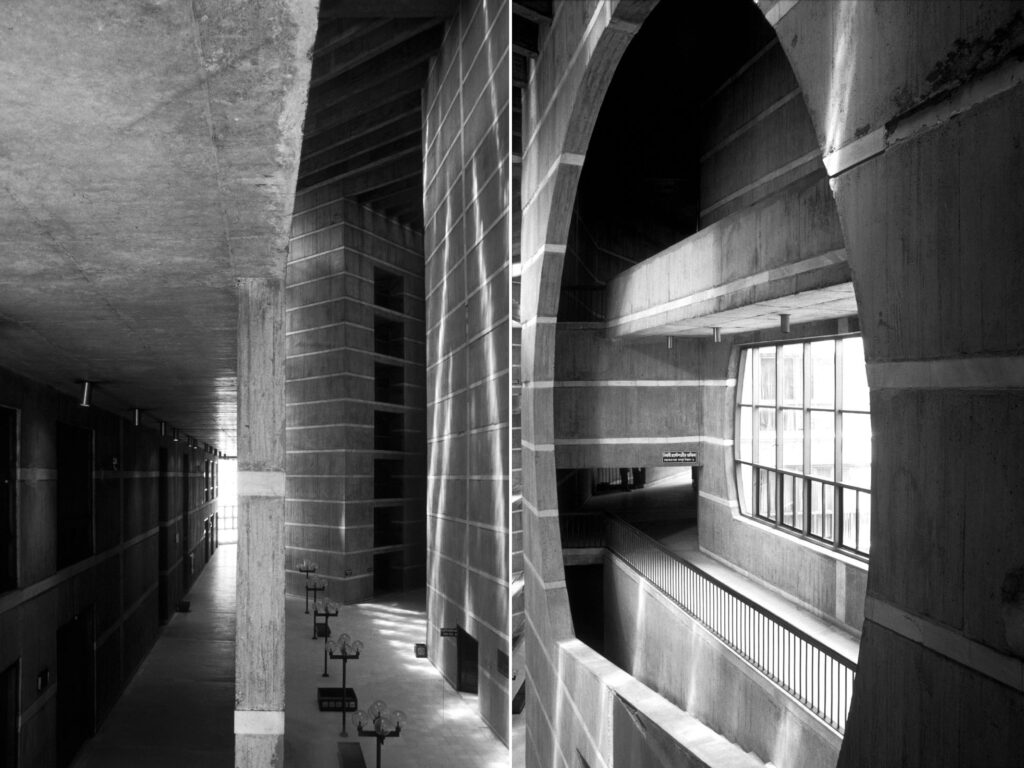
Interior shots of the National Assembly of Bangladesh, designed by Louis Kahn (1982). Images by Naquib Hossain.
It is also here that one can finally understand Louis Kahn. The child who reached toward the coals did not simply learn that fire wounds. He learned that what draws us most powerfully is never fully given to us. That to desire to dwell is to admit we are never at home.12 His language—‘Silence and Light’—names this condition with unusual precision. Silence, the unmeasurable, is not absence but the depth from which meaning comes; ‘Light’, the measurable, is not mere visibility but the event in which that depth becomes perceptible without being exhausted. Between them lies not resolution, but threshold.
What began in the fascination of a child before a flame thus returns, at the end, as an architectural and theological task. Not to master what burns, nor to reduce what shines, but to build in such a way that what is given can still exceed what is made. In this way, the work of light in architecture becomes a silent hope—that what is gathered and disclosed here might yet bear the presence of God.
2. Gaston Bachelard, The Psychoanalysis of Fire, trans. Alan C. M. Ross (Boston: Beacon Press, 1964), 7. ^
3. Ibid. ^
4. Vitruvius, On Architecture, trans. Richard Schofield (London: Penguin, 2009), 37-41. Book II.1.1-9. ^
5. Antonio Averlino detto il Filarete, Trattato di architettura, 2 vols., ed. Anna Maria Finoli and Liliana Grassi (Milan, 1972), 21. ^
6. John Ruskin, “Education in Art,” in The Works of John Ruskin (New York: John B. Alden Publishers, 1895), 122. ^
7. Kahn, Between Silence and Light. Spirit in the Architecture of Louis I. Kahn, 22. ^
8. Tom Ravenscroft, “Seven alternative spires for Notre-Dame Cathedral,” Dezeen, 25 April 2019. ^
9. Kahn, Between Silence and Light. Spirit in the Architecture of Louis I. Kahn, 22. ^
10. Auguste Rodin, The Cathedral is Dying, trans. Elisabeth Chase Geissbuhler (New York: David Zwirner, 2020), 23. ^
11. Ibid, 49. ^
All images licensed for use under Creative Commons 2.0 and/or used with permission.
Find more of Erick Reifer Marchak’s architectural photography here.