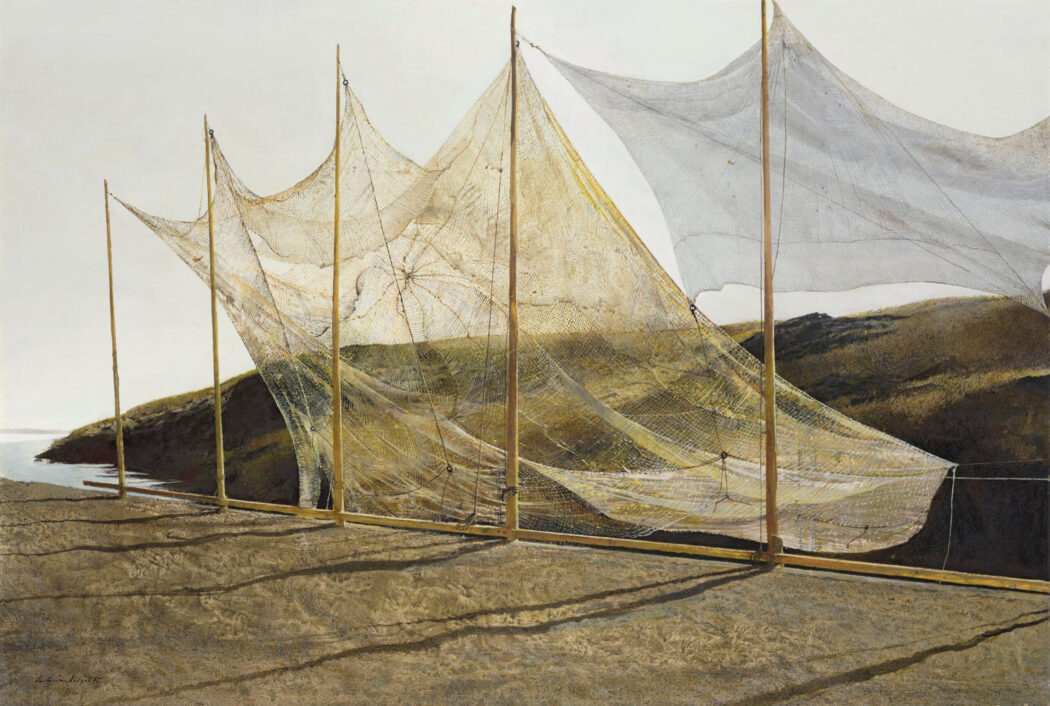
Andrew Wyeth (1917-2009), an American regionalist landscape painter, reframes Christian imagery of Pentecost in his 1989 painting of the same name.
In Pentecost, large fishing nets hang out to dry on poles, illuminated gold by an off-canvas sun. A wind is made visible by the nets themselves, which expansively fill the space between earth and sky. This suggestion of wind, paired with the visual of the gold-tinged net bridging the space between heaven and earth, call to mind the rushing wind and tongues of fire described in the Pentecost event of Acts 2. Wyeth creates a salient image of the activity of Pentecost by these means, along with other visual markers characteristic to his landscapes such as an intensely bright white sky contrasted with drab hillsides.
One year prior to Wyeth’s Pentecost, another American artist created a work about Pentecost that illustrates the event more explicitly, but on visually similar terms. Nancy Chinn (1940–)’s Tongues of Fire was a 1988 mixed-media installation for Grace Cathedral in San Francisco, California comprised of fifty strips of nylon netting, individually painted and hung to display the movement of the Holy Spirit on Pentecost Sunday. The two artworks bear striking similarities, though created in different mediums. Interestingly, both engage the same material (or image of material)—nets—to illustrate the Holy Spirit’s descent from heaven to earth. Additionally, both artworks include wind as an invisible character made visible through the nets; in Tongues of Fire, the strips of netting were positioned to catch the airflow in the cathedral nave, providing the same sense of visual dynamism that Wyeth later captured in his still painting.
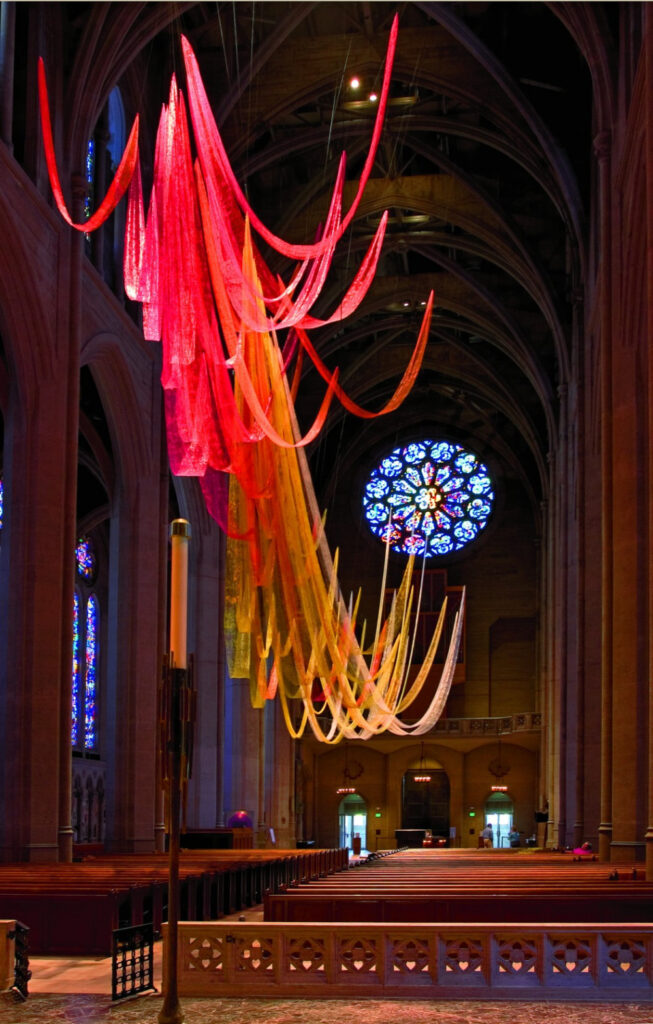
Nancy Chinn, Tongues of Fire, 1988. Fifty painted nylon-net strips, 18 in. × 10–50 ft. (dimensions variable). Temporary installation at Grace Cathedral, San Francisco.
However, despite the works’ visual parallels, Chinn’s Tongues of Fire provides a foil to Wyeth’s Pentecost, revealing the necessity of a believing community for a true Pentecost to take place. A viewer of Tongues of Fire, when it was on display, had to physically occupy the same space as the artwork, phenomenologically participating in the work as the church that the Spirit descends upon, bestowing the gift of Himself. The viewer of Wyeth’s Pentecost, in contrast, is separated from the Pentecostal motion of the blazing fire and rushing wind. This is in part due to the nature of a painting rather than an installation in a place of worship, like Chinn’s, but Wyeth’s painting evokes a further existential anxiety.
Wyeth’s artist statement about Pentecost illuminates the work’s dissonance. When asked about spiritual meaning in Pentecost, Wyeth, who was not a Christian, responded: ‘I felt the spirit of something when I did it. You see, at that time … a young girl was washed out to sea in a storm. They couldn’t save her. In time the body floated by off Pemaquid Point. I was thinking about that girl’s body floating there underwater, and the nets became her spirit’. Wyeth thus offers an inverted interpretation of Pentecost which contrasts to the Scriptural account of the Holy Spirit descending as a generative, empowering gift to the early church.
Visual analysis of the painting yields presence and absence in dissonant ways: the aforementioned visual signals of spiritual activity in Pentecost pair with a stark absence of human figures, and negative space in the net perceives the disembodied nature of the spirit. Wyeth’s explanation of the girl’s spirit makes no allusion to a traditionally Christian understanding of the afterlife, either, instead reframing the imagery as an aesthetic suggestion of a singular spirit dissipating into the world. The emptiness of the nets is reminiscent of two Scriptural images in the Gospels where Jesus uses the imagery of nets to display spiritual fruitfulness; first, in Matthew 4:19, when he calls fishermen Simon Peter and Andrew to become ‘fishers of men’, and in John 21 when he appears to the disciples by filling their fishing nets so abundantly that ‘they were unable to haul the net in because of the large number of fish’. Art historian Michael Kammen recognises this phenomenon in Wyeth’s paintings, saying that ‘One of Wyeth’s most characteristic qualities, in fact, is his fondness for the absence of a presence… in Rope and Chains, whose subject is the slaughter of pigs, only the instruments of death are present, not the victims. In Brown Swiss, we do not see the cattle, only their tracks’.1
Viewing Pentecost as Wyeth’s response to a death in his locale crystallises his reinterpretation: to Wyeth, the painting is less akin to Acts 2 and more reminiscent of Martin Heidegger’s being-towards-death: an encounter with death which strikingly highlights the question of Being. Heidegger says of this phenomenon that ‘only humanity “has” the distinction of standing and facing death, because the human being is earnest about Being (Seyn): death is the supreme testimony to Being (Seyn)’.2 Death, as an experience, can never be fully represented by another; it is purely individual and phenomenological in a way that those who bear witness cannot fully understand. However, the experience of another being’s death is likewise a uniquely human experience which sharpens perception of death’s eminence. Pentecost uses spiritual imagery to pose existential questions that follow similar threads: what happens when we die? What does it mean to have a spirit? Is rising up as a wind through a glittering fishnet the final outcome for a life that could not be saved?
The painting and its meaning stand in particular contrast to its title, too, because of what Pentecost is, and who it is for. Pentecost is a gift for the living, not the dead; wholly generative, bestowed to the church for the purpose of the church’s growth, following Christ’s directive to ‘go therefore and make disciples of all the nations, baptizing them in the name of the Father and of the Son and of the Holy Spirit’.3 The generative nature of Pentecost—of life begetting life—is the antithesis of emptiness, which makes the stark emptiness of Wyeth’s Pentecost all the more dissonant.
In this way Wyeth’s Pentecost, considered with other non-Christian artists of the period, is also indicative of a greater shift in American culture towards the ‘crypto-religious’4 in art in the later twentieth century, where religious themes were reframed or redeployed to express something other than conventional belief. Other artists of the period like Andy Warhol and Mark Rothko engaged with the sense of a supernatural presence in their artworks, whose effects were ‘often made more intense by [their] separation from formal religion’.5 Wyeth likewise engages in a sense of mystery responding to a felt spiritual presence in Pentecost, but reframes the ‘spirit of something’ as a negation of generativity, and instead an omnipresence of mortality.
It’s possible that Wyeth’s redeployment of Pentecostal imagery in Pentecost to process existential anxiety and being-towards-death is simply an agnostic relation of human spirit to the Holy Spirit of Pentecost – ‘the spirit of something’. However, for the Christian reading the image of paintings like Pentecost, the absence of what is named in the painting’s title can paradoxically guide the viewer towards hope. Though perhaps not Wyeth’s intention, the effect on a viewer who understands the significance of the events of the Christian liturgical year can call to memory the promises established by God through the event of Pentecost—serving as a practice for exercising a faith that is ‘the substance of things hoped for, the evidence of things not seen’.6
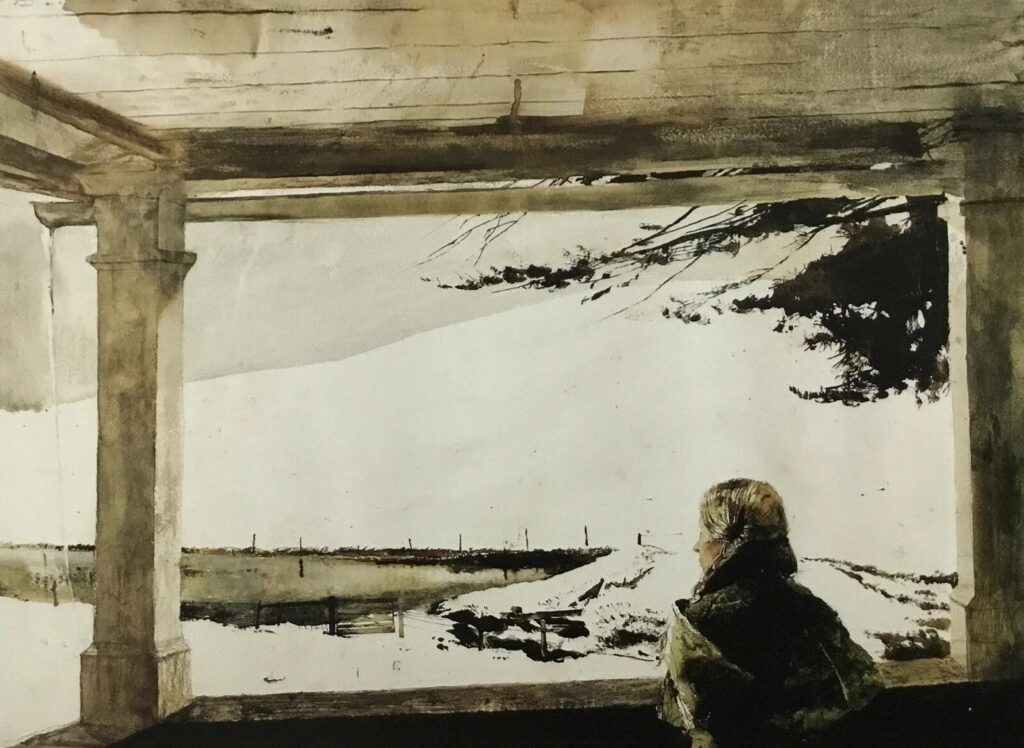
Andrew Wyeth, Easter Sunday, 1975. Collotype print created 1994. 22 1/2 × 28 1/2 in. Private collection.
An example of this can be found in another Wyeth painting, titled Easter Sunday. A lone figure gazes out from her porch onto the onto a barren, wintry field with no visible signs of spring. The viewer joins in the figure’s longing gaze, joining in the silent lament of a long winter. But the viewer is steadily expectant of what is not yet seen on the canvas: the spring that unfailingly resurrects the world each year. Pentecost’s golden fishnets moving between the heavens and the earth can act in a similar sense, reminding the viewer of what Pentecost gives, and all that is needed for it to take place: ‘the Holy Spirit, the communion of saints, the forgiveness of sins, the resurrection of the dead, and the life everlasting’.7 The visual of heaven meeting earth allows the viewer to remember, recognise, and hope for all that can take place when the Creator comes to meet the created.
1. Michael Kamman, “Andrew Wyeth: Resonance and Dissonance,” Beth Venn et al., eds., Unknown Terrain: The Landscapes of Andrew Wyeth (Whitney Museum of American Art, 1998), 202. ^
2. Martin Heidegger, Being and Time, translated by Joahn Stambaugh (Stambaugh State University of New York Press, 2011), GA 65: 230.^
3. Matthew 28:19 ^
4. ‘Crypto-religious’ is a term coined by Polish poet Czesław Miłosz in a letter to Thomas Merton in 1951. “Cryptoreligious art is work that incorporates religious words and images and motifs but expresses something other than conventional belief.”^
5. Paul Elie, The Last Supper: Art, Faith, Sex, and Controversy in the 1980s (Farrar, Straus and Giroux, 2025). ^
6. Hebrews 11:1. ^
7. Taken from the Apostle’s Creed. ^