
After a year of being offline, Transpositions is back. And we, for one, couldn’t be more thrilled about this news.
Through a series of unfortunate events, we found ourselves without a website early last year. Thanks to the hard work of many, we were able to recover much of it, and have been hard at work refreshing things ever since. But you may have noticed it looks a little different around here now.
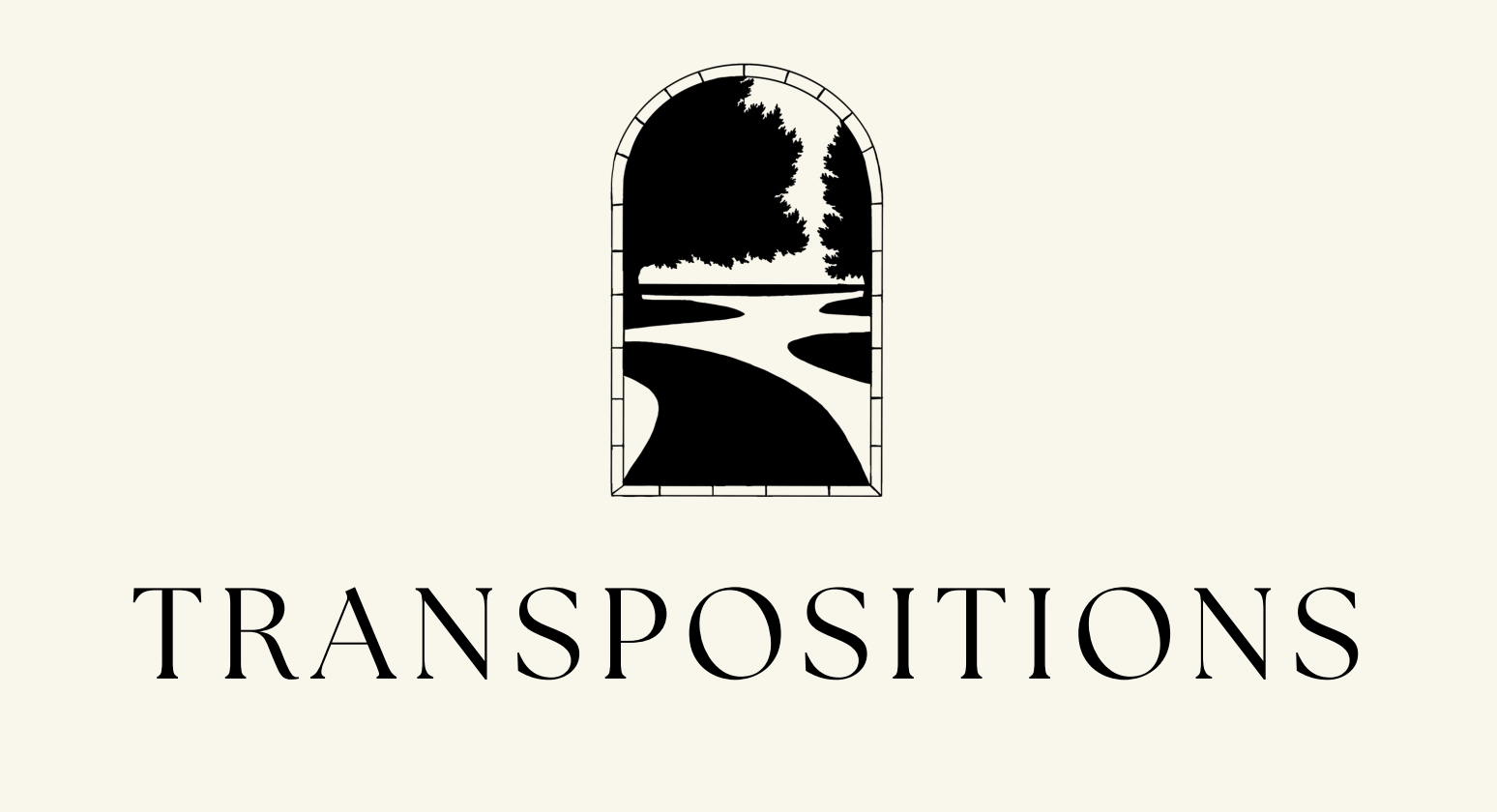
We used the time offline to update some things, including a new logo and look.1 Like good arts scholars, we’re keenly interested in the relationship between form and content, and thus started considering the way this site could reflect a little more of who we are.
Introducing The Holm Oak
Each Friday morning during the school terms, the graduate students in the Institute for Theology, Imagination and the Arts gather for a weekly research seminar in College Hall. Here, we listen to a scholar in the field give a paper, after which we have a discussion about their work. There is tea, the riches of academic community, and, more often than not, some vibrant conversation.
About halfway through the seminar, on a sunny day, mid-morning light pours through the broad windows that line the eastern wall, drawing one’s attention outside. There, at the centre of St Mary’s quad, lives an approximately 286-year-old tree, with a wide canopy of branches that shelter a decent radius of said quad. Framed by the windows of College Hall, the holm oak captivates.
Our new logo is a head nod to this formidable tree. In this, it places us. Though Transpositions facilitates an international dialogue, inviting writers from all over the world to contribute to our discussion on theology and the arts, we are, after all, rooted here in Scotland at the storied University of St Andrews.
Yet our new logo also invokes ideas of windows and, with this, of meeting points that transcend the particulars of any specific place. This meeting point is crucially mutual. Yes, the path leads our attention outwards, but from another angle, it approaches us as we invite it in. The logo is further reminiscent of stained glass church windows, of the interplay of shadow and light, and even of the essay from which our journal gets its namesake. (Learn more about that here.)
Take a Look Around
If it’s been a while — and, I mean, it’s been at least a year — then stay here for a bit and get to know us again. Learn more about Transpositions here, meet our new team of editors, and stay updated on our latest call for submissions, which will remain open until June 15.
For the next several weeks, we’ll be publishing essays on the theme A World Ablaze. Given the recent celebration of Pentecost Sunday, we find ourselves thinking about those tongues of fire that descended ‘like a dove’ to enliven something new. With this in mind, we asked you for essays that interrogate the imagery, implications, and ideas this story evokes. Given that fire is a multifaceted image in both theology and the arts — representing everything from glory and theophany to purification and destruction, even resurrection — we expected a diverse set of submissions, and can happily report that this topic has had seemingly wide purchase. There are essays on meeting points, tensions of divine presence and absence, transformations, and more. Browse a few preliminary highlights here:
- ‘The Spirit of Something’: Presence and Absence in Andrew Wyeth’s Pentecost by visual artist and PhD candidate Ellie Goings
- A House for Prometheus by Dr. Charles Howell — in which an architect-turned-theologian reflects on the role of light (and its absence) in famous works of architecture
- Purged and Prepared: The Great-Great Grandmother’s Rosefire in George MacDonald’s Princess Stories by Sophie Burkhardt
- Salvation by Fire: The Magdalene and the Madonna in Dostoevsky’s Poetics by PhD candidate Christina Eickenroht
Each week this spring, we’ll share a new essay for you to enjoy. We have articles coming on Prince of Egypt and Heidegger, ecology and architecture, Hamnet, the theological aesthetics of J.M.W. Turner, and much, much more.
We also have two reflections highlighting a recent exhibit by Transept — a group of multidisciplinary practising artists connected to ITIA — that showcase some of the creative work happening right here in St Andrews, by some of our very own. The exhibit theme was Immaterial Evidence, and these articles consider this theme from a theological and artistic lens.
- Dr. Dan Drage reflects on the gap between our comprehension and mystery, the place where art is bodied forth.
- Dr. Charles Howell similarly considers the requisite nature of distance and desire in relation to the immaterial.
Stay in Touch
We love to hear from our readers. Send us a note here, or find us on Substack, Instagram, or Twitter. Don’t be shy — say hi! And if you like what you see here, feel free to share it with others.
Gratefully,
The Team of Editors
Transpositions

